Masters Thesis

Tensor-based ESPRIT for Radio Channel Estimation

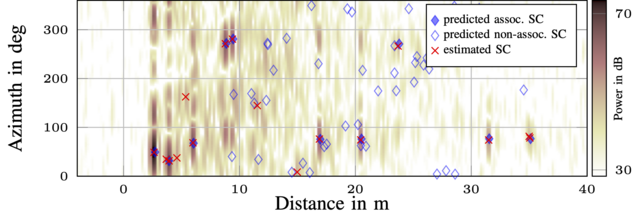
Delay-angle power spectrum (DAPS) of a radio signal and estimated specular multipath parameters.

Accurate parametric channel estimation is essential for many applications in future 6G communication networks. Our group has recently developed advanced Bayesian channel estimation algorithms [1, 2]. In this thesis, you will focus on a low-complexity alternative, a subspace-based algorithm that estimates multi-dimensional channel parameters using tensor decomposition techniques [3]. This thesis offers the opportunity to work on cutting-edge signal processing methods with direct relevance to future wireless systems and modern automotive radar applications

Your Task

  • Implement the subspace-based tensor decomposition algorithm [3].
  • Compare its performance against our Bayesian approaches.
  • Use both synthetically generated data (from an environment model) and real measurement data collected with our lab equipment.

Your Profile

  • Familiar with (statistical) signal processing.
  • Inclined to do theoretical/simulation based work.
  • Experience with python or matlab is beneficial.

References

  1. S. Grebien, E. Leitinger, K. Witrisal, and B. H. Fleury, “Super-resolution estimation of UWB channels including the dense component – An SBL-inspired approach,” IEEE Trans. Wireless Commun., vol. 23, no. 8, pp. 10 301–10 318, Feb. 2024.
  2. J. Möderl, A. M. Westerkam, A. Venus, and E. Leitinger, “A block-sparse Bayesian learning algorithm with dictionary parameter estimation for multi-sensor data fusion,” in Proc. Fusion-2025, Brasil, Rio De Janeiro, Jul. 2025. [Online]. Available: https://arxiv.org/abs/2503.12913
  3. F. Wen, J. Kulmer, K. Witrisal, and H. Wymeersch, “5G positioning and mapping with diffuse multipath,” IEEE Trans. Wireless Commun., vol. 20, no. 2, pp. 1164–1174, 2021.
Contact
image/svg+xml