
Colour Schlieren Visualization
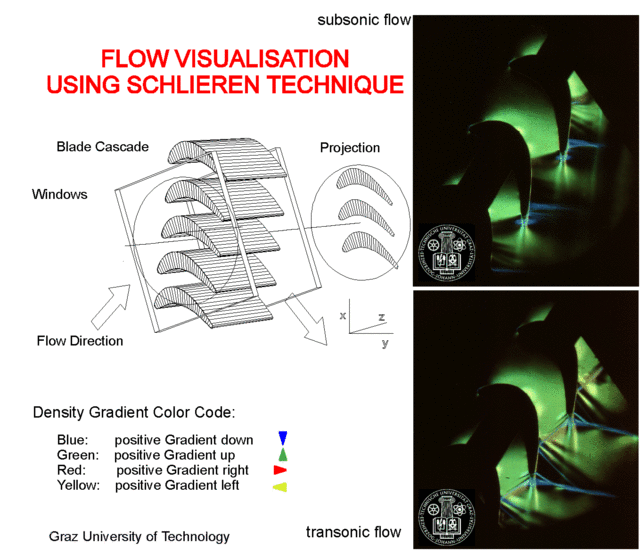
The Schlieren method, which is used here for compressible flows, utilises the deflection of light at density gradients within the flow. This technique provides a fast means of visualising the flow in real time. At the Institute for Thermal Turbomachinery and Machine Dynamics, a high-speed video camera may also be employed for this purpose. Using a background-oriented Schlieren method, even larger areas can be illuminated and the flow visualised. The picture below shows the basic setup used in the linear turbine blade cascade at the Institute. This type of Schlieren visualisation is used for all flow investigations at the institute. In the next image, the flow through a VKI LS59 cascade at Mach 0.7 and 1.2 is shown.
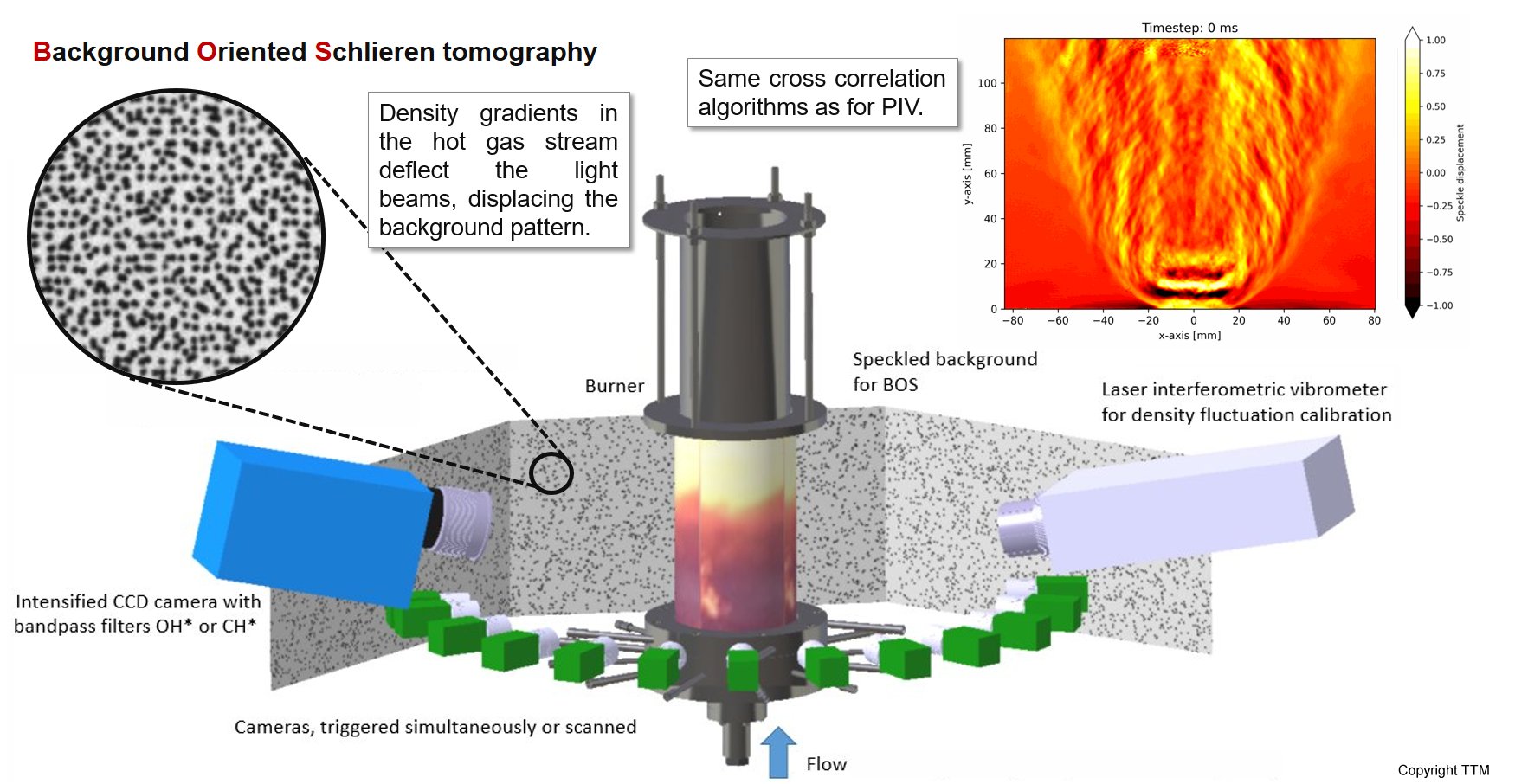
The Background-Oriented Schlieren technique is superior to the classic schlieren technique because it enables density gradient fields to be measured quantitatively. As the schlieren method is always line-of-sight, only the Background-Oriented Schlieren method can measure density fields tomographically. The following image, for example, depicts the setup and a result for the tomographic reconstruction of thermoacoustic oscillations in a swirl-stabilised flame.
Institute of Thermal Turbomachinery and Machine Dynamics
Graz University of Technology
Inffeldgasse 25/A
A-8010 Graz
Tel: +43 (0)316 873 - 7226
Fax: +43 (0)316 873 - 107226
ttm@tugraz.at