“We have been able to experimentally confirm many predictions of quantum theory,” explains Viktor Eisler, a physicist who has just moved from Graz University of Technology (TU Graz) to the University of Graz. However, he will remain connected to TU Graz via the large NAWI Graz Physics network. Quantum physics is his field of research: “Of course, there are still many unanswered questions. For example, the collapse of the wave function or entanglement.”
Simple Quantum Systems
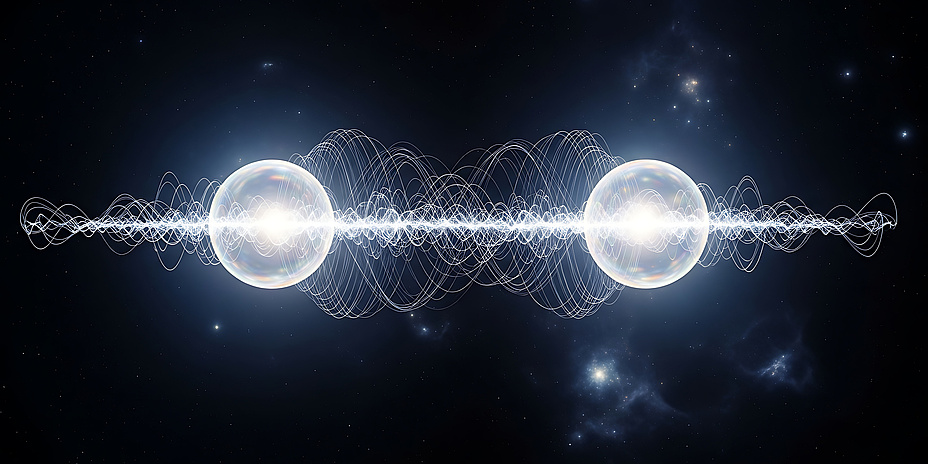
The latter is part of his scientific research. He is investigating how entanglement can be described in simple quantum systems. Entanglement means that in quantum systems, two particles are connected to each other even over large distances. In quantum physics, particles can assume multiple states at the same time: so-called superpositionality. Each state only occurs with a certain probability. And only during a measurement does the particle “decide” instantly which state it is currently in. Quantum systems are described mathematically through the wave function. If a system is measured and assumes an unambiguous state, this is referred to as the “collapse of the wave function”. If two particles are entangled and only one of them is measured, then the second particle immediately assumes the same definite state. The quantum level concerns the tiniest parts that make up our world. It is in the microscopic range. In contrast, classical physics deals with the macroscopic level, i.e. the world that we can see.
Many-Body Systems
In his work, Viktor Eisler researches quantum mechanical many-body systems and wants to track down their properties. In these quantum mechanical systems, effects can be observed that we are not familiar with from the world of classical physics. Eisler tries to find mathematical descriptions for these and uses an analogy to thermodynamics from classical physics, for example. A classical system always has a temperature which is determined by the environment – a so-called heat bath. The energy fluctuations in the system are described by the Boltzmann distribution, which includes the temperature. If a system is cooled down to absolute zero, these energy fluctuations disappear. Nevertheless, there are still quantum fluctuations. These result from the uncertainty created by the probability in the wave function. This is because quantum particles can assume multiple states in the so-called superposition and each state only occurs with a certain probability during a measurement. If I remove one particle from an entangled quantum system, uncertainty remains about the state of the other particle.
“The thermal description of a classical system can be described in a quantum system using an entanglement operator, a mathematical expression that replaces the ratio of energy to temperature. And the question in our research is what role this operator plays,” says Eisler.
Temperature at the Edge of the Subsystem
In a subsystem, the entanglement operator and thus also the effective temperature is limited to one location. If the overall system is cooled to a temperature of zero, then the temperature in all subsystems should also be zero. But in the quantum mechanical description, it looks as if there is a temperature at the edge of the subsystems because of particle entanglement. The further away from the edge you look at the subsystem, the closer the supposed temperature approaches zero. “We were therefore able to show the structure of the entanglement and that it actually originates from the edge of the system.”
The results have been tested and confirmed by means of experiments in Innsbruck. “Our colleagues have already used the entanglement operator to reveal the state of their experiments. This makes the problem actually treatable experimentally.”
In the future, Eisler would like to continue working on the topic of entanglement operators, but would like to focus even more on complicated, topological systems, which could subsequently be relevant for quantum computers.
Play video
Viktor EISLER
Priv.-Doz. Dr.
Institutr of Theoretical and Computational Physics
Petersgasse 16/II
8010 Graz
Phone: +43 316 873 8176
viktor.eisler@tugraz.at