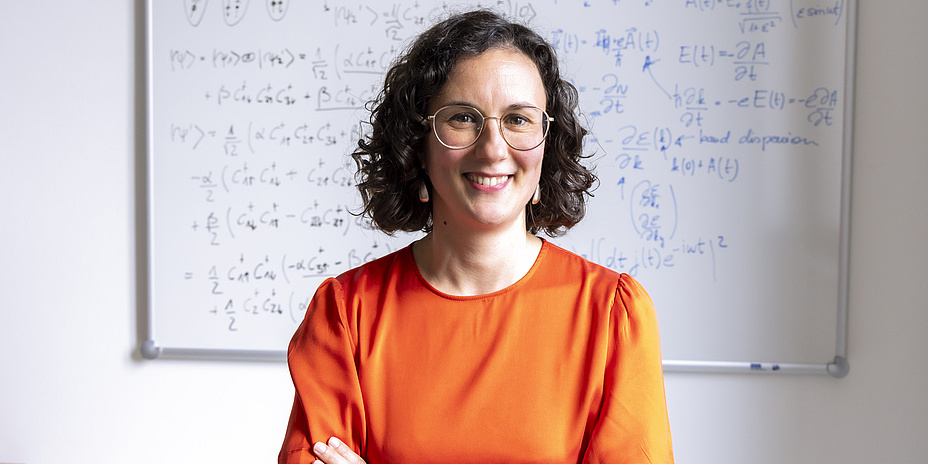
When interesting phenomena become apparent in experiments, it is often not immediately clear what they mean, why they occur and what effects they have. Theoretical researchers who get to the bottom of such questions as part of their research work can redress this. For example, Anna Galler, theoretical physicist at Graz University of Technology (TU Graz). “Colleagues from Korea approached us because they had seen exciting oscillations and peaks in the spectrum in an experiment with tungsten disulphide, but couldn’t explain why.” So the researcher set out on a quest.
Tungsten disulphide is a 2D material; in other words, it only consists of a thin layer of atoms. When a powerful laser hits this crystalline material in the infrared range, spectra are created that consist of integer multiples of the original radiation – so-called high harmonics. “We can think of it like the overtone spectra of a musical instrument,” explains Anna Galler. These spectra can provide information about the tone colour of the respective instrument – and it was assumed that the high harmonics could also reveal information about the irradiated material. “This is particularly interesting for semiconductors such as tungsten disulphide, because they are used in electronics,” explains Galler. For example, to build transistors that can be constructed on an extremely small scale and efficiently thanks to the 2D materials. “That’s why we want to find out more about the materials, for example how quickly they can switch.” This is revealed by the electrical band structure – i.e. the energy distribution of the electrons in a solid – and the movement of the electrons in the material.
Tungsten disulphide has a band gap of around two electron volts and could be controlled using light in the optical range. It also has what is known as valley selectivity. The electronic band structure basically has a characteristic shape with different valleys. The energy gap in the band structure is smallest at the valleys and a laser can rapidly excite electrons there in a controlled manner. “This valley selectivity behaves similarly to qubits in quantum computing and could also be relevant for this.”
Researchers have now seen exciting phenomena in experiments. Depending on the intensity of the laser, there are peaks in the spectrum that split up. Oscillations also occur when the laser intensity varies. However, why the material behaved in this way was not clear. “We tried to explain these effects using various theories and were ultimately successful with the semiconductor Bloch equations,” says Galler, explaining the path of discovery. “These equations, which are based on quantum theory, describe the optical response of semiconductors to light sources such as lasers, and it is precisely the effects described there that we saw in the experiment. Peak splitting is an interference phenomenon that occurs when electrons are driven through the Brillouin zone.”
The researchers discovered that high harmonics are an interesting new method for analysing semiconductor materials and their properties. “We believe that high harmonics are also characteristic of other materials and that we have found a great new method of analysis. However, further research is needed to confirm this.”
The results were recently published in the renowned journal Nature Communications. You can find the paper Quantum interference and occupation control in high harmonic generation from monolayer WS on ature Communications.
Anna GALLER
Dipl.-Ing. Dr.rer.nat. BSc BA
Institut für Theoretische Physik - Computational Physics
Petersgasse 16/II
8010 Graz
Tel.: +43 316 873 8195
anna.galler@tugraz.at