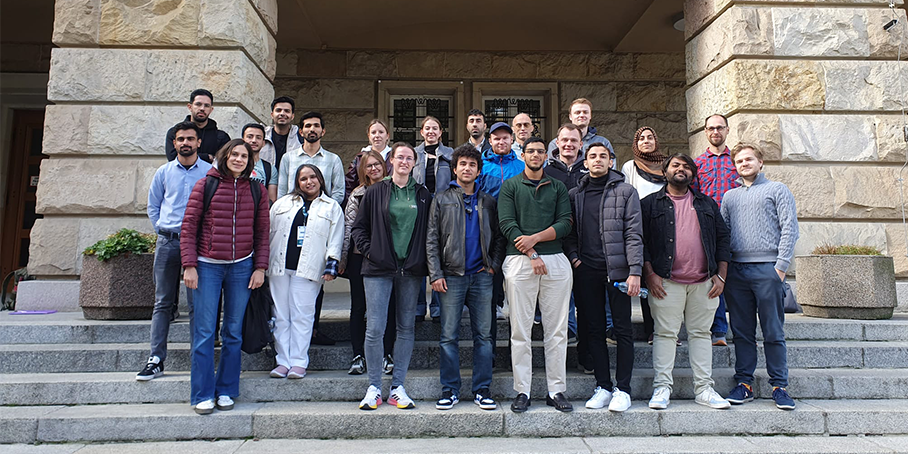
Four practical examples within the Unite! University Alliance, a consortium of nine leading technical universities from nine different European countries, demonstrate the success and added value of international teaching concepts.
What really defines international teaching goes beyond language skills and international networking: it broadens horizons and creates new perspectives -for teachers and students alike.
What are the benefits of international collaborative teaching?
In international courses, students gain valuable experience through exchanges with peers from other universities and by learning and working in international teams. The latter point in particular represents an environment that they will find themselves in later in their professional lives. My experience with students in international courses to date clearly shows that learning together makes them much more open-minded and receptive to new challenges and new contacts, and enables them to adapt more quickly to a new working environment. These are qualities that every internationally active employer is looking for.
As a teacher, I also find it inspiring to accompany young students as they work together on projects. Their different personalities, previous experiences, approaches, and cultural differences highlight the different requirements of students, provide invaluable feedback for my own teaching, and promote understanding of diversity.
Exchanging ideas with teachers from other universities has also given me valuable input and different perspectives, especially regarding my own courses, and has often led to new project ideas.

What does it take to teach internationally?
In my opinion, developing a new international course requires four essential elements:
- Enthusiasm for teaching
- Personal commitment
- An idea for an innovative teaching concept
- A like-minded counterpart at a partner university
The most important factor is your own motivation to offer attractive, sustainable teaching with added value. Feedback from students also provides motivation to continuously develop and improve courses. When redesigning international courses, having a motivated counterpart at the partner university is also an extreme advantage. In my case, I knew a colleague from the Politecnico di Torino through my several-month stay abroad in Turin. The idea for a joint course was quickly born, and the jointly developed didactic concept immediately proved its worth and has already been transferred to other courses.
Further practical tips and insights can be found in a podcast episode with Daniel Fruhwirt.
Didactic concept
I conduct the courses I offer either entirely online or in a hybrid format. The theoretical input is provided in online sessions, while the practical part takes place on site at a partner university. This increases the efficiency of on-site activities and saves resources.
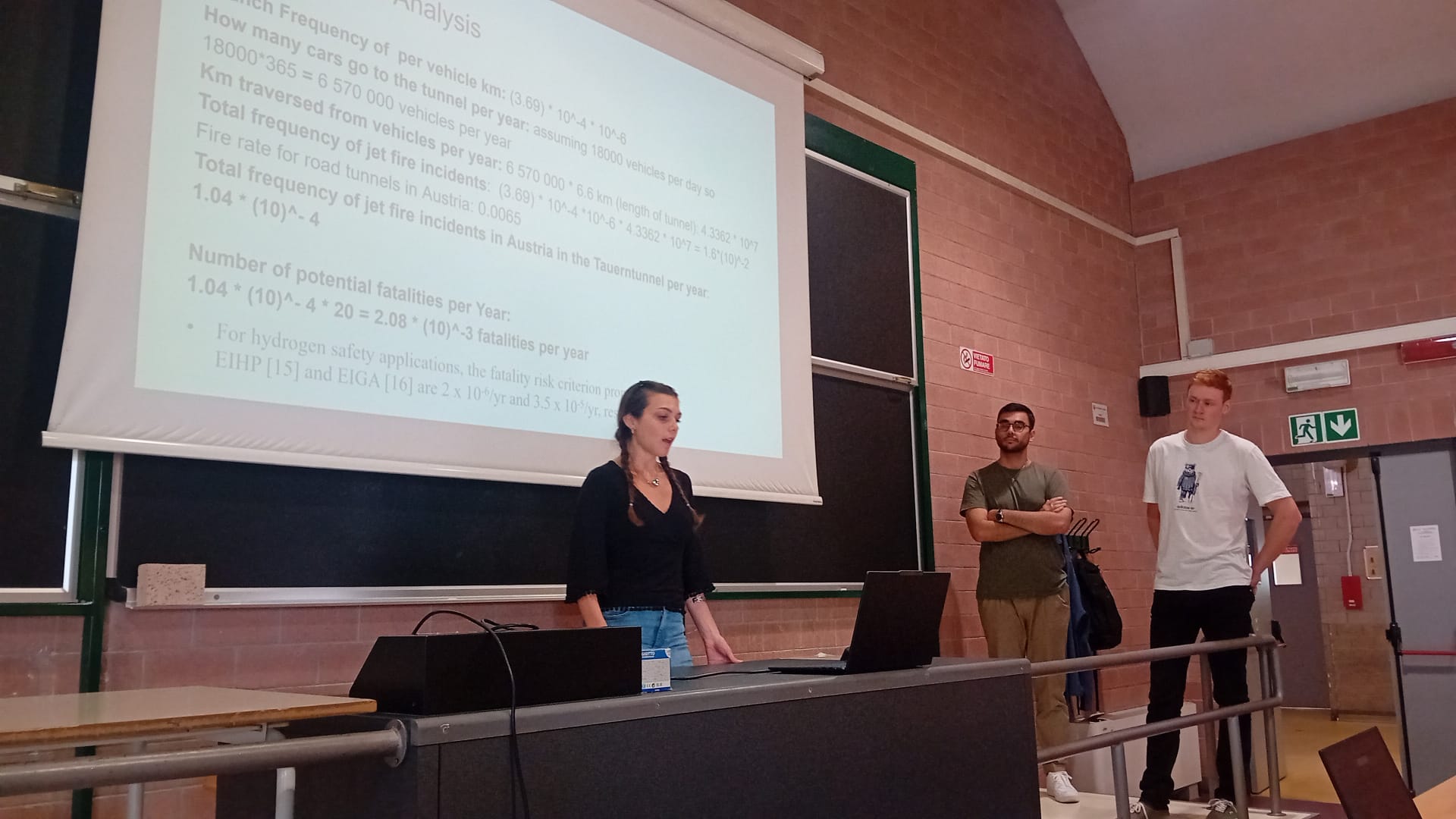
The aim of the online sessions is to introduce the respective topic, teach the basics, but also to test the students' prior knowledge and, if necessary, offer supplementary or refresher content. In the practical parts, small teams (maximum of 5 students) work on specific project tasks, such as risk analysis for an accident involving a hydrogen-powered vehicle. The teams are made up of students from different universities and disciplines. In my opinion, an important element of the group work is that each student is assigned a specific responsibility (e.g., overall project manager). This has proven to be extremely effective. The project work concludes with a mutual presentation of the projects by all teams, followed by a discussion round.
Concrete examples of implementation
My current teaching portfolio includes four international courses:
- Tunnel Ventilation and Safety (Graz University of Technology, Politecnico di Torino, external lecturers from industry)
- Summer School on Safety of Underground Transport Infrastructure (Wroclaw University of Science and Technology, TU Darmstadt, Politecnico di Torino, Graz University of Technology)
- Hydrogen Safety in Mobile Applications (Politecnico di Torino, Universitat Politècnica de Catalunya, Graz University of Technology)
- Environmental Impact of Road Traffic (Graz University of Technology, KTH Stockholm)
You can find useful information on planning and implementing collaborative offerings in the Unite! Online Toolkit.
Personal benefits and student feedback
In general, a stay abroad is always a special highlight and, in addition to attending courses, naturally also offers the opportunity to get to know new people, cultures, and cities. I find working together on site to be much more efficient, as direct personal communication within and between teams is easier.
While the Tunnel Ventilation and Safety course is designed as a purely online course, the Summer School and the Hydrogen Safety in Mobile Applications course takes place in a hybrid form. Here, both personal observations based on the project results of the student teams and student feedback show that the hybrid form is preferred.
Hybrid courses can be designed as Erasmus+ Blended Intensive Programmes (BIP). After successful application, teachers receive funding to develop and implement their course. More information about BIPs.
Another aspect that students particularly appreciate is external guest lectures by industry partners. These break up the theory-heavy input phases and at the same time highlight the highly practical orientation of the course.

Funding opportunities with Unite!
The Unite! university network offers the perfect platform for establishing international courses. It provides exclusive access to eight partner universities across Europe, from Portugal to Poland, from Finland to Italy. In addition, the recurring Unite! Seed Fund Calls are particularly attractive for obtaining start-up funding for international teaching projects. Both the joint summer school and the “Hydrogen Safety in Mobile Applications” course were financed by the Seed Fund in the first year. In subsequent years, the courses were held as Erasmus+ Blended Intensive Programmes. Additionally, TU Graz also offers attractive internal funding for joint (online) courses.
The current Unite! Seed Fund Call for teachers and researchers supports joint international projects and teaching formats with funding of up to €80,000. The registration deadline is March 20!
The TU Graz fund is also a great opportunity for teachers to develop joint teaching programmes in collaboration with partner universities and receive financial support. The application deadline is April 15.
Teachers can find an overview of funding opportunities and resources for international, collaborative teaching on the TU4U intranet.
The service centers at Graz University of Technology (International Office – Welcome Center, Teaching and Learning Technologies, etc.) have supported me from the initial idea for new courses to their implementation and follow-up, so I can highly recommend everyone to knock on their doors!
Are you interested in teaching together with colleagues from the Unite! network? We can help you with that!
The International Office – Welcome Center (unite@tugraz.at) can help you with questions about funding opportunities and administrative requirements.
The Teaching Academy (teachingacademy@tugraz.at) can assist you with didactic planning and implementation.
The Teaching and Learning Technologies team advises you on the technical implementation of digital/hybrid teaching (telucation@tugraz.at).

LLMs, Digital Twins, Flipped Classrooms and more: The Project Fund for Teaching 2025
Not least in the project fund, the introduction of artificial intelligence into teaching has been clearly evident in recent years. But even aside from this, our teaching staff once again impressed…
The R in Erasmus Stands for Roaming

I'll take you on my discovery tours away from the classic destinations and share personal recommendations from my Erasmus stay in Turin.
Where Mountains meet Minds: The Unite! Research School 2025
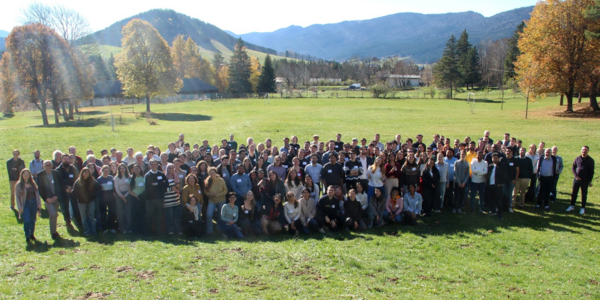
Five intense days in the French Alps brought together cutting-edge research, inspiring people, and unforgettable moments — here’s why you should not miss the next Unite! Research School.