Thinking about an exchange semester in India? Here is what student life, academics, hostel culture, and Mumbai beyond campus really feel like at IIT Bombay.
There are only a few cities in the world that don’t just welcome you, but they instantly stay with you. Mumbai is one of them. The moment you step into this city, it doesn’t feel like you are arriving somewhere new; it feels like you are entering a rhythm that has been moving long before you and will continue long after you leave. Mumbai is loud, chaotic, and beautifully alive all at once.
Mumbai doesn’t try to impress you. It simply lives, fully and unapologetically, and somewhere between the noise and the waves, it teaches you how to live too. This city has a personality: loud, generous, relentless and it leaves a mark on you whether you spend a week here or a lifetime. As an International Student Ambassador from India, I’d like to show you what your exchange semester there might be like.
Experience a different world: discover IIT Bombay in Mumbai, India
Inside this beautiful madness called Mumbai, sits a place that Indians talk about with a certain kind of respect, almost like you lower your voice a little when you say the name: the Indian Institute of Technology Bombay (IIT Bombay). If Mumbai is the city of dreams, then IIT Bombay is where some of the sharpest dreamers come to sharpen themselves even further. Established in 1958, it is one of the most prestigious technical universities not just in India, but in the whole world. If you grow up in India, the letters I.I.T. don’t just spell a college name; they spell a dream your parents whispered before you even knew what engineering was. And this is not just emotion talking. The numbers behind IIT Bombay are honestly crazy. Every single year, somewhere between 1.2 to 1.5 million students across India sit for an exam called JEE (Joint Entrance Examination). These are kids who have spent two, sometimes three years of their teenage life studying twelve to fourteen hours a day, sometimes skipping sleep all for one shot at this exam.
Out of those 1.2 to 1.5 million students, only around 1200 to 1300 make it to IIT Bombay. And now if we do the math, that is roughly a 0.1% chance. To put it in perspective, getting into IIT Bombay is statistically harder than getting into Harvard.
Indian student life: living on the IIT Bombay campus
IIT Bombay is in Powai, spread over 550 acres. When you step inside the campus, you forget for a moment that you are in the middle of one of the busiest cities on the planet. The campus is huge, green, and sits right next to the Powai Lake. The institute has seventeen academic departments, thirty-five additional academic centres, and three schools.
Inside the campus, students live almost in their own little world. There are hostels that never really sleep, chai(tea) spots where assignments become group therapy sessions, sports grounds that are still active after midnight, and cafés where start-up ideas are discussed with the same seriousness as exam preparation.


Now, let's talk about where you will actually live. Because this is the part nobody tells you about properly, and I think you deserve the full picture before you pack your bags. IIT Bombay is a fully residential campus. Which means you don't just study here, you live here, eat here, argue about life here at two in the morning, and somewhere between all of that, you grow up a little.
You will be staying in one of the twenty-one student residences, called hostels, on campus. Each hostel is basically its own small world with a mess, gym, culture, inside jokes, and reputation completely unique to it. Some hostels are the "sporty" ones. Some are the "nerdy" ones.
Now, coming from Graz where your student apartment is probably clean, quiet, and comes with a kitchen you use. The hostel room might feel like a bit of a culture shock at first. The room is simple: A bed, a study table, a cupboard, a fan, and a LAN connection that is honestly faster than what most European universities offer. There is no fancy interior design. There is no espresso machine on the counter. But here is the thing – you will spend literally zero time in your room, because there is always something happening outside of it.
Now you might be wondering: no kitchen? Then what exactly keeps engineering students alive? Well, your kitchen will be the canteen, called mess, what Indians call the hostel dining hall which serves food four times a day. Breakfast, lunch, evening snacks, and dinner. The menu rotates and it covers dishes from across India. On a bad day, you will walk to the campus canteen instead, which is open till four in the morning. Yes. 4 AM. In Austria, if you are hungry after 10 PM, you are basically on your own with whatever is left in your fridge. Here, at midnight, you can order hot food, sit outside under the sky, and have a full philosophical conversation with someone you met three days ago who already feels like a friend for life.
University structure and attending courses in India
Let's step into the classroom now. At TU Graz, a lot of your academic life is built on trust. You manage your time, you choose how deep to dive, and sometimes your entire grade rides on one final exam. At IIT Bombay, the system is built on something called "continuous evaluation." What this means in real life is that your grade is built from many small pieces: for example, about 5% for attendance, 10% for assignments, 20% for quizzes, a 25% midsemester exam, and a 40% final exam. And yes, attendance is not a suggestion. An official rule states that attending less than 80% of your lectures means you simply cannot pass the course, full stop.
Remember PowerPoint from our TU Graz lecture hall? Well, you might miss it. Many professors at IIT Bombay are devoted, heart-and-soul, to the blackboard. This sounds old-school, but it forces you to be present in a way a slide deck never can.
And present you will want to be, because every person sitting around you in that room cleared that 0.1% JEE filter we talked about earlier. The energy is quiet, focused, and seriously sharp. The result is a classroom culture that feels intense, fast-moving, and very alive. IIT Bombay pushes you hard academically, but somewhere in that pressure, it also teaches you discipline, resilience, and how much you are actually capable of doing when everybody around you is running at full speed too. As an exchange student, you're in a unique position: you get to experience this intensity without the full degree pressure. You can take the challenge, absorb the energy, and walk away with something more than grades - a quiet confidence that you can handle far more than you once believed.
Student life that reaches far beyond classes
But life at IIT Bombay isn't all quizzes and blackboards. When the pressure needs somewhere to go, the campus throws two festivals that will genuinely make you rethink what a university celebration can look like:
- Mood Indigo: Every December, something extraordinary happens on this campus. The whole place transforms. Mood Indigo or "MoodI", as everyone here calls it, is Asia's largest college cultural festival. It started back in 1971 with a budget of just five thousand rupees, which is equivalent to about forty-five euros. Today, more than 1.46 lakh visitors (which are about 146,000 visitors) arrive for over two hundred and forty events spread across four days. This includes concerts, comedy nights, theatre, dance battles, art installations, silent discos, and performances by Bollywood legends and international artists.
- Techfest: If Mood Indigo is the heart of IIT Bombay, Techfest is its brain. Started in 1998, it has grown into Asia's largest science and technology festival, drawing over 1.8 lakh visitors (which are about 180,000 visitors) in its latest edition. Students, researchers, industry leaders, and innovators from across the globe all arrive on the same campus. Robots fighting in arenas, hackathons, competitions, AI workshops, start-ups, futuristic ideas, it´s like engineering decided to throw its own festival. Techfest has even broken a Guinness World Record, for the most LED lights lit simultaneously as part of a campaign promoting solar energy across India.
And somewhere between the music of Mood Indigo and the robots of Techfest, you realize IIT Bombay is not only training engineers. It is creating experiences people remember long after graduation.
Discovering Mumbai beyond the university
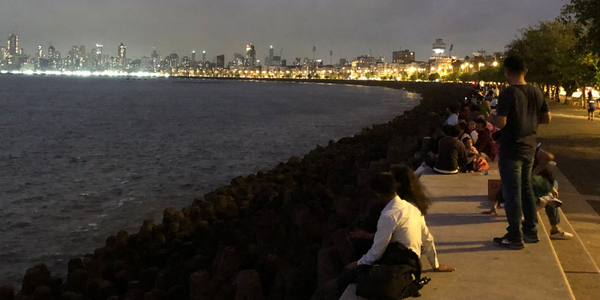
And then there is Mumbai outside the IIT gates. The city that waits for you after lectures end. The sea at Marine Drive, the impossible energy of local trains, street food corners, monsoon evenings, old cafés, crowded markets, quiet sea faces, and stories hidden in places you would never find on a tourist map.
Honestly, Mumbai beyond the campus deserves a blog of its own, because this city is not something you visit in a paragraph. It is something you slowly collect, one evening, one train ride, and one chai at a time. So for now, let me just say this: if IIT Bombay becomes your university for a semester, Mumbai will quietly become your second classroom. I’ll write a separate, detailed blog about exploring Mumbai beyond IIT. Consider this your official invitation to go read it next. Stay tuned!


Next step: Apply for your exchange semester at IIT Bombay!
Dear TU Graz student, if you have read this far, maybe a small part of you is already curious. Maybe you are still unsure. Maybe India feels too far away, too different, too chaotic, too unknown. I understand that feeling. But I want to tell you something from someone who has lived between these two worlds: sometimes the best decisions begin exactly where your comfort zone ends.
Comfort is a beautiful thing. But it does not change you. It does not stretch you. It does not place you in a room full of people who fought harder than almost anyone on this planet just to be there, and quietly ask you - what are you made of? India does that. IIT Bombay does that. Mumbai does that. Not loudly, not aggressively, but slowly, steadily, and in ways you will not fully understand until you are back home in Graz, sitting in your old routine, and you realise that something is different. You are different. You think bigger. You adapt faster. You complain less. You appreciate more. You have eaten the best food of your life for less than a euro. You have survived a grading curve with some of the sharpest minds in Asia.
An exchange semester is not just a line on your CV. It is not just a stamp in your passport. It is the semester where you find out who you are when everything around you is unfamiliar. And India - loud, warm, overwhelming, incredible India - is perhaps the most honest mirror you will ever stand in front of. It will show you your patience, your curiosity, your courage, and occasionally your complete inability to handle spice. All of it matters. All of it shapes you.
I came to Austria for my masters with two bags and a lot of uncertainty. I know what it feels like to land somewhere completely new and wonder if you made the right choice. And I can tell you - you always find your footing. You always figure it out. And when you do, you carry a version of yourself that you could never have built by staying comfortable.
So dear TU Graz student - say YES. Book the flight. Pack light. Leave room in your bag for everything you are going to bring back. Not just souvenirs. Not just spices. But stories, friendships, lessons, and a quiet unshakeable confidence that you are capable of far more than you once believed.
IIT is waiting. And trust me - it is absolutely worth it.
Ready to immerse yourself in India's culture? Applications for an exchange semester at IIT Bombay or IISc Bangalore as part of the OverSEAs programme are open until 10 June. Further information can be found on the TU4U intranet on the “OverSEAs programme – outside Europe” page.


From the Mur to Marine Drive: An Exchange Semester at IIT Bombay
Thinking about an exchange semester in India? Here is what student life, academics, hostel culture, and Mumbai beyond campus really feel like at IIT Bombay.
The R in Erasmus Stands for Roaming

I'll take you on my discovery tours away from the classic destinations and share personal recommendations from my Erasmus stay in Turin.
Semester abroad outside Europe: Find your accommodation
Live on campus or in the city? Your choice of accommodation will shape your semester abroad. This report gives you practical tips on dormitories, apartments, cost traps, and choosing a location.