What documents do institutes and service departments have to hand over to the Archives for storage?
According to the regulations of the TU Graz Archives all documents that document the work and achievements of Graz University of Technology (TU Graz) must be handed over to the Archives for storage. The basic rule is that all written and documentary material that hasn’t been in daily use for seven years has to be handed over to the TU Graz Archives for storage before being destroyed.
What is meant by ‘all written and documentary material’?
Documents, files, legacy materials, official and business records, (institute) meeting minutes, annual and activity reports, construction files, documents relating to events, printed matter and pamphlets as well as electronic data carriers are considered to be written material. The term documentary material includes image, film, video and sound material, stamps, plans, historical devices, machine-readable data carriers and storage media. Personally addressed documents or the email correspondence of TU Graz employees do not have to be handed over to the Archives.
What happens to the documents as soon as they end up in the Archives?
Documents are subject to various retention periods. The moment documents are handed over to the Archives, the associated compliance with the General Data Protection Regulation (GDPR) is transferred to the Archives. The file-producing organisations such as institutes and service departments are then no longer responsible for their records/documentation material. The Archives preserve the documents carefully and sensitively. Personal data has a retention period of 110 years from birth, while normal files are subject to a retention period of 30 to 50 years, which can be reduced to 20 years by the Rectorate ‘for justified reasons’. If documents are needed again, the submitting organisation receives its documents back for use and inspection at any time, but the documents remain the property of the Archives.
How does the transfer of documents to the Archives work? How do the Archives support this?
- Discuss the intended hand-over in advance with the Archives.
- Not all documents are kept by the Archives. Staff of the Archives inspect the documents in question for their archival value locally at the institute/service department.
- The submitting office places the selected documents in boxes (boxes are available free of charge from the archives) and arranges a transport date with the Buildings and Technical Support organisational unit.
- The Archives check the documents and draw up a hand-over protocol; the submitting organisation receives a copy of the protocol.
- The documents are taken to the central depot in Petersgasse, where the detailed cataloguing begins. The documents are organised and indexed according to clear structures.
Further information can be found in TU4U: Abgabe von Unterlagen an das Archiv (in German).
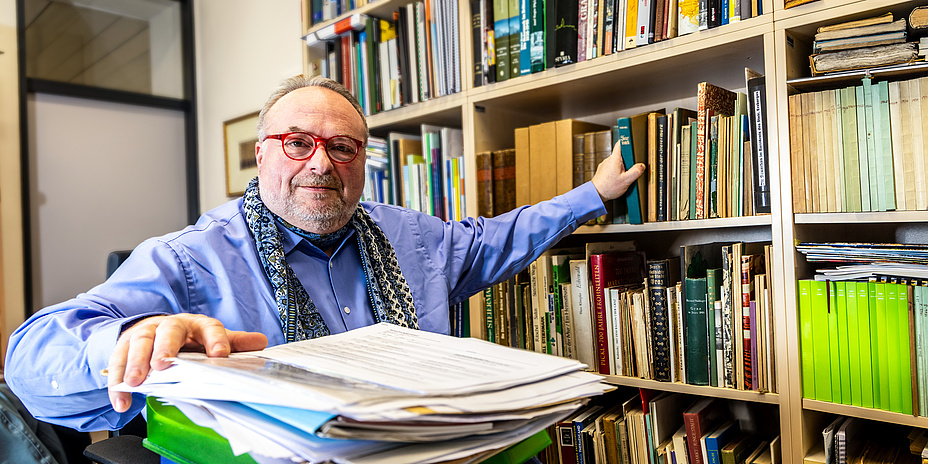
Bernhard Reismann
- Head of the TU Graz Archives since 2012.
- Area of responsibility: Inventory cataloguing, supports researchers with enquiries, is currently working on a concept for digital long-term archiving.
- The TU Graz Archives contain around 3,700 linear metres of files with over 200,000 image documents.
You can find this article and other articles to browse through in TU Graz people #95, the magazine for TU Graz employees and interested parties.