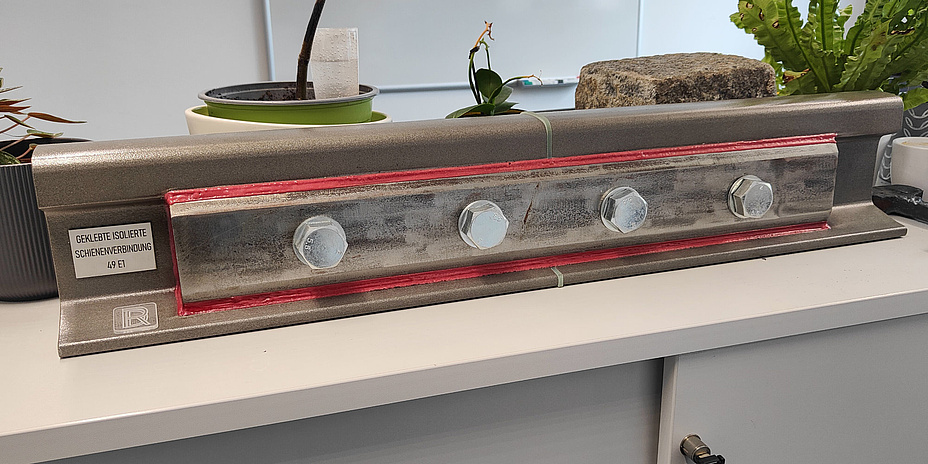
Insulated joints are little known, but many railway lines could not be used without them. They divide the rail network into electrically separated sections and register when a train enters and leaves a section. Only when the section is free again the next train is allowed to enter. Around 33,000 insulated joints are currently installed in Austria, but they wear out quickly on heavily used lines. Together with ÖBB and Martin Schienentechnik, Graz University of Technology (TU Graz) has now developed a prototype for significantly more robust insulated joints using improved materials and new geometries. According to current research findings, they should have at least twice as long a service life and therefore significantly reduce failures and damage.
Consideration of the overall system
“In a project like this, it is important for us to look not just at the individual components, but at the entire system – from the load exerted by the vehicles to the transmission of forces to the substructure”, says Ferdinand Pospischil from the Institute of Railway Infrastructure Design at TU Graz. “In the Research Cluster Railway Systems, we have experts from all relevant fields working together at TU Graz. This enabled us to develop an insulating joint prototype that lasted much longer in simulation and did not show a negative impact on the other track components.”
On the way to the solution, the researchers first identified weak points in the network using data from track measurement cars. The team then carried out measurements on defective insulated joints locally in order to understand the forces acting there and the interactions between the train, track superstructure and subsoil. From this database, they developed a digital twin with which they could virtually design and test prototypes.
Promising initial tests
The resulting prototype had to prove itself in tests on the track. The initial results show that it causes much lower stresses in the material. The forces that occur are better distributed, which makes the entire system more stable and should at least double the service life of the new insulating joints compared to the previous ones. The prototype therefore promises fewer delays, lower maintenance costs and a more reliable rail network.
“On busy lines, some insulating joints wear out very quickly; every train axle puts fresh stress on them,” says Stefan Marschnig from the Institute of Railway Engineering and Transport Economics at TU Graz. “According to the latest research findings, our newly developed insulated joint system should last significantly longer and cause less damage to other track components. At the same time, we made sure that the insulating joint could be produced at an acceptable cost.”
Ferdinand POSPISCHIL
Univ.-Prof. Dr.techn. M.Sc.
TU Graz | Institute of Railway Infrastructure Design
Phone: +43 316 873 35080
ferdinand.pospischil@tugraz.at
Stefan MARSCHNIG
Univ.-Prof. Dipl.-Ing. Dr.techn.
TU Graz | Institute of Railway Engineering and Transport Economy
Phone: +43 316 873 6717
stefan.marschnig@tugraz.at

![[Translate to Englisch:]](https://www.tugraz.at/fileadmin/_processed_/5/6/csm_Crashtest-left-view-by-VSI-tugraz_df1467dc56.jpg)