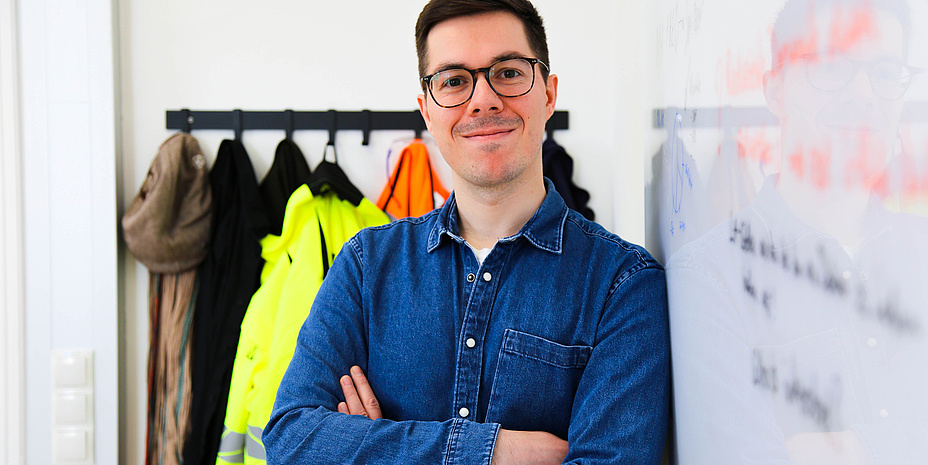
“I studied at Graz University of Technology (TU Graz) and then simply never left,” says Markus Loidolt with the hint of a lopsided smile. As assistant professor, he recently took up a six-year tenure track position at the Institute of Railway Engineering and Transport Economy and has also been deputy head of the institute for the past year.
More than just two rails
In research, he specialises in the maintenance of tracks, which are “more than just two rails”. This also includes fastening systems, elastic intermediate layers, sleepers, ballast and the entire substructure on which the rails are laid. And these tracks have to withstand intensive loads. At best, they lie outside in the rain, snow and bright sunshine for up to 50 years and have to withstand the weight of trains weighing several tonnes that roar over them every day. And they have to be one thing above all: safe and reliable.
To ensure this, tracks must be checked and maintained at regular intervals. However, Markus Loidolt starts even earlier in the process and subjects the rails to a kind of preventive health check. “I want to find out how these problems arise so that I can prevent them from happening in the first place.”
Preventive healthcare
In his doctoral thesis, for example, he focused on a very common source of error: track setting. When a train runs over them, tracks are dynamically loaded – the load initially increases and then decreases again. In addition, rails cannot be laid in one long piece, but must be welded together at several points. The weld seams create so-called weld joints, which are noticeable as small dents and bumps on the rail surface. These areas are subject to greater loads when trains run over them and the ballast bed and substructure can often be damaged there. The track settles and wears out. However, if these weld joints were ground, the problem could be significantly reduced in advance.
Data analysis going back over 20 years
In his future career, Markus Loidolt would like to analyse track measurement data in order to find further sources of danger to rail health. “Thanks to a cooperation with ÖBB (Austrian rail), I can draw on a wide range of data from the past 20 years. This data already exists, it just needs to be analysed correctly.” And that is exactly what the railway researcher now wants to do. He wants to look at the problems from two sides. On the one hand, he wants to find the most common causes of track damage from existing literature, experiments and data analyses. On the other, he intends to search the data for previous maintenance work and assess its cost. By combining both approaches, he aims not only to find the obvious problems, but also to identify sources of error that have not yet been recognised. “Taxpayers’ money is invested in the railway system and every small improvement is important.”
Inspired by his brother
Markus Loidolt found his way into the railway industry via technical secondary school (HTL) for mechanical engineering, “because my brother did it and it sounded exciting.” However, he decided to study civil engineering “because my brother didn’t do it and it sounded exciting.” An interest in infrastructure developed in his master’s degree programme and the “most interesting courses” were in the field of railways. This is how he finally found his way to the institute. Thanks to its name, he now finds himself confronted with amusing prejudices in his environment. For example: “Many people think that I know every timetable by heart or know every train by name. But that’s not true,” he says laughing as he says goodbye.
![[Translate to Englisch:]](https://www.tugraz.at/fileadmin/_processed_/5/6/csm_Crashtest-left-view-by-VSI-tugraz_df1467dc56.jpg)