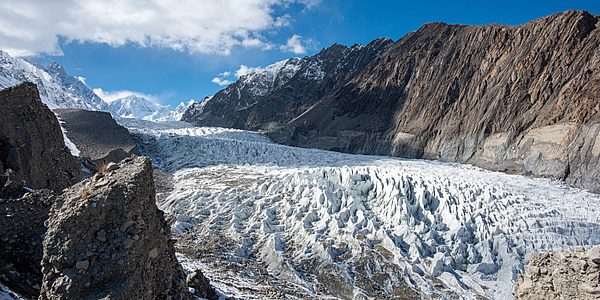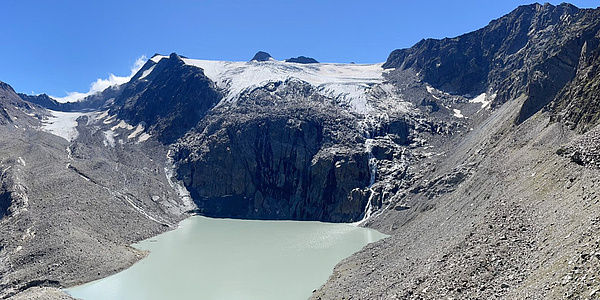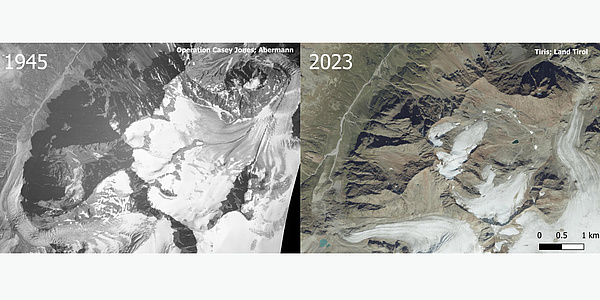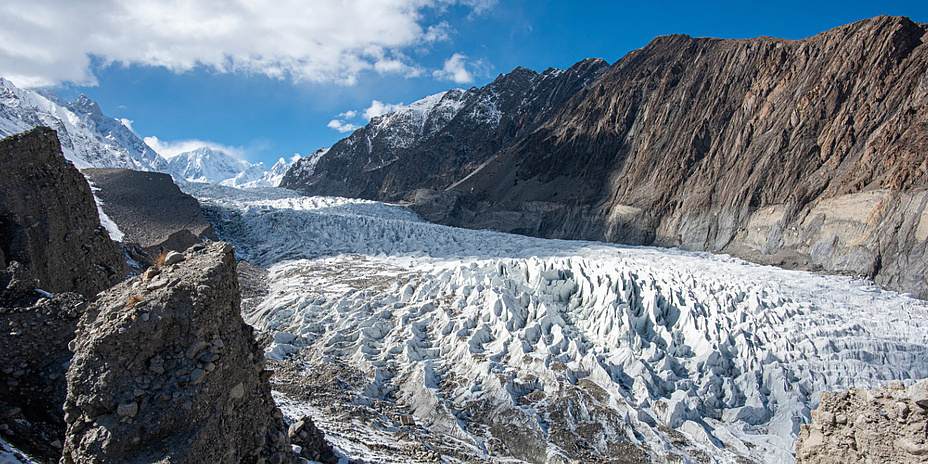
Glaciers around the world continued to melt significantly last year: excluding the ice sheets of Greenland and Antarctica, glaciers lost slightly more than 400 billion tonnes of ice mass in the hydrological year 2025, leading to a rise in sea level of around 1.1 millimetres. This is the outcome of a study by the World Glacier Monitoring Service (WGMS), published in Nature Reviews Earth Environment, to which Tobias Bolch from the Institute of Geodesy at Graz University of Technology contributed.
Five Olympic swimming pools per second
“2025 was another year in which glaciers continued to melt at a very high rate”, says Michael Zemp, Director WGMS and corresponding author of the study. “To put this into perspective, the annual mass loss from glaciers in 2025 would have filled five Olympic pools in every second of that year”.
The Alps have been particularly affected
The regions of Western Canada, the USA, Iceland and Central Europe recorded the largest proportional losses. “The Alps are among the mountain ranges on Earth where glacier retreat is most severe,” says Tobias Bolch.
In recent decades, global glacier retreat has accelerated sharply – from less than 100 billion tonnes per year in the period 1976–1995, to 230 billion tonnes per year (1996–2015), and most recently to 390 billion tonnes per year in the past decade. Since 1975, global glacier retreat has led to a rise in sea level of 26.4 millimetres.
Publication
The WGMS Network (2026)
Global glacier mass change in 2025
In: Nature Reviews Earth & Environment
DOI: https://doi.org/10.1038/s43017-026-00777-z
Tobias BOLCH
Univ.-Prof. Dr.rer.nat.habil.
TU Graz | Institute of Geodesy
Phone: +43 316 873 6848
tobias.bolch@tugraz.at