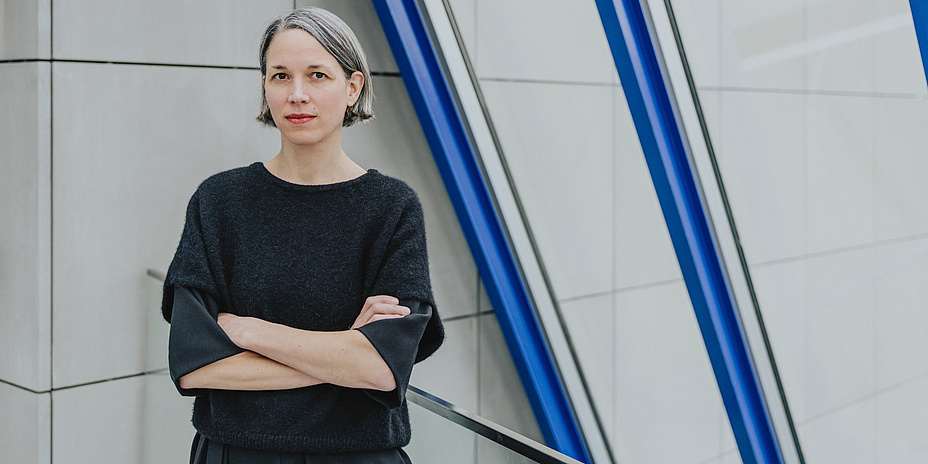
A warm welcome back to Graz University of Technology (TU Graz)! You studied here and have now returned, following stints in Bolzano and Vienna, to head the Institute of Design and Building Typology. What are your main areas of research?
Eva Mair: In the field of design and building typology, we try to identify fundamental organisational patterns and design types in buildings and apply the insights gained from this to design practice. My focus in practice, teaching and research lies in conversion and extension. If we assume that in future we will no longer lightly demolish and replace buildings that have outgrown their primary use, but instead wish to continue using and transforming them, then the ability to recognise architectural qualities that can be abstracted from a building’s design takes on particular significance. I wish to practise and develop associative thinking with students in relation to typological affinities. These associations should not be conveyed and examined in the form of rigid, one-dimensional categories, but rather as lines of reference within dynamic arrangements.
How do you intend to approach your professorship at TU Graz?
Mair: I see architectural practice, research and teaching at our institute as closely interlinked. Concrete questions arising from practice should be addressed in all their complexity and examined from different perspectives within the framework of design courses and research projects. In doing so, I wish to bring the students’ unbiased perspective on society, the environment and architecture into a serious dialogue with the specific knowledge of experts from various disciplines, so that we can work together on current issues within our discipline.
In principle, there is nothing new about conceiving and designing buildings as structures open to multiple uses.
(Eva Mair)
Buildings are normally constructed for a specific purpose and designed architecturally to fulfil that purpose. What challenges arise when I wish to repurpose such a specialised building?
Mair: In principle, there is nothing new about conceiving and designing buildings as structures open to multiple uses. Buildings that offer a certain degree of spaciousness and were not designed to meet minimum standards have an advantage in this regard. Over the last century, use-specific planning has become increasingly entrenched, based on function-specific building regulations and minimum standards. In addition to the conditions that shape a building’s morphology – such as room dimensions, spatial relationships and circulation logic – when it comes to repurposing and transformation, we must also address the challenges arising from the dismantlability and interchangeability of elements. Buildings where, for example, all the technical systems have been cast into load-bearing components are particularly difficult to work with.
What difficulties do you encounter in practice?
Mair: The current building regulations and standards are geared towards new constructions and create many strange contradictions when working on existing buildings. We also reach our limits when it comes to certifying components for reuse. Who takes responsibility for guaranteeing this?
What role does the university play in this?
Mair: At the university, we have the freedom to ask questions without always having to provide immediate answers that take all construction requirements into account. We can be generous and think beyond standards. It is our job to be critical. The role of the university has changed in recent years. Previously, the prevailing view was that practitioners brought knowledge from the architectural firms into the lecture theatres. Today, a great deal of knowledge flows back from the universities into architectural practice. Here, we can get to the bottom of issues for which there are no resources in practice.
At the university, we have the freedom to ask questions without always having to provide immediate answers that take all construction requirements into account.
(Eva Mair)
Are there any projects where, in your opinion, the conversion has been particularly successful?
Mair: I recently attended a talk by Astrid Staufer and Peter Bauer. They spoke about a competition entry they had developed together, which impressed me on several levels. The project demonstrates what is already possible in Basel – not least because of a completely different mindset regarding the use of resources and circular construction. The competition brief consisted not only of good site plans with reliable data, but also of an extensive catalogue of used building components available for the project. The “Dschungeli” project demonstrates the transformation of an exhibition hall into a building complex for affordable housing. Not only components from the existing hall itself, but many other elements that the city of Basel has collected and catalogued come together in the design to form an exciting, precisely composed architecture. Not a haphazard or staged bricolage, but a clearly articulated, complex architecture.
Would something like this be possible in Austria?
Mair: In Austria, we do not operate on the same principles. A fundamental shift in thinking is still needed here. The reuse and repurposing of buildings or building components does not yet carry the same weight here, and as long as the aforementioned principles are lacking, no well-defined designs can be developed. We remain in the realm of speculation. Furthermore, we must also question our visual habits, our understanding of beauty and perfection. We have a tendency to think things through to completion in a familiar form, and that limits our openness to transformation.
So should we think of buildings as temporary?
Mair: That is misleading. Life – not just human life, but all life – is constantly changing. Architecture, however, is slow to change. And sustainable architecture is architecture that endures. It does so when it does not push itself into the foreground, but is understood as a backdrop – in the sense that it allows for different uses and multiple meanings. For architecture to have a long life, it must be socially accepted, perceived as beautiful, and be accessible both physically and emotionally. Not all materials and elements are designed to have the same lifespan. In particular, finishing elements and building services should be installed in such a way that they can be easily replaced or dismantled.
Life – not just human life, but all life – is constantly changing. Architecture, however, is slow to change.
(Eva Mair)
Back to the regulations. There is a good reason why they are so strict, isn’t there?
Mair: Yes, of course. Building regulations make sense and protect us as people. However, when it comes to the conversion and continued use of buildings, they create many contradictions. It would make sense not to ensure quality and desired standards solely by ticking off individual criteria, but to assess architecture more holistically. A more nuanced approach is particularly necessary when defining what constitutes appropriate usefulness. To whom do the prescribed standards apply – and in what context? And what does this mean specifically for building in the existing built environment? Under certain circumstances, specific requirements could be set aside if, in return, other qualities are preserved or newly created. For example, the required number of car parking spaces could be dispensed with, while the existing garden is preserved. Or only a very small living area might be heated to agreed standards, whilst additional rooms, which do not meet building physics standards, are retained and can be used – depending on the season or with appropriate clothing. These approaches are by no means new.
Do you want to preserve all buildings?
Mair: No, I do not take a dogmatic or one-dimensional stance. A sensible approach to existing buildings begins with a careful examination of the structural elements and spatial qualities. If the desire for a specific spatial programme forms the starting point of the discussion, a replacement building that fulfils this use more economically and in accordance with applicable standards can easily be justified – and appears correspondingly convincing. However, the reverse approach would make more sense: we should develop usage scenarios based on the spatial qualities of the design.
I do not wish to promote a form of architecture that is driven solely by the desire to reduce CO2 emissions. While this aspect is important, it should not be the sole determining factor in how architecture looks. I am interested in architecture in its entirety – architecture that can be seen as a contribution to building culture.
But isn’t it easier just to demolish and rebuild?
Mair: Of course, that’s usually easier. But simplicity isn’t what interests me most. A conversion is more complicated than a new-build and more expensive. A thorough assessment of the existing building costs money, and the planning – which must respond to the specific current condition – costs money too. It requires context-sensitive thinking that constantly raises new questions. And that interests me. Not only because we need to use our resources differently, but also because for us architects it represents a certain liberation from the constraints of pure service provision. My aim is to sharpen our appreciation of the qualities of existing buildings and to embrace discoveries that would scarcely be possible in regulated new-build projects.
How did you come to be involved in this area of research?
Mair: I am interested in architecture as a cultural and artistic practice. I attended a grammar school in Bolzano with a focus on the arts, where we were taught both practical skills – drawing, painting and sculpture – and the history of art and architecture. It was this background that led me to decide to study architecture. Everything comes together for me now in architectural practice. At the same time, I approach building with great respect and repeatedly notice an inner resistance to certain tasks. It often seems more meaningful to me to prioritise reflection on architecture over the act of building itself. The fact that, since completing my studies, I have always been active in research, teaching and practice in parallel has enabled me to work in diverse ways towards architecture as a cultural practice. That is why I am particularly looking forward to this new role, which gives me creative freedom once again.