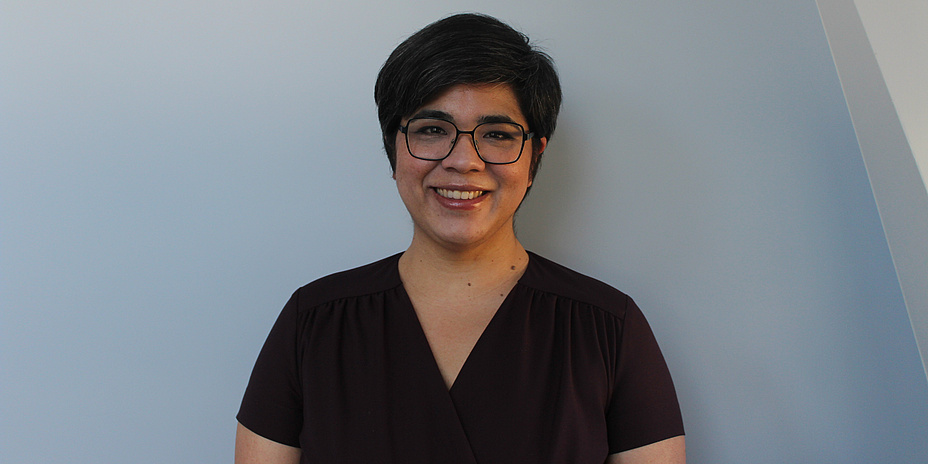
TU Graz News: You have been dealing with transport issues for many years. Why transport? And how did this come about?
Ana Tsui Moreno Chou: I studied civil engineering in Valencia, Spain, and was particularly interested in marine construction – bridges, dams, harbours and so on. I find bridges in particular incredibly interesting and beautiful. During my studies, I took a student job in the field of transport and wrote my master's thesis on the subject of safety in connection with the design of transport routes. I asked myself questions like: What makes roads safe? How do I design the road layout for different driving speeds? What effects do different design elements have on safety? How do congestion and traffic jams occur?
You can see from the last question that the organisation of transport also became important to me. Here, too, the design side has a lot of influence. I addressed this in my doctoral thesis and looked for good designs that break through congestion patterns on rural roads.
What happened after your doctoral thesis?
Moreno Chou: I took up a post-doctoral position at the Technical University of Munich (TUM) and investigated another exciting aspect of transport planning – the motivation for journeys. Cars don't drive by themselves, but rather people have certain transport needs. I looked at these needs and conducted research on why people make certain journeys and what patterns there are. And I wanted to know why they use a car for these journeys and not public transport or active mobility. Every journey has a purpose and limitations, and people try to adapt to them. And this of course has an effect on congestion.
Every journey has a purpose and limitations, and people try to adapt to them.
(Ana Tsui Moreno Chou)
And now you’re at TU Graz.
Moreno Chou: The position at Graz suits me very well because it addresses all my research aspects and I fit in very well with my profile.
You’re not only taking over the professorship, but also the management of the Institute of Highway Engineering and Transport Planning. How will you approach both posts?
Moreno Chou: The institute has an excellent reputation in the research community and leads many projects. It was a bit intimidating at first, I have to admit. Like me, my predecessor Martin Fellendorf works in modelling, but uses a different approach. Both approaches complement each other wonderfully. I would therefore like to continue the work in order to expand my knowledge and integrate our networks. In addition, I would like to make a greater contribution to the area of safety through design.
When you model traffic systems, do you use real data?
Moreno Chou: Our models have been developed using real data and can therefore be applied to real road systems. They work for Munich, where they were developed, but also for Graz, for example. We can use them to view entire regions/countries, as well as to zoom in on individual city districts and simulate the traffic flow there.
We can use them to view entire regions/countries, as well as to zoom in on individual city districts and simulate the traffic flow there.
(Ana Tsui Moreno Chou)
Our models simulate road users and their behaviour. The data comes from traffic statistics as well as anonymised and data protection-compliant mobile phone data which we have been familiar with from movement profiles since the COVID-19 pandemic. And to be able to create even more detailed simulations, we combine this data with traditional household surveys, where different information is requested – such as how many people live in the household, what their employment situation is, what journeys they make every day and what activities they do.
This data is not only interesting for transport planning, but also for energy and health care.
(Ana Tsui Moreno Chou)
Using our models, we can predict the effects of certain changes – for example, if the frequency of a tram service changes, if there are roadworks or if new cycle paths are established. This data is not only interesting for transport planning, but also for energy and health care. We would therefore like to make our agent-based models available as open source to all researchers.
Is your research based on fundamental principles or does it deal with specific questions from actual transport systems?
Moreno Chou: Both. We conduct basic research because we want to develop our transport models into a new generation of pioneering, demand-orientated models. The Institute has very good contact with decision-makers in various places and there is interest in our results. And of course it's exciting for us when we work on questions that the public are really asking themselves right now.
How is it that you are interested in these topics?
Moreno Chou: I grew up between different cultures. In Spain and Europe in general, we have an infrastructure where you can get around very well without a car – especially in the cities. Valencia, for example, is very flat and all the important points are within easy walking distance. In my mother's home country – Taiwan, there is mass public transport in Taipei, but people also like to use cars and motorbikes. In the USA/Canada, on the other hand, where I also have family and studied, there are areas where no transport is possible without private cars – seeing the eight-lane and completely inefficient motorways in Los Angeles as a child was very interesting.
What will you be focusing on in particular in the coming years?
Moreno Chou: The next generation of researchers is particularly important to me. I put a lot of work into teaching. And here I am particularly concerned about young women – we need many more female researchers in the transport sector. I have always had wonderful female role models and now I want to give that back.
![[Translate to Englisch:]](https://www.tugraz.at/fileadmin/_processed_/5/6/csm_Crashtest-left-view-by-VSI-tugraz_df1467dc56.jpg)