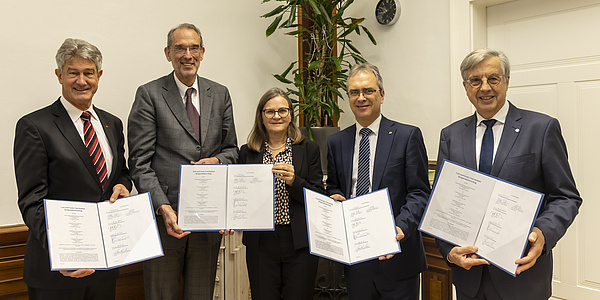
The Austrian Academy of Sciences (ÖAW) has appointed Giulio Superti-Furga as the inaugural scientific director of the CORI Institute for Metabolism Research in Graz. The institute was established through a unique partnership between the ÖAW, the University of Graz, the Medical University of Graz and Graz University of Technology (TU Graz). CORI aims to become Europe’s leading interdisciplinary centre for metabolism research: metabolic processes in cells are investigated systematically, experimentally and through molecular biology, and modelled using mathematical methods – with the aim of specifically intervening in these processes, modifying them and developing new therapeutic and technological solutions.
An outstanding researcher and experienced leader
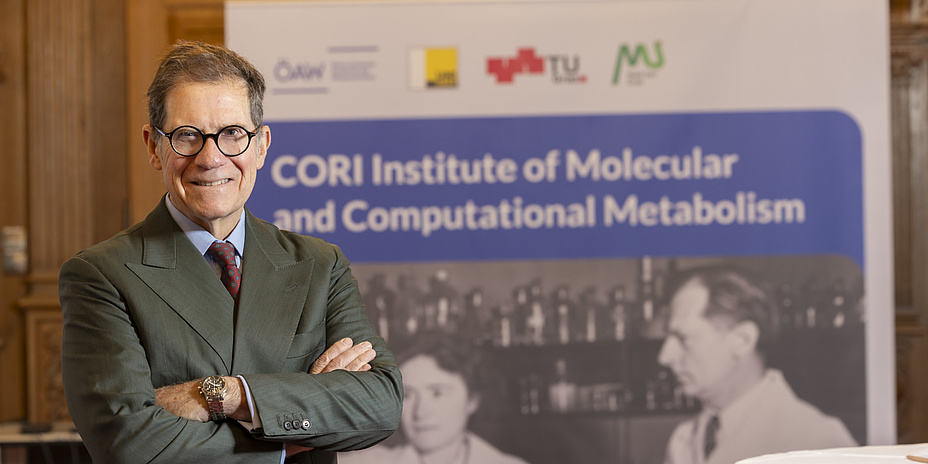
Giulio Superti-Furga is one of Europe’s most renowned biomedical scientists, with many years of leadership experience in research institutions. As the founding director of the CeMM Research Centre for Molecular Medicine of the Austrian Academy of Sciences (ÖAW) in Vienna, which he led for two decades, he established an internationally recognised institute at the interface of biology, medicine and data science. The four-time ERC grant holder is Professor of Medical Systems Biology at the Medical University of Vienna, a member of five scientific academies and co-founder of five biotechnology companies. Most recently, Superti-Furga was involved in establishing the Ri.MED Foundation’s research centre in Palermo, drawing on his expertise.
Focus on human health
The CORI Institute is named after Gerty and Carl Cori, who are regarded as icons of metabolic research and were awarded the Nobel Prize in Medicine in 1947. CORI will address major challenges in human health and aims to become the leading centre for metabolism-oriented science, enabling predictive models for health and disease as well as new strategies to strengthen human resilience. By combining experimental approaches with artificial intelligence and mathematical methods, the institute aims to develop comprehensive models of human metabolism and translate these into new therapies, as well as to specifically design, modulate and technically harness metabolic systems. At the institute, researchers from biology, medicine, mathematics, computer science and engineering will work together in teams.
ÖAW partnership with Graz universities
CORI will cooperate closely with the University of Graz, the Medical University of Graz and TU Graz. Where possible, group leaders will be offered a secondary affiliation at one of the partner universities to help shape and actively contribute to their scientific integration from the outset. Recruitment of the first group leaders and administrative management begins immediately, with the first scientific activities scheduled to start as early as September 2026. The institute will initially operate from temporary premises and subsequently move into the two purpose-built research buildings on Leechgasse in Graz. At full capacity, CORI will employ up to 150 internationally recruited researchers.
Giulio Superti-Furga, Founding Director of the CORI Institute: “It is an honour and a privilege for me to establish the CORI Institute in Graz and to harness Graz’s excellence in metabolic research to create a new international beacon. Metabolism is not just one research field among many: it is the organising logic of life. Our aim is to create a new kind of institute that combines mathematics, artificial intelligence and experimental biology to make metabolism understandable and predictable, and furthermore to actively shape, control and harness it for technological applications. At CORI, I see an opportunity to contribute my experience in establishing and shaping research institutions to create an institute that brings together the most attractive and forward-looking elements of modern biomedical science.”
ÖAW President Heinz Faßmann: “Metabolism has developed into one of the key future fields of modern biomedicine. In Giulio Superti-Furga, we have secured an internationally outstanding scientist and proven architect of scientific institutions to establish the CORI Institute. He brings with him a strong international network as well as close ties to the Academy’s life sciences institutes and to the ÖAW as a whole. This constellation places Graz even more firmly at the centre of our commitment in Styria and consolidates its position as a leading location for biomedical research in Austria and beyond.”
Peter Riedler, Rector of the University of Graz: “The University of Graz stands for excellent research that transcends disciplinary boundaries and provides answers to fundamental questions regarding our understanding of humanity, nature and society. With BioTechMed Graz, we have created a strong inter-university foundation that links biomedicine, technology and medicine and strengthens metabolic research. The CORI Institute ties in seamlessly with the MetAGE Cluster of Excellence and our BioHealth profile area. The fact that Giulio Superti-Furga, an internationally renowned figure, has chosen to take up the leadership role in Graz underscores the appeal of our university location in southern Austria. We look forward to working together and to further establishing Graz’s international standing.”
Andrea Kurz, Rector of the Medical University of Graz: “Metabolism and the cardiovascular system are among the key future research areas at the Medical University of Graz and are closely linked to the issue of healthy ageing. In Giulio Superti-Furga, we are gaining an internationally renowned scientist who brings both scientific excellence in this field and extensive experience in establishing high-performing research structures. Particularly valuable is the international reach of his scientific work, as well as his close collaboration with leading partner institutions in the life sciences sector, which will provide new impetus for the further development of this field of research. By establishing the CORI Institute, we are specifically strengthening our research at the interface of metabolism, circulation and healthy ageing.”
Horst Bischof, Rector of TU Graz: “The broad interdisciplinary approach, which encompasses the consistent integration of state-of-the-art technologies in artificial intelligence and data science, makes the CORI Institute a unique centre for international metabolic research. Its leadership by the globally recognised leading researcher Giulio Superti-Furga guarantees the institute’s success. The CORI Institute is ideally placed to become a magnet for young, international research talent and thus to strengthen the research hub in the long term.”
Christine Moissl-Eichinger, Director of BioTechMed-Graz: “In Graz, we live and breathe scientific collaboration. This is evident at BioTechMed-Graz through the pooling of the scientific strengths of the three BioTechMed-Graz partner universities. Metabolic research, in particular, is a key multidisciplinary research area at BioTechMed-Graz, which is why the CORI Institute fits perfectly into Graz’s research landscape. This new flagship initiative will specifically strengthen Graz as a research hub and further advance our shared vision of scientific excellence. We are very much looking forward to our future collaboration!”
Willibald Ehrenhöfer, Provincial Councillor for Science and Research: “The CORI Institute for Metabolic Research is another milestone for Styria. It allows us to underline our position as a location of high scientific excellence and, furthermore, to further expand the economic strength of human technology. A key factor in this success is a Styrian core competence – close collaboration. In this case, between three local universities and the Austrian Academy of Sciences (ÖAW). Giulio Superti-Furga’s credentials speak for themselves and will significantly boost Styria’s international visibility as a research hub, increase opportunities for healthy ageing in our region, and greatly enhance prospects for our economy in this sector.”
Debora KNOB
Press Officer of the Executive Board
Austrian Academy of Sciences
Phone: +43 1 51581 1209
debora.knob@oeaw.ac.at
Barbara GIGLER
TU Graz | Press Officer
Phone: +43 316 873 6006
barbara.gigler@tugraz.at