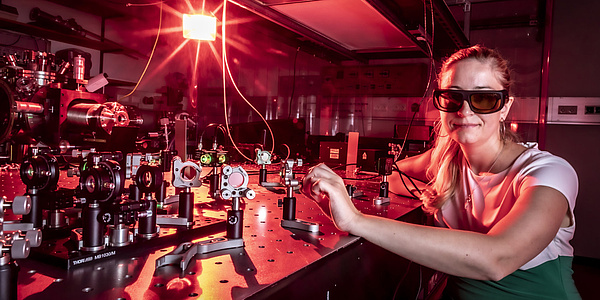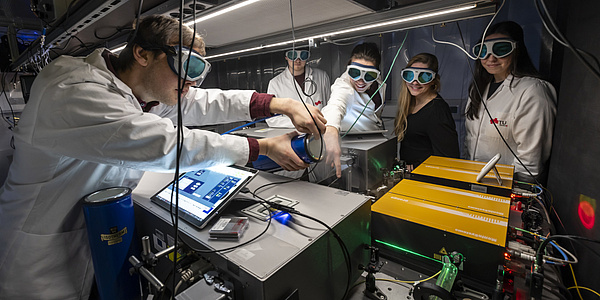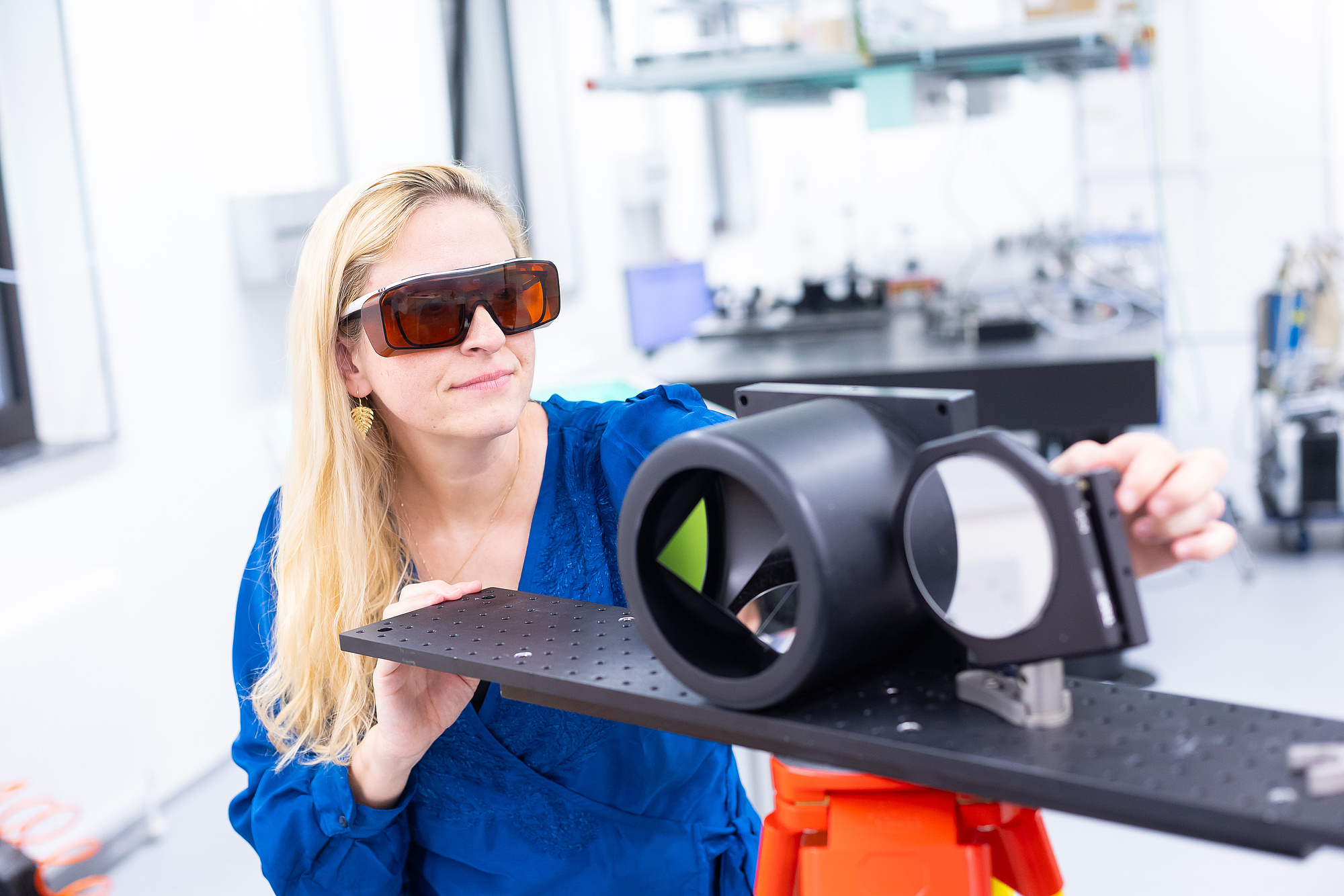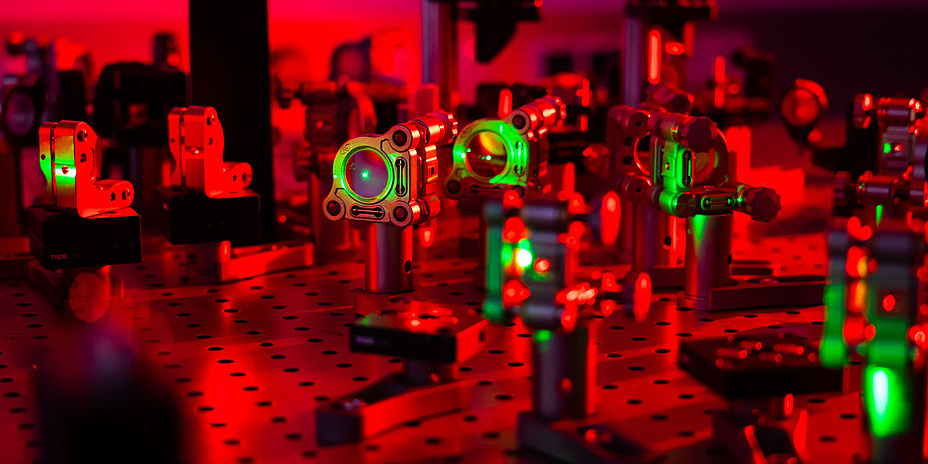
Birgitta Schultze-Bernhardt and her team at the Institute of Experimental Physics at Graz University of Technology (TU Graz) have developed a new type of UV dual-comb spectrometer that detects gaseous air pollutants with unrivalled accuracy and sensitivity. Using ultraviolet double laser light, the device measures the concentration of harmful gases such as formaldehyde within half a second. Thanks to its compact design and a measuring range of up to two and a half kilometres, the spectrometer is not only suitable for laboratory analyses, but also for mobile measurements in cities, industrial areas and agricultural regions.
Fingerprint of pollutants
As a starting point for its measurement, the device generates two laser pulses in the ultraviolet spectral range within fractions of a second. When this UV light hits gas molecules, it excites them electronically and causes them to rotate and vibrate – physicists refer to this as rovibronic transitions. These transitions are different for every gaseous substance and swallow up part of the laser light in a unique way. “Every air pollutant therefore has its own fingerprint, which our UV dual-comb spectrometer recognises,” says Birgitta Schultze-Bernhardt.
Schultze-Bernhardt and her team developed the first version of their spectrometer a good two years ago. At the time, it was the first of its kind in the world, but large laboratory set-ups were necessary for the measurements. The new version has been shrunk to the size of a cardboard removal box. One reason for this is that one laser source instead of two now generates the double laser pulse. “This also allows us to dispense with the complex electronic stabilisation of the system,” explains Birgitta Schultze-Bernhardt.
Resolution of 1 GHz
The new spectrometer can detect the frequencies of UV light with a resolution of 1 GHz and thus significantly outperforms all conventional UV spectrometers. This enabled the researchers to gain new, fundamental insights into the UV light absorption of the air pollutant formaldehyde: “We measured absorption patterns of formaldehyde that had never been observed experimentally before, as the resolution of any previous devices was too imprecise,” says Birgitta Schultze-Bernhardt.
57-year-old rotational constants corrected
The measurements in Graz have shown that the rotational constants of formaldehyde, which have been available in physics databases and textbooks since the 1960s, are incorrect. “In collaboration with the Harvard-Smithsonian Center for Astrophysics, Atomic and Molecular Physics in the USA, we have corrected the values of this fundamental, molecule-specific parameter by up to 15 per cent,” says Birgitta Schultze-Bernhardt. Collaboration with Rolf Breinbauer from the Institute of Organic Chemistry at TU Graz, who produced high-purity formaldehyde for the investigations in a two-stage process, also contributed to this progress in basic research.
Application in environmental protection
Beyond basic research, the spectrometer has the potential to make the measurement of air pollutants and gas leaks in cities and industrial areas much more precise and easier. “In principle, our device can accurately detect any semi-transparent, gaseous substance. And we are currently working on determining the concentration of several pollutants with a single measurement,” says Birgitta Schultze-Bernhardt. Funded by a Proof of Concept Grant from the European Research Council, the experimental physicist is also currently developing a UV spectrometer that can also be used by laypersons to monitor air quality, for example in companies or environmental authorities.
Funded by the Austrian Science Fund, ERC and NAWI Graz
The development of the UV dual-comb spectrometer is based on research projects led by Birgitta Schultz-Bernhardt, which were funded by the Austrian Science Fund FWF and the European Research Council. The NAWI Graz cooperation initiative financed the novel laser source of the current spectrometer as part of its infrastructure funding.
Publication:
Free-running Ultraviolet Dual Comb Spectroscopy enabling Absolute Electronic Fingerprinting
Authors: Lukas Fürst, Mithun Pal, Alexander Eber, Emily Hruska, Clemens Hofmann, Iouli Gordon, Martin Schultze, Rolf Breinbauer, Birgitta Bernhardt
In: PhotoniX 7, 33 (2026)
DOI: https://doi.org/10.1186/s43074-026-00250-6
Birgitta SCHULTZE-BERNHARDT
Univ.-Prof. Dipl.-Phys. Dr.rer.nat.
TU Graz | Institute of Experimental Physics
Phone: +43 316 873 8663
schultze-bernhardt@tugraz.at