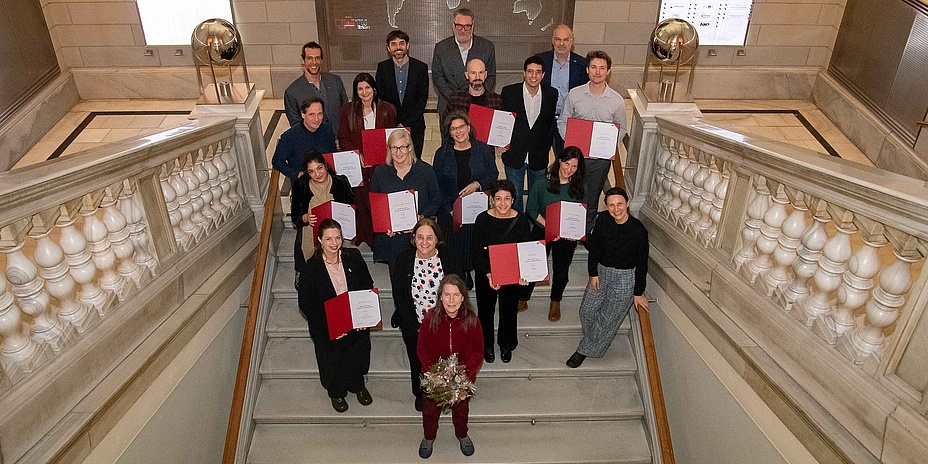
Graz University of Technology (TU Graz) presented six Mind_the Gap diversity awards for outstanding university work in the areas of diversity, inclusion and equal opportunities in 2025. The prizes are endowed with 750 euros for individuals and a maximum of 1,500 euros for team submissions.
Two teams and four individuals were awarded prizes for their projects, theses and teaching formats. One of the award-winning projects, for example, is about showcasing women architects in and from Graz since 1935 and thus challenging historical role models. Other research projects investigate diversity and equal opportunities in AI-supported systems as well as the use of AI in sensitive areas such as choosing personnel. A master’s thesis analyses how Balkan memes shape and reflect cultural affiliation, emotions and social power relations. As part of a bachelor’s thesis, a mobile learning app was developed to provide a playful approach to Austrian sign language. And an award-winning course deals with absences and repression in the history of places.
The thematic diversity of the six award-winning projects impressively demonstrates how research, teaching and student projects at TU Graz assume social responsibility.
INFORMATION: All information on the Mind_the Gap Diversity Awards can be found on the TU Graz diversity website. The call for entries for the 2026 awards starts on 8 March on the occasion of International Women’s Day. Applications can be submitted until the end of September.
The 2025 Award-winners
Women Architects in/from Graz; research and publication project by Antje Senarclens de Grancy, Clara Neuhold, Bettina Paschke (Architecture & Archives/Library)
The research and publication project Women Architects in/from Graz makes the lives and works of selected female architecture graduates of TU Graz since 1935 visible for the first time. Based on archive work and interviews, previously unknown biographies and careers of ten women architects were analysed and made accessible to a broad public. A total of 232 women architecture graduates were recorded. This provides a pool for further work. The project corrects male-dominated histories of architecture and creates historical role models for future generations.
Play video
AI-based Recommender Systems: Fairness, Transparency and Regional Value Creation (Fair RecSys); research project by Bernhard Wieser, Anna Schreuer, Simone Kopeinik, Dominik Kowald, Peter Müllner (Computer Science/ Human-Centred Computing & Know Center)
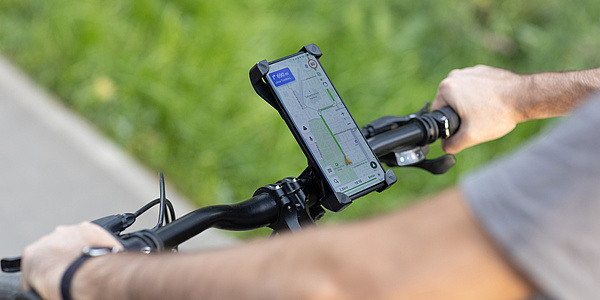
The Fair RecSys research project investigates how AI-based recommendation systems can be designed to be non-discriminatory. The focus is on fairness criteria relating to gender, age and physical requirements, such as mobility restrictions. Through interdisciplinary and transdisciplinary collaboration, the project combines technological innovation with social responsibility and makes an important contribution to the ethical design of AI systems. The Fair RecSys team succeeded in doing this using the example of a bicycle app, for which inclusive design guidelines were developed and applied.
Play video
Ethical AI in Recruitment; master’s thesis by Lisbora Likaj (Computer Science/ Human-Centred Computing)
In her master’s thesis, Lisbora Likaj analyses the use of large language models in choosing personnel. To this end, she analysed the accuracy and fairness of AI-supported pre-selection processes compared to human recruiters using ten real job advertisements and 102 CVs. The work makes it clear that technological efficiency and equal opportunities must be considered together – particularly with regard to gender, age and ethnic origin.
Play video
Balkan Memes: Emotions and Affect in the Context of Digital Practices; master’s thesis by Maria Anastasia Manousopoulou (Electrical Engineering & Sociology)
In her master’s thesis, Maria Anastasia Manousopoulou analyses memes as digital practices in which cultural affiliation, emotions and social power relations are negotiated. The focus is on Balkan memes that both reproduce stereotypical images of others and visualise processes of self-representation. The work shows impressively how digital communication spaces characterise and reflect cultural, linguistic and origin-related diversity.
Play video
Engaging Sign Language Learning through a Gamified Mobile Application; bachelor’s thesis by Florian Rudolf Wohlmuth (Computer Science/ Human-Centred Computing)
In his bachelor’s thesis, Florian Rudolf Wohlmuth develops a playfully designed mobile learning app called Handzeichen (Hand signs), which is intended to make it easier to learn Austrian sign language. The aim is to give people without hearing loss low-threshold access to sign language and thus break down language barriers. The work combines gamification with inclusive design and shows how digital education can contribute to the promotion of accessible communication. An expansion of the app and public access to it are being planned.
Play video
Finding the Shape Described by an Absence. On Reading the History of Sites; course by Rose-Anne Gush (Architecture /Institute for Contemporary Art)
Rose-Anne Gush’s excellent course invites students to explore absences and repression in the history of places. With the help of feminist and situated research methods, archival work and oral history, participants develop new approaches to the critical interpretation of history. The focus on gender, ethnic origin and the history of National Socialism makes structural invisibilities in academic knowledge tangible. The students’ strong desire for an extension of the course shows the lasting effect of this format. It not only imparts knowledge, but also shapes attitudes – thus creating an impact that is rarely so clearly felt.
Play video
2025 Jury
- Stefan Vorbach, Vice Rector for Academic Affairs
- Andrea Höglinger, Vice Rector for Research
- Wolfgang Richter, Institute of Hydraulic Engineering and Water Resources Management, Working Group for Equal Opportunities
- Armin Stocker, Institute of Construction and Design Principles
- Wilfried Grassegger, Occupational Health Management and Service Point for Accessible Learning
Armanda PILINGER
TU Graz | Equity, Youth, Care
Gender, Diversity and Equal Opportunities Unit
Phone: +43 316 873 6090
team.diversity@tugraz.at
![[Translate to Englisch:]](https://www.tugraz.at/fileadmin/_processed_/5/6/csm_Crashtest-left-view-by-VSI-tugraz_df1467dc56.jpg)