Green hydrogen is considered an indispensable component of the global energy transition, but its production still faces massive economic and environmental hurdles. For example, the promising PEM (proton exchange membrane) electrolysis process, which is particularly suitable for producing green hydrogen when the supply of electricity from wind power and photovoltaic systems fluctuates, is still very expensive compared to production using fossil fuels. Sustainability also needs to be scrutinised here. This is because it relies on environmentally hazardous substances such as forever chemicals (PFAS), which the EU wants to ban soon. These disadvantages are to be eliminated in the EU project SUPREME. Over the next three years, an international team led by the University of Southern Denmark with the participation of Graz University of Technology (TU Graz) will be conducting research on a PFAS-free and highly efficient electrolysis technology that also requires far fewer critical raw materials such as iridium and is therefore much more cost-effective.
Important step towards the green transition
“Hydrogen is used as a raw material in very large quantities, and this will continue to increase in the future. These include the production of ammonia, methanol production and the steel industry,” says Merit Bodner from the Institute of Chemical Engineering and Environmental Technology at TU Graz. “If we succeed in avoiding the use of harmful substances in the production of green hydrogen and we can also bring it to a similar price level as fossil hydrogen in economic terms, we will have taken an important step towards the green transition. This also makes it more attractive for other applications, such as storing surplus energy from renewables.”
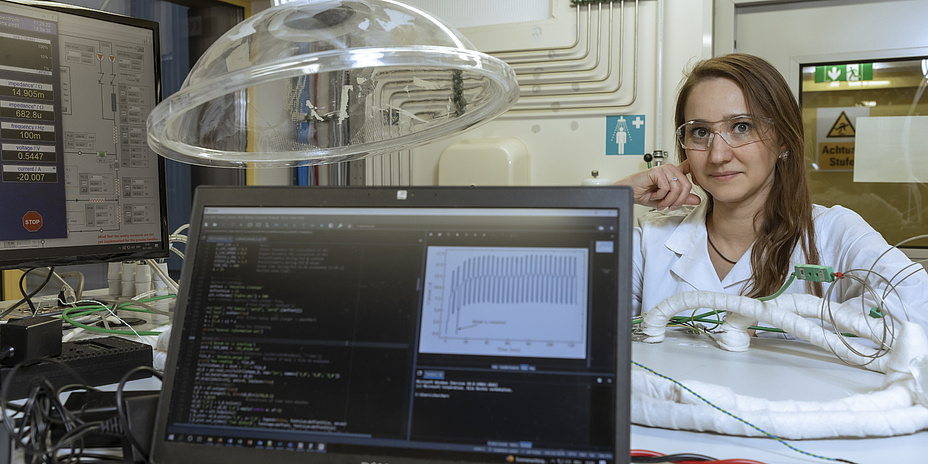
The role of TU Graz is of central importance in this project. Merit Bodner’s team is evaluating which PFAS-free alternative materials are commercially available and is analysing how they compare to the current industry standards. Particular attention is paid to whether the more sustainable materials are similarly durable and efficient in continuous industrial operation to serve as a fully-fledged replacement. The use of these alternatives for the synthesis of membranes is being researched by the Turkish Science and Technology Council TÜBITAK, which is developing the next generation of microporous PFAS-free membranes.
Reducing and recycling iridium
The University of Southern Denmark and the British metal and catalyst company Ceimig are conducting research on how the use of the expensive platinum-group metal iridium can be reduced by up to 75 per cent. In addition, this team would like to develop processes with which around 90 per cent of the iridium still required can be recycled. The German research institute Fraunhofer ISE is producing the membrane electrode units, while the Norwegian hydrogen company Element One Energy AS (EoneE) is developing a new type of rotating electrolyser.
This research was funded by CETPartnership, the Clean Energy Transition Partnership under the 2024 joint call for research proposals, co-funded by the European Commission (GA N°101069750) and with the funding organisations detailed on https://cetpartnership.eu/funding-agencies-and-call-modules.
Merit BODNER
Ass.Prof. Dipl.-Ing. Dr.techn. BSc
TU Graz | Institute of Chemical Engineering and Environmental Technology
Phone: +43 316 873 4977
merit.bodner@tugraz.at