
Ion sensors

5. Ion sensors

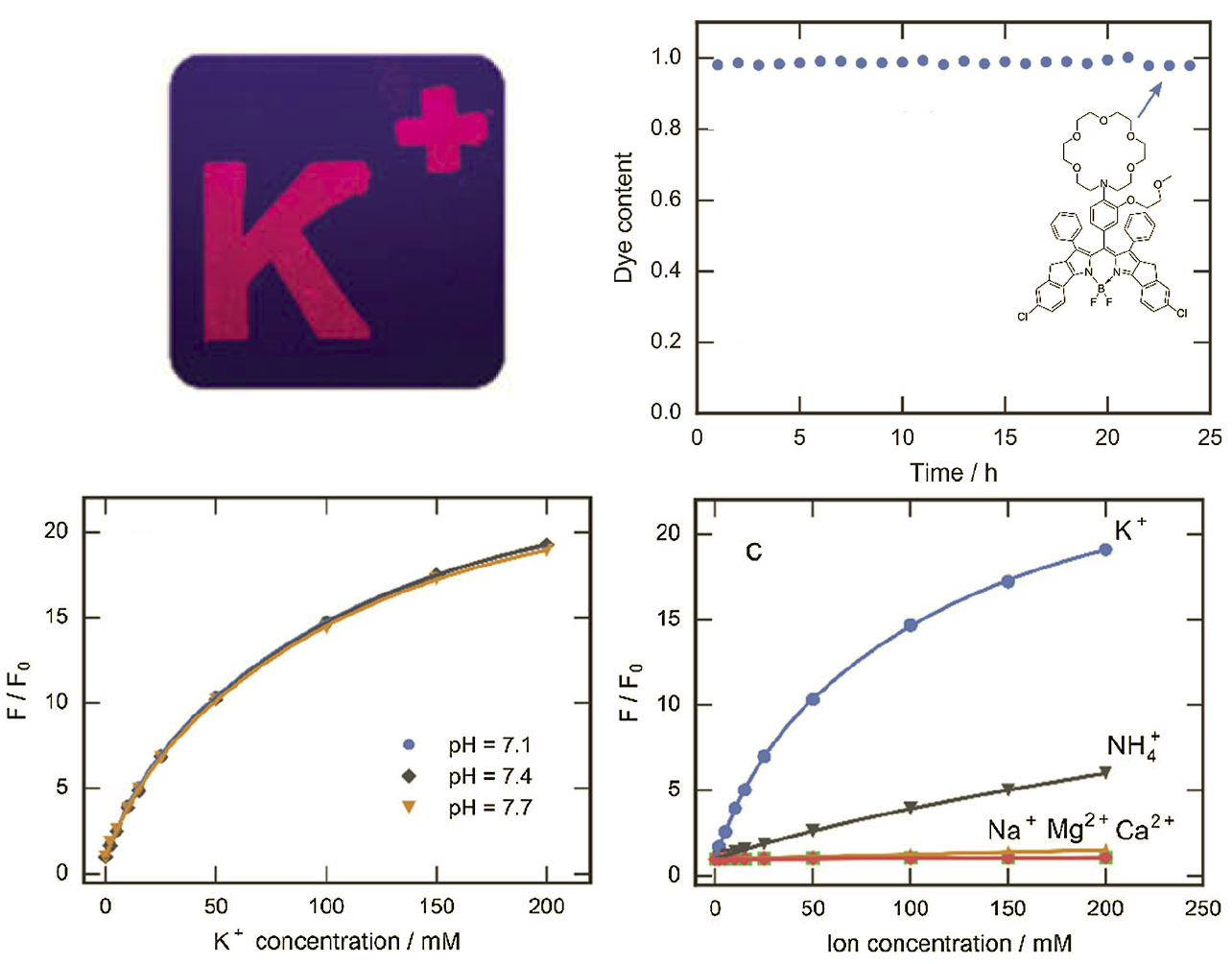
Based on the sensitized K+ and Na+ fluoroionophores [34, 35] optodes for these analytes were manufactured by immobilization of the indicators into hydrogel matrices. The potassium sensor (Fig. 5.1) shows excellent “switch on” behaviour in presence of K+, shows no leaching of the indicator during prolong measurements in presence of the analyte, does not show any cross-talk above pH 5.5 and shows only very minor cross-sensitivity to sodium. The sodium sensor based on BODIPY dye with smaller crown-ether receptor [35]  shows very similar spectral properties and cross-talk to pH. It possesses high selectivity against K+ and virtually neglectable cross-talk to Mg2+ and Ca2+. The new sensor was applied for monitoring of seawater salinity via measurement of Na+ concentration.
Figure 5.1. Properties of the K+ optode. Upper left: photographic image of the optode (λexc 365 nm) with the emission switched on by 150 mM K+. Upper right: sensor signal upon continuous pumping of aqueous solution containing 100 mM K+ indicating that no leaching takes place. Lower left: calibration curves at 3 physiologically relevant pH values. Lower right: response of the sensor to K+ and to other potentially interfering ions. Reprodcued from [34].

References:

[34] Müller, B. J.; Borisov, S. M.; Klimant, I. Red- to NIR-Emitting, BODIPY-Based, K+-Selective Fluoroionophores and Sensing Materials. Adv. Funct. Mater. 201626 (42), 7697–7707. [35] Müller, B. J.; Rappitsch, T.; Staudinger, C.; Rüschitz, C.; Borisov, S. M.; Klimant, I. Sodium-Selective Fluoroionophore-Based Optodes for Seawater Salinity Measurement. Anal. Chem. 201789 (13), 7195–7202.