Dirac and 2D Material Surfaces
We are interested in how surfaces interact with their environment — from exotic Dirac materials and topological insulators, promising candidates for spintronics and quantum computation, to the everyday physics of how molecules move across a surface. Our main tool is helium atom scattering (HAS): an exceptionally gentle technique that probes a surface with a beam of helium atoms rather than electrons or X-rays, revealing both structure and dynamics while disturbing almost nothing.
A quick word on 2D materials
Materials that are only one, or a few, atoms thick — such as graphene and hexagonal boron nitride (h-BN) — behave very differently from their everyday, bulk counterparts. They're being explored for faster electronics, membranes, catalysts and more. But to put them to use, we first need to understand exactly how they form, atom by atom, and how molecules — including water — behave once they land on them. The highlights below come from that effort.
Project highlights
Building 2D materials, atom by atom
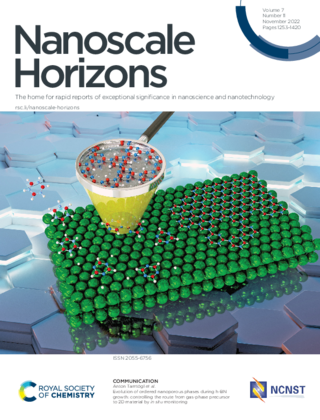
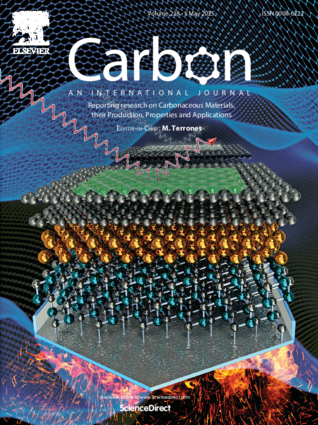
2D materials like h-BN are usually grown by dropping a gas onto a very hot metal surface and letting it react there — a process that happens fast and at high temperature, making it extremely hard to watch as it unfolds. Using helium scattering, we followed the growth of h-BN in real time and found something unexpected: before the final material forms, an intermediate, see-through structure appears, perforated with regularly spaced nanopores.
"We were amazed to see that, instead of the expected diffraction pattern of hexagonal boron nitride, we recorded a very different one" — finding a new phase of such a well-known material was, as one of our PhD researchers put it, "like discovering a completely new species of butterfly in your own backyard."
A follow-up study then built a full first-principles model of the entire growth pathway, giving a step-by-step explanation of why these intermediate, porous structures appear and how growth conditions could be tuned to control them — useful for engineering nanoporous or functionalised 2D materials on demand.
Read more: ChemEurope — "Growth of nanoholes visible for the first time" · AZoNano — "Modeling the growth of hexagonal boron nitride" · Behind the paper: tailored holes in 2D materials
 |
 |
A "moonlander" rolling across graphite
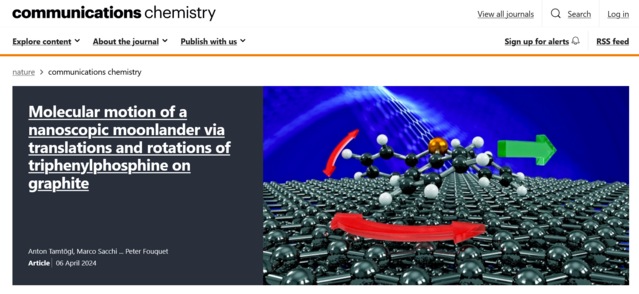
How does a molecule actually move across a surface? For a long time, the simple picture was a point-like particle hopping from one favourable site to its nearest neighbour. We found that this picture breaks down for larger molecules. Triphenylphosphine, a tripod-shaped molecule that binds to graphite via three "legs", turns out to roll across the surface rather than hop — with its legs moving almost freely while the molecule's body translates slowly, much like a tiny moonlander touching down and inching forward.
We've seen related behaviour in other molecules too, including a bowl-shaped "buckybowl" rolling over graphite, studied in collaboration with colleagues in Cambridge and at the Institut Laue-Langevin in Grenoble.
Read more: Phys.org — "A molecular moon lander: insight into molecular motion on surfaces" · Behind the paper: the nanoscopic moonlander
Why water moves so differently on h-BN than on graphene
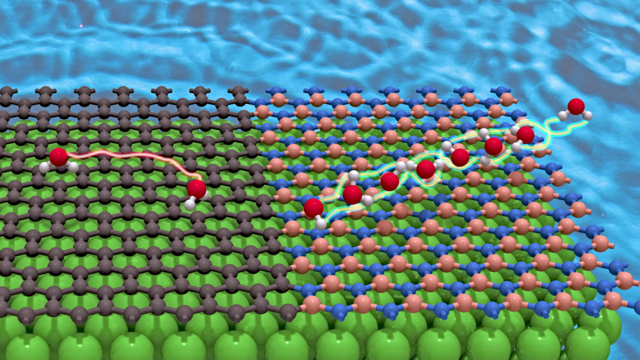
Graphene and h-BN look almost identical — both are honeycomb sheets one atom thick — yet a single water molecule experiences them very differently. On graphene, water hops between sites in discrete jumps, holding a fairly fixed orientation. On h-BN, it instead glides smoothly while continuously rotating and tumbling, in a motion closer to walking than hopping — and the energy barrier to that motion is two-and-a-half times lower. Add a supporting metal underneath and the friction water experiences on each material can even flip places, with water gliding nearly eight times more easily on supported h-BN than on supported graphene.
Findings like these matter for designing microfluidic devices, anti-icing coatings and selective membranes, where controlling exactly how water moves at the molecular scale makes all the difference.
Read more: Behind the paper: water dances on hexagonal boron nitride