Future Learning, Analytics & AI for Teaching
The FLAAIT Team (Future Learning, Analytics & AI for Teaching) within the OU Educational Technology explores emerging technologies for teaching and learning processes. The focus lies on researching, developing and piloting digital solutions that support teaching, learning and study success and are gradually developed into sustainable digital services for lecturers and students.
Future Learning
Forward-looking research in educational technologies helps identify technological developments at an early stage and make them usable for teaching and learning.
To develop new digital learning tools on a solid foundation, FLAAIT collaborates closely with the Institute of Human-Centred Computing (HCC).
A central approach is to design innovations directly in real teaching and learning scenarios, test them together with lecturers and students, and iteratively refine them. In this way, scientific insights are combined with practical experience, resulting in robust and meaningful digital solutions.
The development of new learning technologies is based on an evidence-based framework developed by the Ed-Tech Research Community. It is carried out in close collaboration with other areas of FLAAIT in order to create solutions that are sustainable both technologically and pedagogically.
Learning Analytics
When digital learning environments are used, a wide range of data is generated. These data are analysed to better understand learning processes and to support students more effectively. Within projects in the field of Learning Analytics, these data are used to provide students with immediate feedback on their learning behaviour.
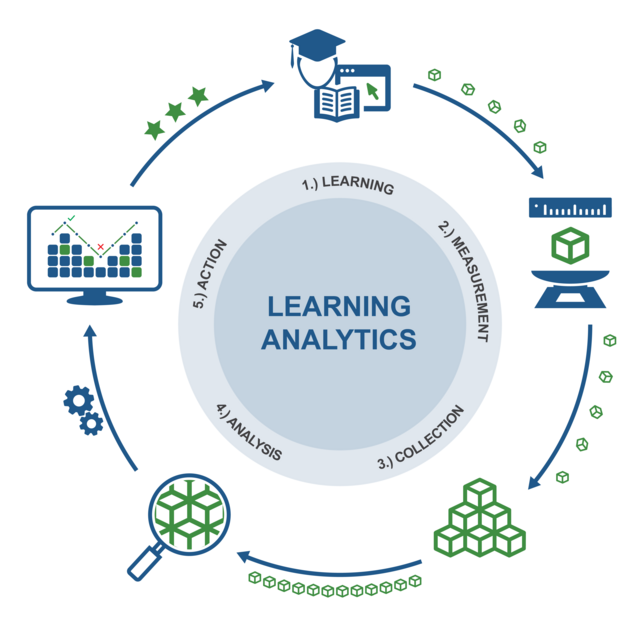
Learning Analytics cycle: learning, measurement, data collection, analysis and resulting actions.
The tools developed support students in reflecting on their learning behaviour and managing their studies more successfully. This contributes to improved study conditions and strengthens the university as a supportive learning environment for diverse study realities.
The focus lies on evidence-based learning support and needs-oriented support services. Learning content and learning pathways can therefore be adapted more effectively to the needs of students, complemented by individual feedback and support for different groups of learners in various teaching and learning situations.
Projects in the field of Learning Analytics are implemented by FLAAIT both to support lecturers and students at TU Graz and in collaboration with partner institutions in Austria and across the EU.
To present insights from Learning Analytics in an accessible way, the results are visualised in dashboards. Examples currently used at TU Graz include:
- Student Dashboard
- Project “Learners Corner” (Course Dashboard)
AI for Teaching
In the field of Artificial Intelligence (AI), FLAAIT develops and pilots practical tools that support lecturers in their pedagogical work and guide students within their courses.
One focus lies on integrating AI into teaching. This includes initiatives such as AI tutors that accompany courses and support both lecturers and students in the use of AI.
FLAAIT also contributes to professional development activities related to the use of AI in teaching and provides relevant resources. These include MOOCs (Massive Open Online Courses) on the topic of AI in higher education teaching as well as tools for safe and effective prompting, for example through the platform prompting.school.
In addition, FLAAIT develops AI-supported solutions for administrative tasks, such as a chatbot for creating and analysing course descriptions, which helps simplify administrative processes.
The goal of FLAAIT is to promote a responsible, transparent and pedagogically meaningful use of AI in different teaching and learning scenarios.
MOOC: Learning Analytics for higher education (German only)
MOOC: Teaching with Learning Analytics (German only)