

Best Paper Award for Felix Auer
25.03.2026
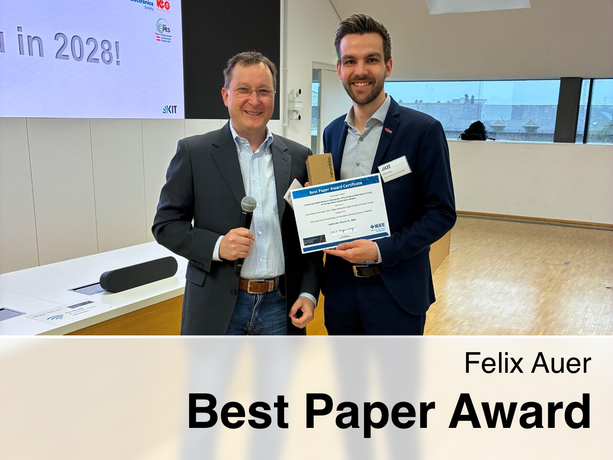
Felix Auer received the Best Paper Award at the 4th International Workshop on Open Source Modelling and Simulation of Energy Systems in Karlsruhe.
Great success for Felix Auer: He has been awarded the Best Paper Award for his contribution “Uncovering Hidden Biases in Hydropower: Why Detailed Inflow Data is Crucial for Energy System Optimization Models”. The award was presented at the 4th International Workshop on Open Source Modelling and Simulation of Energy Systems (OSMSES) in Karlsruhe.
In his work, Felix Auer investigates the impact of temporal aggregation of inflow data on the results of energy system optimization models. Hydropower plays a central role in future highly renewable energy systems, yet it is often represented in a simplified manner in models due to the limited availability of high-resolution inflow data. Instead, aggregated time series—such as daily, weekly, or monthly data—are commonly used.
Using an adapted NREL-118 bus test system as well as the open-source LEGO (Low-carbon Expansion Generation Optimization) model, the study analyzes how different temporal resolutions of inflow data affect investment and operational decisions. By computing an ex-post regret measure, the study quantifies the cost and planning errors caused by aggregation.
The results clearly show that aggregated inflow data can lead to significant cost increases and misallocation of generation capacity investments—especially when hydropower represents a substantial share of the energy system. This is mainly due to the systematic underestimation of inflow variability at coarse temporal resolutions.
The work was carried out as part of the iKlimEt project, which focuses on the interface between climate models and energy system models, with a particular emphasis on the consistent use of climate-related data for energy system analyses.
The findings highlight the importance of high-resolution, high-quality hydropower time series for robust energy system planning. At the same time, they emphasize the urgent need for openly available and standardized datasets to enable realistic modelling of future energy systems.
We warmly congratulate Felix Auer on this outstanding achievement!

