
NPAP (Network Partitioning and Aggregation Package) is an open-source Python toolbox designed to simplify and standardize the reduction of complex networks of optimization models. It provides a flexible framework for partitioning large-scale graphs and aggregating them into smaller, computationally tractable representations while preserving key structural and functional properties.
It is particularly designed for applications in electrical energy systems, where large and highly detailed grid models often need to be simplified to enable efficient computation. NPAP is built on NetworkX and provides a modular, strategy-based architecture for flexible and transparent network reduction.
Motivation
Modern energy system models represent power grids with a high level of spatial and technical detail. While this level of detail is essential for accurate analysis, it also leads to increased computational complexity and longer runtimes. NPAP helps reduce this complexity by systematically simplifying networks while preserving key structural and electrical characteristics.
Use Cases
NPAP is particularly suitable for reducing power grid models in energy system applications, for example in combination with tools such as PyPSA or expansion planning models. In addition, it can be used for scenario analysis, machine learning applications, or general graph reduction tasks.

How to Start
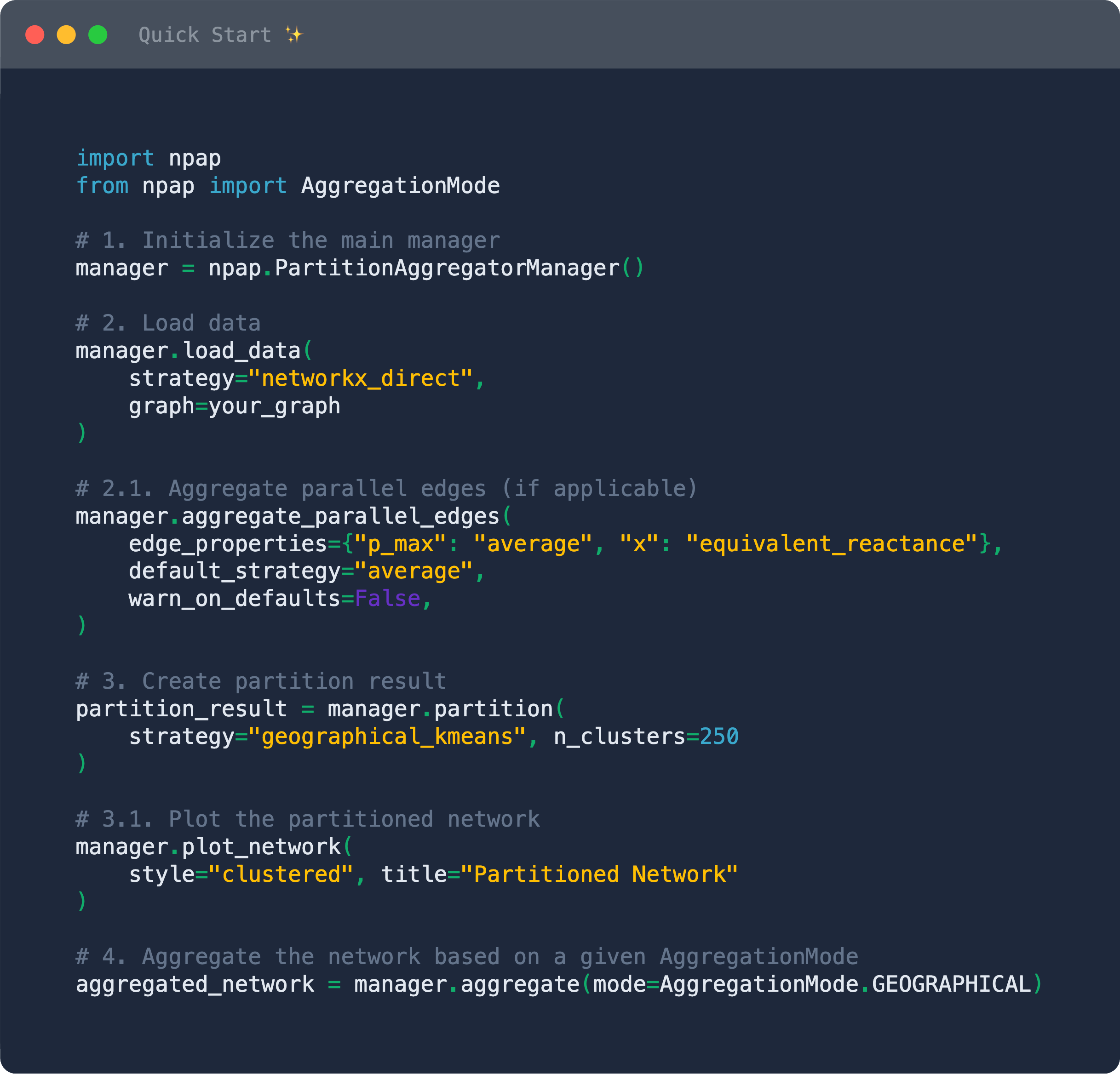
Getting started with NPAP is straightforward. The library can be installed via the Python Package Index (pip install npap) and integrated into existing Python projects. The documentation provides step-by-step examples, guiding users from loading a network to selecting a partitioning strategy and performing aggregation.
Funding agency
Funded by the European Union (ERC, NetZero-Opt, 101116212). Views and opinions expressed are however those of the author(s) only and do not necessarily reflect those of the European Union or the European Research Council. Neither the European Union nor the granting authority can be held responsible for them.