

Essential Engineering Topics / Electronic Engineering
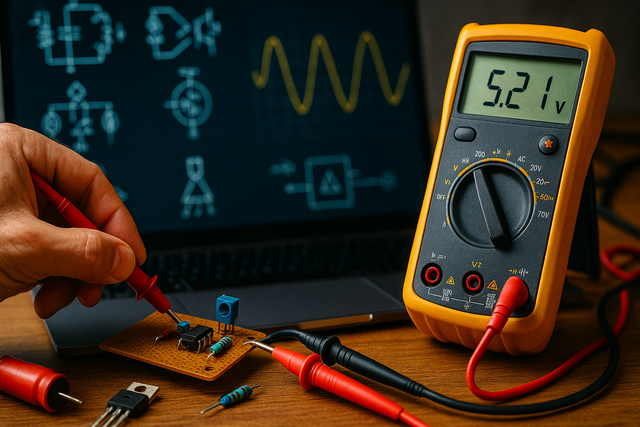
Course developed by: Thomas Klinger, Engineering & IT, CUAS (Fachhochschule Kärnten)
Contact: t.klinger@fh-kaernten.at
Course Description
The fundamentals of electrical engineering and electronics are essential for understanding the further content of the master's program in Systems Design. This course teaches this content and revisits topics already covered in a relevant bachelor's program.
The course is organized as online training. It provides videos for the theoretical content, calculation examples for self-assessment, and online labs for practical testing of the fundamentals learned and understood. Since the course can be completed entirely online, it can either be taken at your own pace during your studies or chosen as a preparatory course for studying systems engineering. The exam can be taken at CUAS either at the beginning of your studies or at the end of the first semester.
Learning Objectives
After finishing the course, students are able to
- Identify and explain the essential properties of DC and AC circuits.
- Apply circuit-analysis methods to study DC and AC circuits.
- Use frequency-transformation techniques to exploit the special properties of AC circuits.
- Analyze AC circuits using appropriate frequency-domain methods.
- Describe the main characteristics and applications of semiconductor devices (diodes, MOSFETs, bipolar transistors).
- Analyze and design circuits that incorporate semiconductor devices.
- Analyze and design circuits using operational amplifiers.
Course access (via CUAS)
Open access provided? No, only for CUAS students enrolled in the study program
Course duration: ~ 62.5 hours/2.5 ECTS
Course type: e-learning
Target audience: Students at Master’s level
Course language: English
Is this course free? Yes, for CUAS students
Self-paced course? Yes
Is the certificate / are the credentials free? Yes, for CUAS students
Assessment type: In-class exam