ETF College at Politecnico di Torino
The Collegio di Ingegneria Elettronica, delle Telecomunicazioni e Fisica (ETF) is one of the thematic Colleges of the Politecnico di Torino. It coordinates all the degree programmes that bring together electronics, telecommunications, and applied physics — disciplines at the heart of today’s technological transformation. The College connects three academic departments — DET (Electronics and Telecommunications), DISAT (Applied Science and Technology), and DIATI (Environment, Land and Infrastructure Engineering) — and ensures that teaching and research activities in these areas are coherent, complementary, and continuously evolving with new technologies.
ETF acts as a bridge between science and engineering, offering students an education that combines rigorous theoretical foundations with strong experimental and design components. The College coordinates several degree programmes, both at bachelor and master level, and provides a unified identity for students who want to work in the wide world of information and physical technologies.
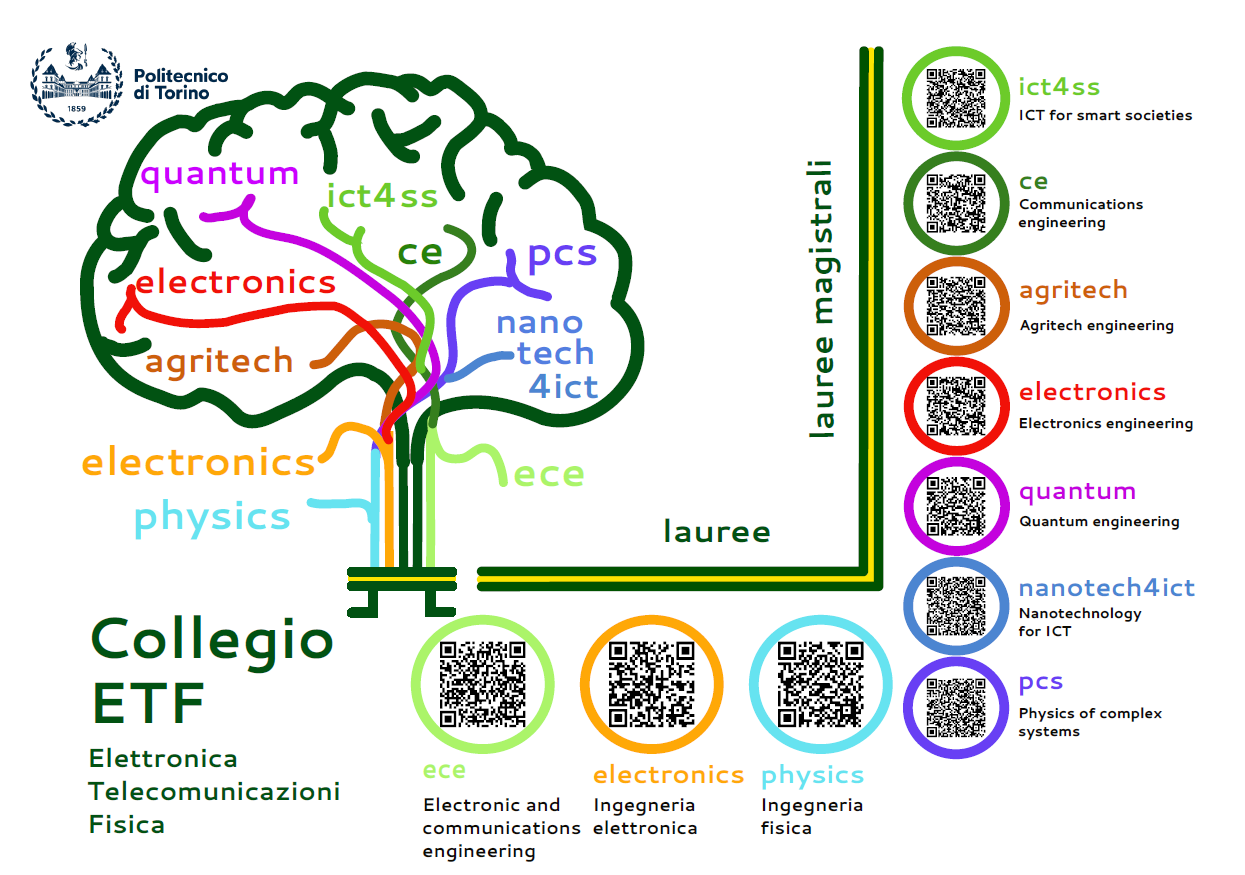
Bachelor’s Degrees (Laurea Triennale)
- Electronic and Communications Engineering (ECE) – an English-taught course designed for an international audience, focused on the fundamentals of ICT, electronics, and communication systems.
- Ingegneria Elettronica – an Italian-language degree that provides a solid base in analog and digital electronics, circuits, and system design.
- Ingegneria Fisica (Physical Engineering) – a programme that merges physics and engineering, ideal for students interested in the physical principles that underpin modern technology, from materials to devices.
Master’s Degrees (Laurea Magistrale)
- Communications Engineering – focused on the design and management of modern communication systems, from wireless to optical networks.
- Electronic Engineering – deepens knowledge in microelectronics, embedded systems, and hardware design.
- ICT Engineering for Smart Societies – an interdisciplinary programme centered on intelligent systems, sensors, and connected infrastructures.
- Nanotechnologies for ICTs – dedicated to micro- and nano-scale technologies that support the next generations of devices and materials.
- Physics of Complex Systems – oriented toward the modeling and understanding of complex natural and artificial systems.
- Quantum Engineering – a recent addition aimed at the technologies of the quantum future, including computing, sensing, and communication.
- Agritech Engineering – a new application field linking digital and electronic innovation with sustainable agriculture.
Students within ETF benefit from a distinctive combination of strong scientific training, extensive laboratory experience, and close contact with applied research. The College’s study paths are designed to develop flexibility and innovation skills, preparing graduates for roles in research centers, high-tech companies, and start-ups across Europe and beyond. Many courses are taught in English, reflecting the international vocation of both the programmes and the Politecnico di Torino itself.
ETF is also deeply involved in projects that link education, industry, and the European agenda for technological sovereignty. Among them, it plays a key role in the GreenChips-EDU initiative, a European-funded project dedicated to strengthening semiconductor education and research capacity across partner universities. Within this context, two master’s programmes coordinated by ETF — Electronic Engineering and Nanotechnologies for ICTs — represent Politecnico di Torino’s contribution. These programmes train the new generation of engineers who will design and produce sustainable and energy-efficient electronic systems, supporting Europe’s ambition to build a greener, more resilient microelectronics ecosystem.