Scientific Program
- Conference Schedule
- Keynote Speakers
Conference Schedule
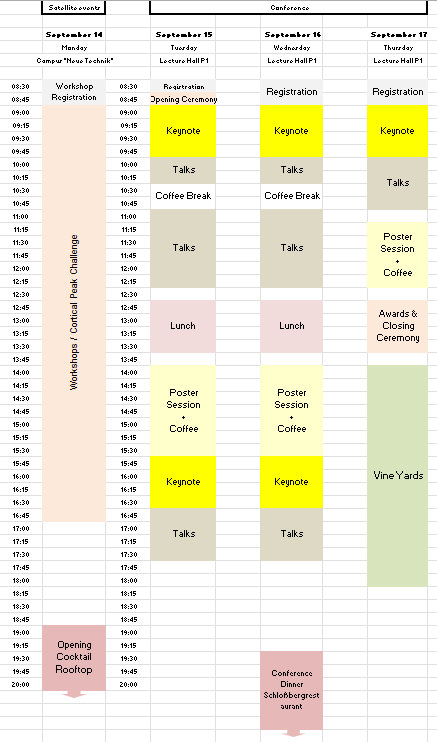
A tentative conference program can be found here. More details about workshops, Cortical Peak Challenge, and the conference itself will be updated soon.
The registration for the conference and workshops is already open.
Keynote speakers
We are very proud to present you the confirmed keynote speakers of the GBCIC2026.
In random order:
Marie-Constance Corsi (Institut du Cerveau / Paris Brain Institute, ICM)
"Neurophysiologically Interpretable Brain-Computer Interfaces for Neurological Disorders: From Decoders to Reliable, User-Centered Systems"
Brain-Computer Interfaces hold transformative potential, yet BCI inefficiency, affecting up to 30% of users, continues to limit their impact. Addressing this challenge requires moving beyond decoder optimization toward a holistic framework integrating neurophysiological mechanisms, adaptive signal processing, and user-centered design. This talk presents a multidisciplinary approach bridging engineering and neuroscience to uncover the neural substrates of BCI skill acquisition. Through analysis of multimodal and longitudinal datasets, we identify performance biomarkers and training predictors that inform next-generation system design. These insights naturally extend to exploring neuronal avalanches, bursts of enhanced neural activity, as both discriminative features and prognostic indicators of user proficiency. Building on this mechanistic understanding, we demonstrate how information enrichment through multimodal integration and ensemble learning enhances mental state detection, with practical implementations released as open-source tools. Finally, we illustrate how these advances enable BCI technologies to transcend traditional communication and control paradigms, opening new avenues for diagnosing and monitoring neurological disorders.
Michael Tangermann (Donders Institute, Radbound University)
Translating Brain-Computer Interfaces
The ability of brain–computer interfaces (BCIs) to decode ongoing brain states has proven useful beyond their original applications, which were primarily focused on control and communication. Over time, BCI approaches have been established in neurorehabilitation settings and now can provide the brain-state estimates required in recent research on adaptive neurotechnologies, including deep brain stimulation, epilepsy treatment, and hearing aids, among others.
With a focus on the data and signal-processing aspects, my lab has contributed to advancing these translational efforts. In this talk, I will share lessons learned, methods that have helped us overcome challenges in this process, and my perspective on how community efforts regarding software and AI methods might accelerate such translations in the future.
Stanisa Raspopovic (Medical University of Vienna)
From Neural Interfaces to Clinical Translation
Abstract: Advances in nervous system interfacing present a promising venue for individuals with different neurological disabilities. Subjects with pain, stroke, or diabetes frequently do not engage fully in everyday activities. They also tend to have reduced mobility, which can induce a sedentary lifestyle that promotes disease development and hinders reinsertion into society, while the neuropathic pain is also common and poorly managed with current medications. Despite a wide range of possibilities for human-machine interfacing, the nature of the optimal human-machine interaction remains poorly understood. We have pioneered a human-machine systems that translates artificial sensors’ read-outs into “language” understandable by the nervous system. The “smart orthosis” for diabetics “speaks” to their residual healthy nerves while diminishing pain. Combination of neuro-stimulating sleeve and exoskeleton restores the independence to highly disabled SCI and stroke patients. These studies not only provided clear evidence of the benefit of neuromodulation for neurologically disabled subjects but also insights into fundamental mechanisms of supraspinal integration of the restored sensory modalities.
Kai J. Miller (Mayo Clinic)
Searching for principles in brain computer interfacing
Abstract:
Gernot Müller-Putz (Graz University of Technology)
35 years of Graz BCI
Abstract: