Cortical Peaks Challenge 2026
With the Cortical Peaks Challenge 2026 we introduce a new brain-computer interface (BCI) based race with a focus on playing entertaining games. We want to make this event as inclusive as possible, which is why we make no restrictions for pilots – everybody is allowed. However, to keep this competition fair there will be a separate score board for able bodied and impaired pilot teams. By including able-bodied pilots, we hope to make this event more accessible for smaller BCI teams.
Game Control
For game control, any type of non-invasive brain-computer interface (BCI) is permitted. The term BCI is used according to the working definition of the BCI Society [1]. Consequently, the intentional use of physiological artifacts, such as eye blinks or teeth clenching, to improve classification performance is not allowed.
Participants may mount an additional display on their wheelchair or place it next to the laptop. This display may be used exclusively for visual feedback and information presentation. It must not be used as an active control interface, including but not limited to SSVEP-based control signals.
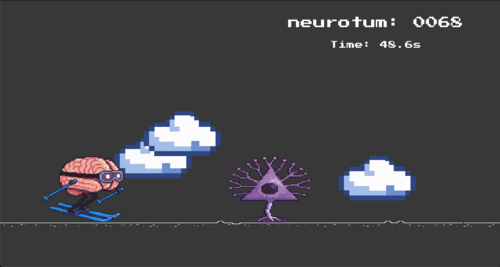
The game control is BCI-agnostic and achieved through exchange of udp packages (an implementation guide will be provided). The game acts as a server, expecting the controls as udp packages from your BCI (client). There will be three binary controls (including rest) and two continuous controls. The same control could be mapped to actions in different games.
About the race:
This BCI race is open to both pilots with spinal cord injury (SCI) and non-disabled pilots. Teams can participate with two pilots — one SCI pilot and one non-disabled pilot.
1 Team Captain
2 Team Members
or
1 Team Captain
1 Team Members
During the event registered people are provided with coffee and fingerfood. Additional members can be registered with EUR 35,- each. Once you have registered, we will contact you with further information regarding the next steps, game access and setup, etc.
Jump + duck →2 binary inputs
Moving obstacles
If you have any questions feel free to reach out to us: mirage91@tugraz.at
Mirage 91 & NeuroTUM