Lukas Maier

Lukas Maier
Dipl.-Ing. Dipl.-Ing. BSc
Phone
+43 316 873 - 30417

About me

I started studying Environmental System Sciences - Natural Sciences/Technology at NAWI Graz in 2017. After completing my bachelor's degree, I pursued master's degrees in Chemical and Pharmaceutical Engineering as well as Biorefinery Engineering. During these studies, I engaged with both the practical application of process engineering through extraction experiments in my first master's thesis and the theoretical consideration of chemical systems in my second thesis. In the latter, I worked on optimizing parameters for a novel activity coefficient model and learned various methods from the field of data science.
Research Focus

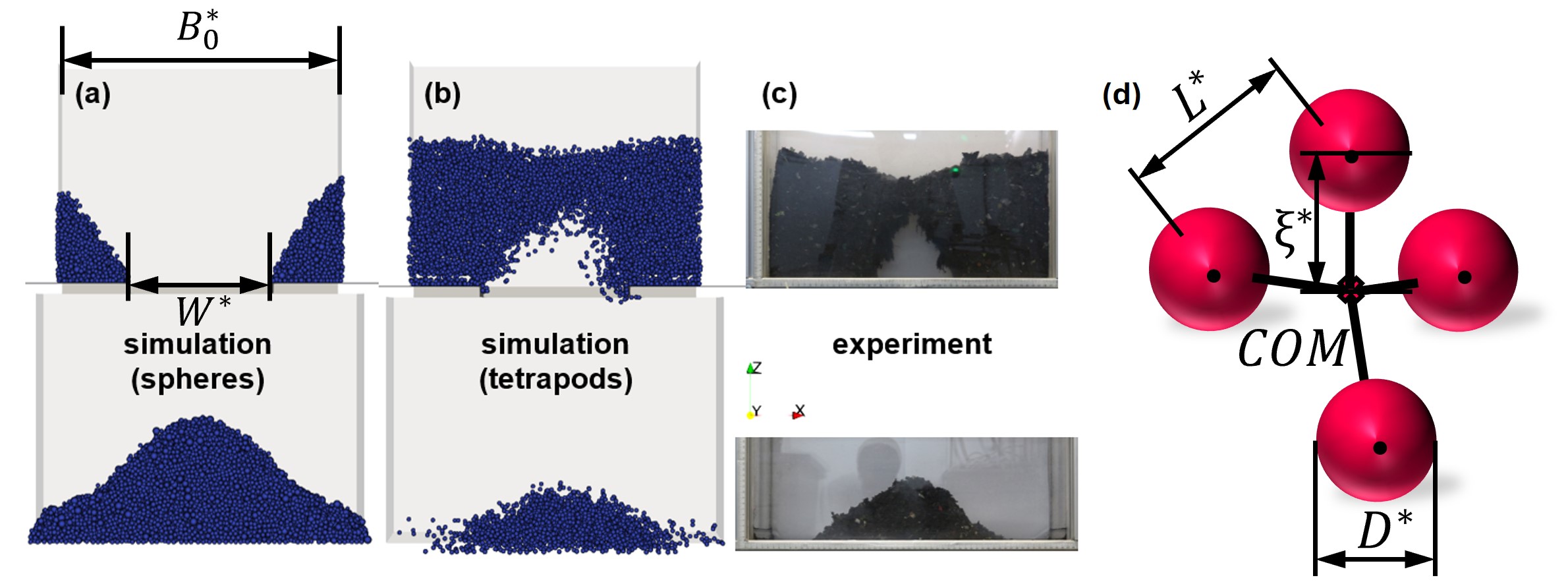
My research combines Discrete Element Method (DEM) simulations with machine learning to understand and predict the behavior of granular materials composed of non-convex particles.
I investigate how particle shapes such as dipods, tripods, and tetrapods lead to interlocking and chaotic dynamics. A key finding is that small changes in initial conditions can cause vastly different outcomes, a phenomenon we systematically quantified and linked to particle geometry.
Using AI-supported analysis across tens of thousands of simulations, I identify the critical parameters that control uncertainty in granular systems and develop methods to minimize computational effort while maximizing prediction accuracy. The goal is to provide reliable simulation guidelines for industrial applications where particle shape variability is unavoidable.

Figure 1: Bridging the gap between simulation and reality: Modeling complex interlocking shapes to predict flow behavior in recycling processes using pod shaped parcels.
Figure 2: Conveying dynamics: While standard spheres settle and slide along the casing floor, the interlocking tetrapods engage with the screw flights, allowing them to be actively transported rather than just pushed.
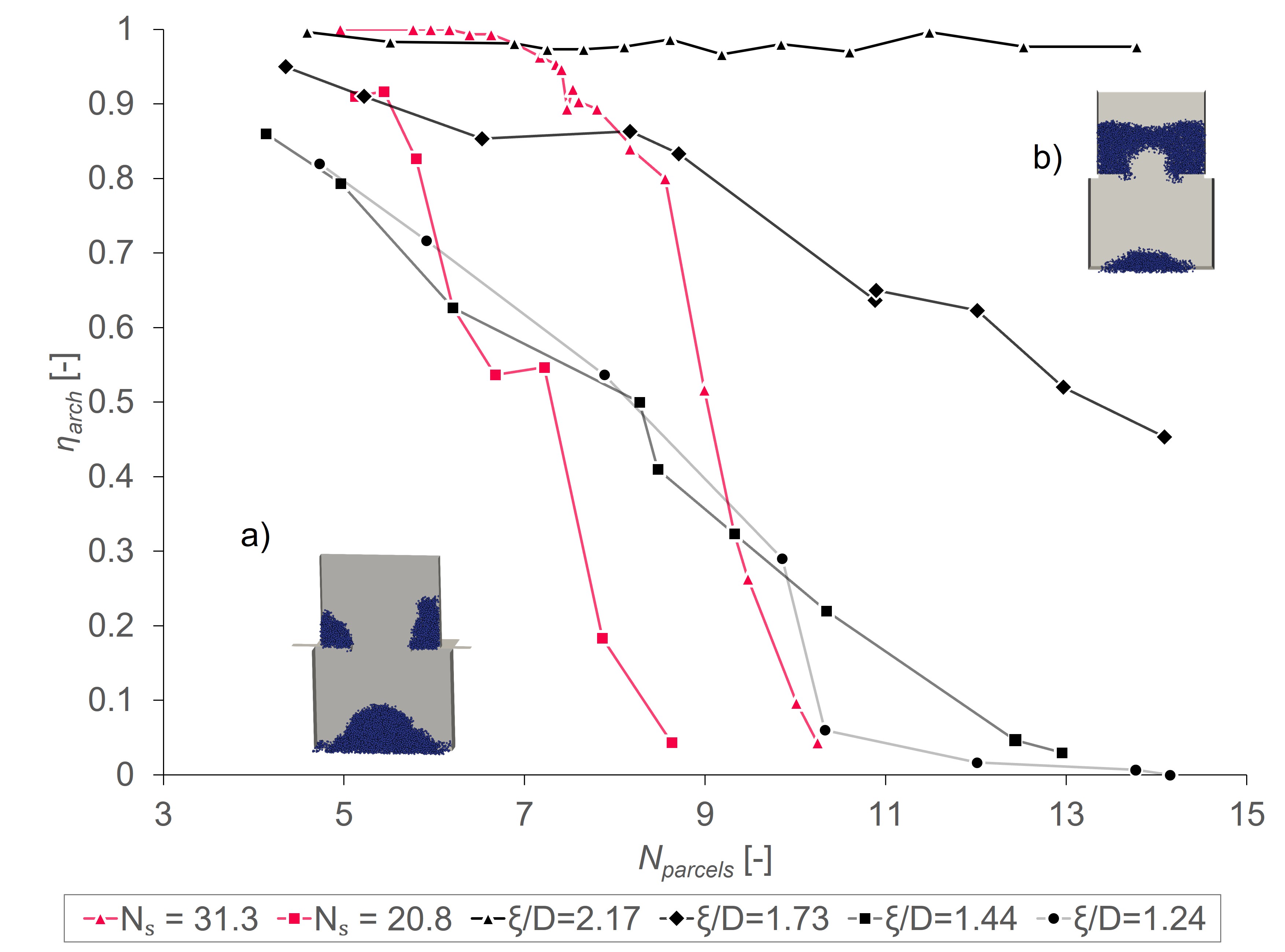
Figure 3: Predicting blockages: The graph correlates the risk of jamming to the size of the tetrapods. The insets illustrate the physical reality behind the data, contrasting free-flowing states with stable arch formations.

Applications

Our findings on chaos and uncertainty in non-convex granular systems have broad industrial relevance:

Recycled Polymer Processing

Shredded plastics and recycled materials are inherently non-convex and irregularly shaped. Our simulation guidelines help predict flow behavior in sorting and processing facilities.

Battery Manufacturing and Recycling

Electrode calendaring and the handling of shredded battery recyclate involve non-convex particle systems where our methods could optimize process parameters.

Pharmaceutical and Chemical Engineering

Powder handling, mixing, and compaction processes involving non-spherical particles benefit from understanding when chaotic behavior emerges.

Computational Cost Reduction

We identified that dipod-like particles require ~100 simulations for statistical convergence, while tripod-like particles require fewer than 40, directly relevant for industrial process design.