
Development Methodology
The increasing dynamism and variety of relationships amongst systems and within systems require new approaches in order for them to be developed. The research area - development methodology - focuses on fundamentals and principles required to tackle future challenges, on the basis of the four interlocking pillars of systems engineering - processes, methods, organization and tools. Furthermore, competences and skills required for future ‘systems engineers’ are being defined to suit future labour markets. Development methodology is also used as an overall framework to connect different competence and research areas of the IME.
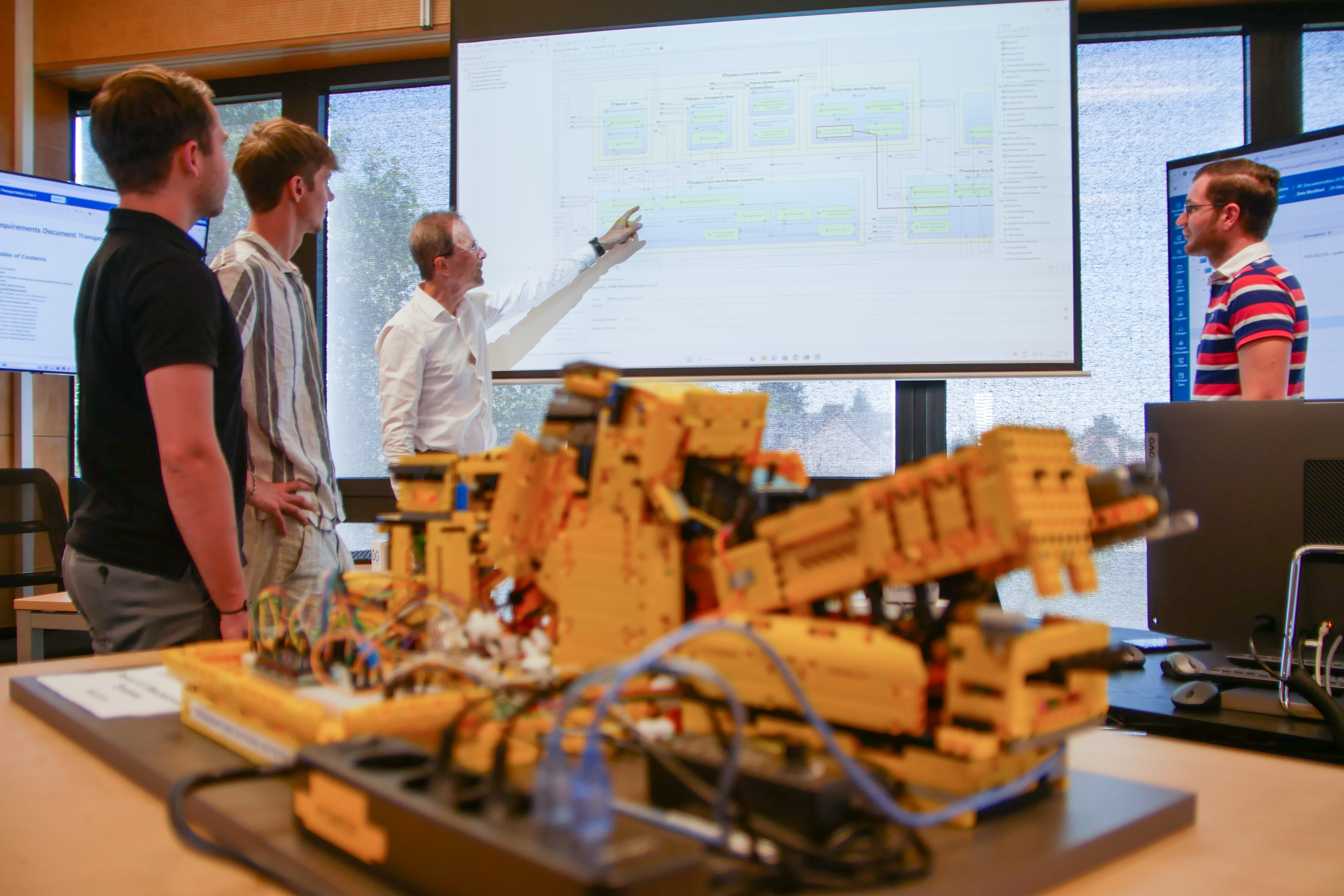
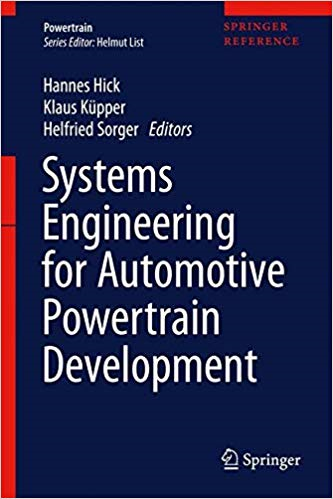
“Systems engineering is an approach, a philosophy for development, that combines well-proven processes, methods, tools, participating engineers (organization) and stakeholders for the development of complex systems. In the scope of technical development, systems engineering is a structured and connected way of thinking and working. Interdisciplinary collaboration and a holistic perspective are of pivotal importance. A discipline-specific perspective is not sufficient to consider all aspects and influences due to the increasing complexity of the systems such as powertrain systems.“ (Bajzek et al. 2020)
Model-based Systems Engineering (MBSE)
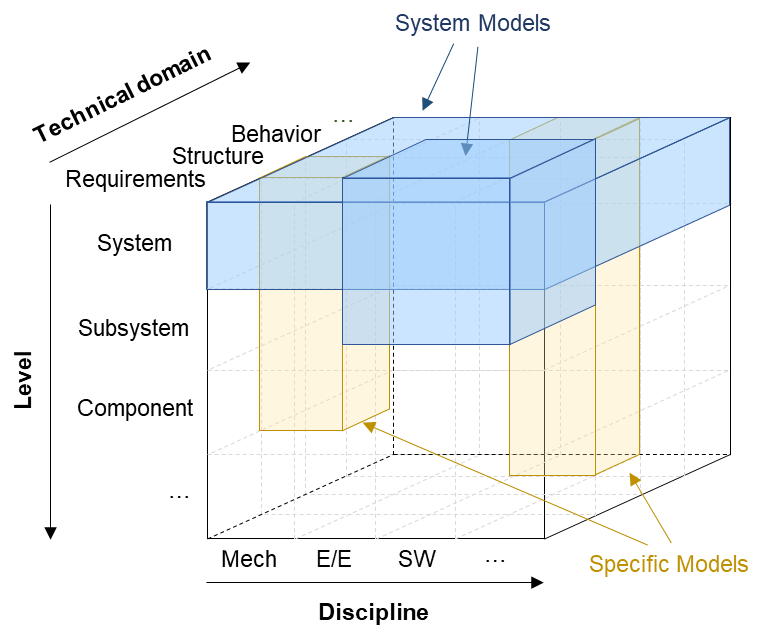
Especially model-based systems engineering (MBSE) brings huge potential with it, and relies on a set of models, which are developed over the course of product development. These models are generated by using related methods and describe the system under development regarding its structure, behavior and requirements. One important task is to develop concepts that support to get an overview of used models thus described system aspects. The figure below shows such a concept developed at the IME:
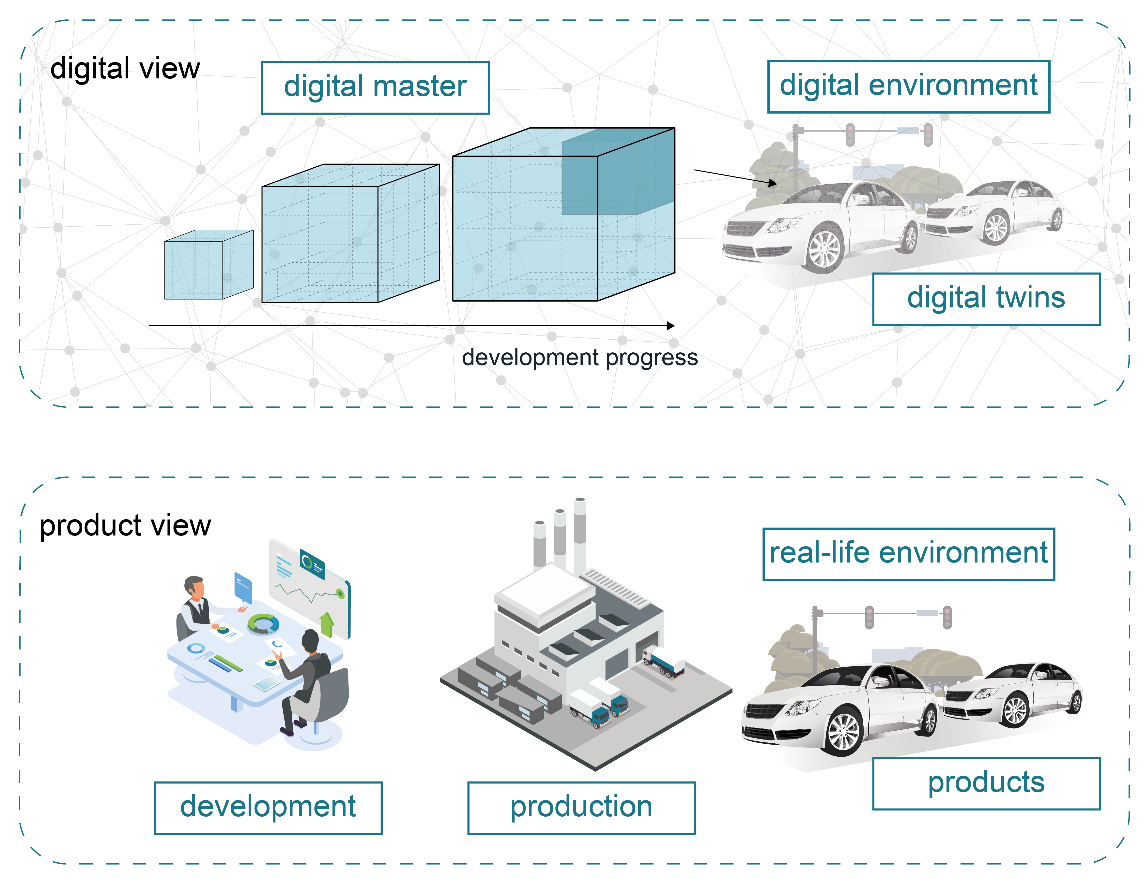
Another topic of interest is the generation of a “digital master” during the development. The base for the digital master is provided by a consistent and connected model-based development approach. MBSE supports this development approach e.g., by providing system models, the necessary methods and related modeling languages.
After the development phase, the digital twin – a digital representation of a physically existing product - is derived from the digital master. Model-based development is a prerequisite to realize this vision of a digital twin and therefore supports development of new business models and provides opportunities for systems optimization in general.
Artificial Intelligence (AI) in Systems Engineering and Product Development
Artificial Intelligence (AI) is reshaping how complex systems are developed. In systems engineering and mechatronic product development, AI enables data-driven insights, intelligent automation and adaptive support across the entire lifecycle, from early requirements analysis to validation and verification.
At the IME, we investigate how AI approaches such as machine learning, including deep learning based on neural networks, as well as AI agents can actively support engineers in handling complexity, exploring design spaces and improving decision quality. This includes discipline-specific design activities such as CAD, as well as verification and validation activities such as simulation, where AI can support modeling, analysis and evaluation tasks.
Integrating AI into development is not just about adding new tools. It requires rethinking the methodological foundation of engineering. Traditional development approaches are largely deterministic and model-based, while AI systems are data-driven, probabilistic and continuously evolving. This shift challenges established concepts of verification, validation, traceability and responsibility.
Our research therefore focuses on developing a new methodological framework that systematically combines model-based systems engineering with data-driven AI approaches. This includes structured lifecycle concepts for AI components, covering data management, training and monitoring, clear integration into existing processes, and well-defined human–AI collaboration models. Transparency, explainability and trust are central design principles.
The goal is to create a robust and future-oriented development environment in which AI is not an add-on, but an integrated and reliable element of interdisciplinary system development, enabling innovation for complex socio-technical systems in industry and research.
Institute of Machine Components and Methods of Development
Inffeldgasse 21b/II
8010 Graz
Tel.: +43 316 873 7361
Fax: +43 316 873 7370
Email: ime@tugraz.at
Web: www.ime.tugraz.at
Bajzek, M., Krems, D., Kollegger, S., Traußnig, T., Dörr, S., Tatschl, M., Kniewallner, J. and Hick, H. 2025. Accelerated Automotive Battery Development to meet Market Opportunities. INCOSE International Symposium, 35: 760-777. https://doi.org/10.1002/iis2.70007
Kranabitl, P., Faustmann, C., Bajzek, M. et al. A fundamental concept for linking methods, system models, and specific models. Discov Appl Sci 6, 2 (2024). https://doi.org/10.1007/s42452-024-05651-5
Hick, H.; Küpper, K.; Sorger, H.; Systems Engineering for Automotive Powertrain Development; Springer; 2020; ISBN 978-3-319-99628-8;in press;
https://www.springer.com/de/book/9783319996288
Grebe, U.; Hick, H.; Rothbart, M.; von Helmolt, R.; Armengaud, E.; Bajzek, M.; Kranabitl, P.; Challenges for Future Automotive Mobility; In: Hick, H.; Küpper, K.; Sorger, H.; Systems Engineering for Automotive Powertrain Development; Springer; 2020; ISBN 978-3-319-99628-8; in press;
https://www.springer.com/de/book/9783319996288
Bajzek, M.; Fritz, J.; Hick, H.; Systems Engineering Principles; In: Hick, H.; Küpper, K.; Sorger, H.; Systems Engineering for Automotive Powertrain Development; Springer; 2020; ISBN 978-3-319-99628-8; in press;
https://www.springer.com/de/book/9783319996288
Bajzek, M.; Fritz, J.; Hick, H.; Maletz, M.; Faustmann, C.; Stieglbauer, G.; Model-Based Systems Engineering Concepts; In: Hick, H.; Küpper, K.; Sorger, H.; Systems Engineering for Automotive Powertrain Development; Springer; 2020; ISBN 978-3-319-99628-8; in press;
https://www.springer.com/de/book/9783319996288
Fischer, R.; Vorbach, S.; Hick, H.; Systems Engineering Organizational Constraints and Responsibilities; In: Hick, H.; Küpper, K.; Sorger, H.; Systems Engineering for Automotive Powertrain Development; Springer; 2020; ISBN 978-3-319-99628-8; in press;
https://www.springer.com/de/book/9783319996288
Hick, H.; Angel, H.-F.; Kranabitl, P.; Wagner-Skacel, J.; Decision-Making and the Influence of the Human Factor; In: Hick, H.; Küpper, K.; Sorger, H.; Systems Engineering for Automotive Powertrain Development; Springer; 2020; ISBN 978-3-319-99628-8; in press;
https://www.springer.com/de/book/9783319996288
Kranabitl, P.; Bajzek, M.; Atzwanger, M.; Schenk, D.; Hick, H.; Automotive Powertrain Development Process; In: Hick, H.; Küpper, K.; Sorger, H.; Systems Engineering for Automotive Powertrain Development; Springer; 2020; ISBN 978-3-319-99628-8; in press;
https://www.springer.com/de/book/9783319996288
Maletz, M.; Bajzek, M; Hick, H.: Systems Engineering Methods for Automotive Powertrain Development; In: Hick, H.; Küpper, K.; Sorger, H.; Systems Engineering for Automotive Powertrain Development; Springer; 2020; ISBN 978-3-319-99628-8; in press;
https://www.springer.com/de/book/9783319996288
Schöffmann, W.; Sorger, H.; Faustmann, C.; Bajzek, M.: Case Study – Engine System Development; In: Hick, H.; Küpper, K.; Sorger, H.; Systems Engineering for Automotive Powertrain Development; Springer; 2020; ISBN 978-3-319-99628-8; in press;
https://www.springer.com/de/book/9783319996288
Faustmann, C.; Kranabitl, P.; Bajzek, M.; Fritz, J.; Hick, H.; Sorger, H.; Future of Systems Engineering; In: Hick, H.; Küpper, K.; Sorger, H.; Systems Engineering for Automotive Powertrain Development; Springer; 2020; ISBN 978-3-319-99628-8; in press;
https://www.springer.com/de/book/9783319996288
Hick, H.; Bajzek, M.; Kranabitl, P.; Faustmann, C.; Erweitertes Digital-Twin-Konzept unter Berücksichtigung des Entwicklers; 2020; Zeitschrift für wirtchaftlichen Fabrikbetrieb; Jahrg. 115 (2020) Special; in press;
https://doi.org/10.3139/104.112302
Walch, S.; Kranabitl, P.; Bajzek, M.; Wobelka, T.; Hick, H.; Kollegger, S.; Model Based Systems Engineering (MBSE) in der Tribologie – Anwendung von SysML-Tool in der Reib- und Verschleißanalyse von Antriebsstrangkomponente; 2019; Österreichische Tribologische Gesellschaft; Symposium 2019;
https://graz.pure.elsevier.com/de/publications/model-based-systems-engineering-in-der-tribologie-anwendung-eines
Hick, H.; Bajzek, M.; Faustmann, C.; Definition of a system model for model-based development; SN Applied Science; 1, 1074; 2019;
https://doi.org/10.1007/s42452-019-1069-0