

Specialisation Module C3:
Load-Bearing Structures for Building Envelopes
Concept and Direction
Stefan Peters, Andreas Trummer
The course is held in cooperation with the IAT design studio and can only be taken in conjunction with design studio 149.666 “Ein Dach am Platz”. Architectural design and structural development are worked on in parallel and coordinated with each other. A roof is designed and structurally engineered for the central regional bus hub at Andreas-Hofer-Platz in Graz.
At the beginning, selected examples will be collected, analyzed, and discussed in terms of their structural principles, material systems, and design logic. In addition, the basics of lightweight structures will be taught. The exercise begins with an experimental exploration of materials and structures using physical working models. The insights gained from this will be incorporated into a verifiable structural and design concept. The use of 3D structural analysis software enables global structural analysis. The results are presented in the form of a physical structural model, drawings, and selected structural design details.
Sign-Up Link
Link to the courses
Link to the institute website

Specialisation Module C3:
Load-Bearing Structures for Building Envelopes
Concept and Direction
Roman Popatnig, Rita Spiegelberg
The building envelope performs space-enclosing and load-bearing functions and offers great potential in terms of construction and design. This semester, the course focuses on element facades made of aluminium and glass.
At the beginning, selected examples of element facades from practice are collected and analysed in order to understand their structural principles, materials and construction logic. In addition, knowledge about typical products, such as profile systems from well-known manufacturers or insulating glass, will be imparted. An excursion and several workshops with representatives from industry will accompany the course. In an accompanying exercise, students will independently construct an element façade.
Sign-Up Link
Link to the courses
Link to the institute website

Specialisation Module C5: Life Cycle Assessment
The Renovation Challenge
Concept and Direction
Giovanna Cassavia, Marcella Ruschi Mendes Saade
The building and construction sector is responsible for nearly 40% of greenhouse gas emissions generated worldwide. Understanding, measuring and predicting their environmental impact is paramount. This course introduces the concept of building sustainability and Life Cycle Assessment, covering the history of labels and certifications, the different tools to measure sustainability and the challenges of the field. The content aims at fostering critical thinking skills for designers to interpret labels, select materials, components and suppliers, and reflect on the environmental sustainability of their designs.
Building upon the concepts of sustainable construction, this course dives into the Life Cycle Assessment (LCA) of buildings, covering the stages to perform an LCA according to International and European Standards, namely (i) goal and scope definition, (ii) inventory analysis (databases and data collection), (iii) impact assessment (classification and characterization) and (iv) interpretation. In the practical portion of the course, students shall apply LCA to a structural system. By the end of this course, students will be able to integrate life cycle thinking into their designs, understand the usefulness of life cycle assessment softwares and gain a better understanding of the resources available to them.
In the practical portion of the Life Cycle Assessment II course, by performing a Life Cycle Assessment of a structural system, students shall master life cycle assessment calculation for whole building systems and their components. Moreover, students will learn to interpret results and make integrated design decisions considering the environmental impact. Special focus shall be given to the global warming potential of the design, but other environmental impact categories will also be covered.
Sign-Up Link
Link to the courses
Link to the institute website

Specialisation Module C7: Architecture and Design Theory
Peter Hellweger: Architekturzeichnungen
Concept and Direction
Daniel Gethmann, Nelly Sanjta
Das Vertiefungsmodul beschäftigt sich mit Architekturzeichnungen als zentralem Ausdrucksmittel des architektonischen Entwurfs, insbesondere mit Architekturzeichnungen von Peter Hellweger. Hellweger studierte in Graz Architektur und arbeitete an der TU Graz als Assistent bei Günther Domenig, sowie später in seinem eigenen Architekturbüro. Dabei entwickelte er einen besonderen Zeichenstil, der in zahlreichen Arbeiten fassbar wird. Sein Werk ist nahezu unbekannt geblieben – es sichtbar zu machen, ist die Intention dieses Moduls. Dazu stellen wir nach einer intensiven Auseinandersetzung mit Architekturzeichnungen eine Ausstellung von Arbeiten Peter Hellwegers zusammen.

Specialisation Module C8: History of Architecture and Art History
Wer hat Angst vor dem Barock?
Concept and Direction
Julian Mändl, Anselm Wagner
Barockarchitektur gilt allgemein immer noch oft als schwülstig, überladen und politisch inkorrekt. Das Vertiefungsmodul versucht diesen (Vor-)Urteilen auf den Grund zu gehen, die meist auf den normativen Geschmacksvorstellungen des Klassizismus beruhen. Über die Lektüre ausgewählter kunsthistorischer und theoretischer Texte und Exkursionen (4.–8. Mai) zu ausgewählten Barockbauten in Graz, Salzburg, Niederösterreich und Wien soll ein neuer Blick auf den Barock entwickelt werden.

Specialisation Module C12: Urban Studies
Re:vive Annenstraße
Concept and Direction
Sabine Bauer, Barbara Russo, Eva Schwab
Vacant shops and ground floor areas are the bane of urban development: changes in retail structures have a major impact on the quality of public space and public life in cities. Closed shops with billboards instead of shop windows, less activity on the streets, security concerns—this is the common spiral of thought. While it is clear that city centres have long since lost the battle for customers to retail parks, shopping centres and online retailers, the obvious is being over- looked: reconceptualising/repurposing the ground floor is a good tool for improving the quality of life of an entire neighbourhood. Vacant properties are to be seen as spaces of opportunity for new ideas for living and doing business in the city. Which uses can be successful depends not only on the structural possibilities of the ground floor premises, but just as much on the dynamics of the surrounding area and the quality of the public space in front of them.
The Re:Space Annenstraße project, part of the Grazer municipal environmental programme ÖKO-PROFIT, aims to promote the reuse of vacant properties and the renovation of existing buildings in the Annenstraße area by encouraging owners to take action and carrying out visible activities.
Together with Re:Space, we want to design, implement, document, and reflect on spatial experiments and temporary actions in the vacant properties on Annenstraße as participatory practices. Seminars focus on theories and methods of participation as well as on-site analysis and conception of the participatory intervention, which will be carried out in a workshop in May.

Specialisation Module C13: History and Theory of the Human Settlement
Permanenz im Städtebau – Arles
Concept and Direction
Aglaée Degros, Alice Steiner, Anselm Wagner
Städte bestehen nicht nur aus Neubauten, sondern aus historischen Überlagerungen und Schichten. Gebäude, Räume und Typologien überdauern Jahrhunderte, passen sich an, werden umgedeutet und weitergenutzt. Arles ist ein außergewöhnliches Beispiel für diese Permanenz.
Von der römischen Antike bis zur Gegenwart überlagern sich hier architektonische Strukturen, städtische Ordnungen und Bedeutungen. Die Stadt wird lesbar als Kontinuität im Wandel. Ausgehend von Aldo Rossis Begriff der Permanenz verstehen wir Stadt nicht als Abfolge von Brüchen, sondern als fortlaufende Transformation bestehender Strukturen. Es werden theoretische und historische Grundlagen über die Stadtentwicklung von Arles als Schichtung von Zeiten aufbauend auf Aldo Rossis „Architektur der Stadt“ erarbeitet und analysiert.
Im zweiten Teil untersuchen wir vor Ort konkrete Bauwerke und ihr städtebauliches Umfeld. Historische Gebäude, wie das Amphitheater, werden als Träger von Permanenz und Veränderung gelesen. Auf dieser Basis entstehen keine klassischen Architekturentwürfe, sondern spekulative Möglichkeitsräume. Wir fragen nicht, wie Gebäude neu gestaltet werden müssen, sondern wie ihre dauerhaften räumlichen und typologischen Qualitäten weitergedacht, neu interpretiert und zeitgemäß genutzt werden können. Permanenz wird dabei nicht als Stillstand verstanden, sondern als produktive Konstante und als Schlüssel, um die Stadt des 21. Jahrhunderts neu zu denken.

Specialisation Module C14: Urban Habitat—Designing the Ecological Turn
Living Architecture. The Architectural Practice of Living in and with Trees
Concept and Direction
Patrik Drechsler, Jennifer Raum, Marlene Schneider
What does it mean to be alive? And how is architecture designed when we take this question seriously, not only for humans, but also for trees, fungi, soils, animals, and the countless forms of life that co-create our environments?
WHAT?
The Specialization Module The Architecture of Living in and with Trees places the living at the center of architectural thinking and explicitly addresses the urgent need to rethink how architectural design is taught in the face of ecological transformation. It begins with a simple but transformative idea: every species inhabits its own lifeworld. Trees, fungi, humans, and soils each exist differently, but none exists alone. For architecture, this means rethinking buildings as participants within ecological and social worlds. We are convinced that this will shape the future of design, and that design pedagogy must evolve accordingly to equip students with the conceptual and methodological tools to work within living systems rather than against them.
HOW?
In this seminar, trees offer a clear insight into one essential condition: living is always co-living. Trees co-produce climate, soil, atmosphere, and habitat. They regulate temperature, store carbon, host species, connect to fungal networks, and shape social realities. Architecture is therefore part of intertwined social and ecological processes rather than external to them. Accordingly, the course reframes architectural training itself: students are not positioned as external form-givers, but as situated actors within complex ecological relations, requiring new modes of observation, representation, and design decision-making.
WHY?
Through thinking, drawing, and research, students explore architecture as embedded in ecological networks and responsive to more-than-human agencies. In doing so, the module advances a necessary adaptation of students’ architectural knowing: from object-centered problem-solving to process-oriented, life-centered design methodologies capable of addressing the climatic, ecological, and societal challenges of the present.
Sign-Up Link
Link to the courses
Link to the institute website

Specialisation Module C16: Architecture Technology
ReSett: Architecture from Re-Used Concrete Stones
Concept and Direction
Lukas Imhof, Markus Jeschaunig, Matthias Lang-Raudaschl, Marisol Vidal
Concrete composite blocks are a building material that often accumulates during the demolition of buildings or outdoor facilities. There is great interest in the “harvesting” (urban mining) of already manufactured, no longer needed, and re-usable concrete components in a future circular construction industry. As a CO2-intensive material, the reuse of concrete is a lever for reducing emissions.
The ReSett course takes a practical, creative, and theoretical approach to examining the reusability of used concrete paving stones in more detail. The aim is to generate knowledge about the manufacture of components from concrete paving stones. In the seminar part, the building material will be examined in terms of its handling/workability, suitability as a building component (e.g., static aspects), and spatial effect. In the practical part, up to 1:1 prototypes will be carried out to explore the design and construction applications in building construction.


Specialisation Module C18: Spatial Design
Lumberjack’s Hut: The Deconstruction
Concept and Direction
Rainer Eberl, Alex Lehnerer, Pia Pollak
The lumberjack's hut stands in the narrow Enns Valley in the Gesäuse region. Above the river, long unused, the massive log construction defies the weather. Some shingles have fallen off, but the natural stone foundation keeps the hut firmly on the ground. We recently acquired it for little money, with the promise of putting it to use again – in a different location. Thus, the lumberjack's hut, built in 1903, became our research object and the location for this course.
The first act will be to dismantle the hut. Here we will learn the craft of joining logs by doing the opposite, loosening historical wood joints. Through this reversed construction process, we will learn a lot about the hut and building.
At the same time, we will consider what we want to do with the hut, where it should be located and what should happen in it.
In order to be able to dismantle the hut during the intensive week, the logistics of the dismantling and the necessary resources must be planned precisely. Among other things, a construction site plan and a quote from a local scaffolding contractor and haulage company with a suitable crane will be required. Not to be forgotten is finding a sunny spot where we will then, in the next course, plan the foundations for the reconstruction.
We are now looking for students who enjoy manual and physical work and share our optimism that we can give the lumberjack's hut from the Gesäuse a second life. And gain a wealth of knowledge.
Sign-Up Link
Link to the courses
Link to the institute website
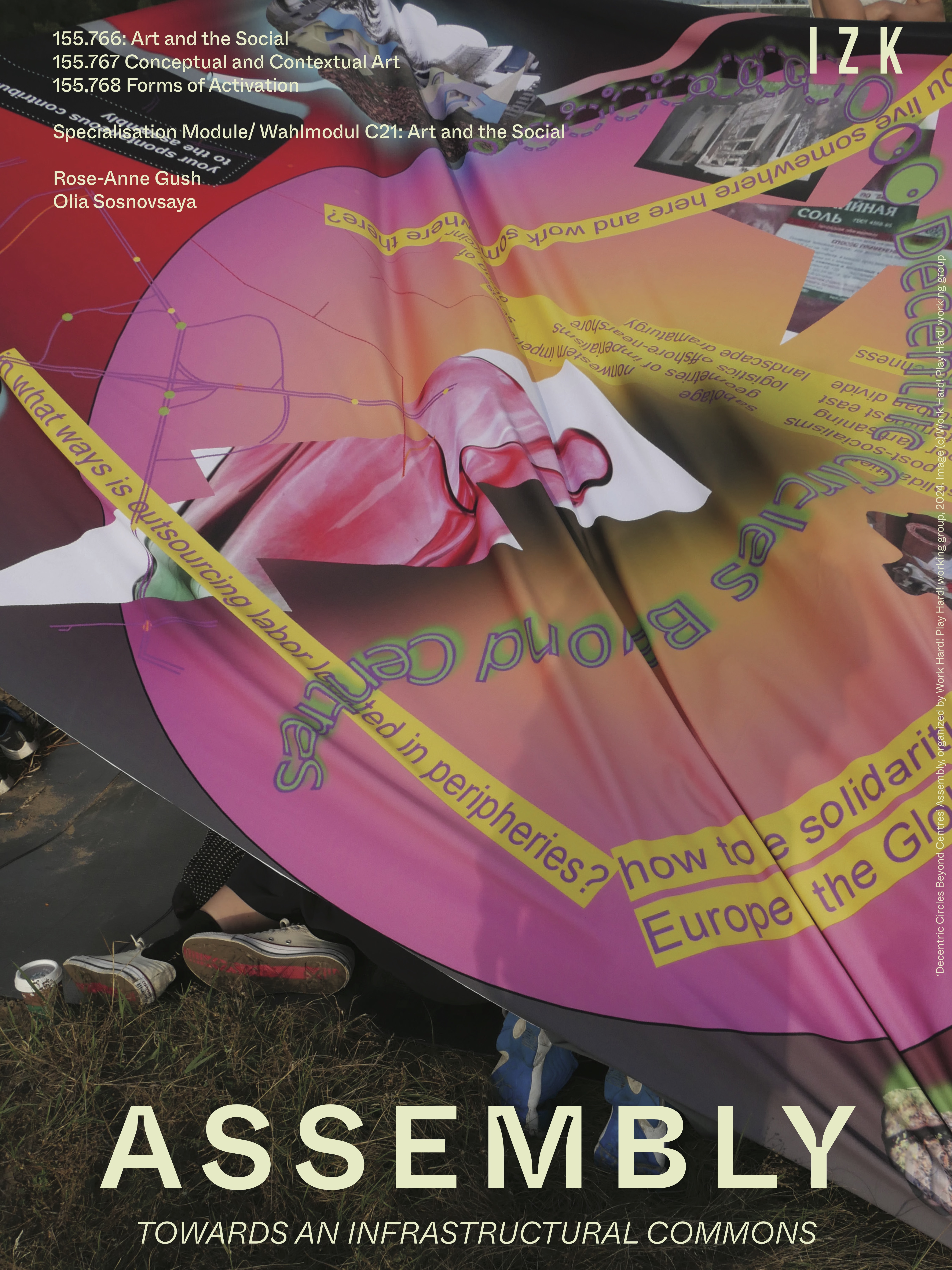
Specialisation Module C21: Art and the Social
Assembly: Towards an Infrastructural Commons
Concept and Direction
Rose-Anne Gush, Olia Sosnovskaya
This semester, the course Art and the Social takes the assembly – a political form of gathering together, (un) learning, protesting, or for processes of deliberative decision-making – as a frame to explore art’s relationship to society. Focusing on assemblies ‘from below’, we will begin by asking: what underpins an assembly? What infrastructures enable speaking, gathering, surfacing materials, showing histories, and amplifying marginalised voices? In short: what kinds of infrastructures make assemblies possible, and what social effects do these infrastructures produce? A core element of the course is a three-day field-work assembly at Museum Peršmanhof, located at the Austrian-Slovenian border. Once a home to families who hosted partisans who resisted Nazis during WWII, the site later became a Nazi crime scene at the end of the war. Today, this unique museum functions as form of social infrastructure, a place of both remembrance and anti-fascist learning. During this intensive research assembly, students will engage directly with the site, its location in the mountains, and its histories, thereby developing field-work methodologies including oral history, sound recording, sketching, site writing, to engage with and uncover hidden, or overlooked narratives within the landscape.
Theoretical foundations for the course will include feminist, ecological and decolonial perspectives, as well as Lauren Berlant’s ‘infrastructural commons’, Marina Vishmidt’s ‘infrastructural critique’, Henri Lefebvre’s ‘production of space’, Kristin Ross’ idea of political memory and the ‘commune form’, and Andreas Malm’s notion of ‘partisan nature’. Through these frameworks, we will move beyond viewing art as a static object, instead approaching artistic practice as a living social process – one centered on the assembly and the infrastructures that activate it. This is a collaborative course built on research, critical discussion, and the development of individual artistic practices within a larger group project. It will culminate in a student-developed assembly, for which students will determine what is needed – conceptually, socially, and materially – to bring it into being. Materials for the physical site of the assembly may include wood, metal, textiles, cardboard, lights, projection, film, photography, sound, drawings, readymade or found objects. These elements should be brought together to form a spatial, performative, and discursive structure – one designed for collective engagement with
the findings of the fieldwork – the histories, documents, stories, and lived experiences produced during the Peršmanhof Assembly.

Specialisation Module C25: Building Energy Performance
Sustainable Drinking Water and Architecture
Concept and Direction
Markus Bartaky, Brian Cody, Chengbin Xu
Drinking water is fundamental to everyday life—from consumption and cooking to hygiene—yet its provision accounts for an estimated 0.48% of global CO₂. While adults are generally recommended to consume around 2–3 liters of water per day, more than 2.1 billion people worldwide still lack access to safely managed drinking water, including millions who rely on untreated surface sources.
Water inequality is a global challenge affecting both developing and developed regions. Although South Asia and sub-Saharan Africa experience the most severe deficits, water insecurity also exists in Arctic and high-latitude regions such as Alaska, Russia, and Greenland, where extreme climate conditions, aging infrastructure, and energy dependence complicate access to water.
This course explores the intersection of drinking water, energy performance, and architecture, examining how architectural design can respond to diverse regional water challenges. Students will investigate how buildings and urban systems can integrate water harvesting, treatment, storage, and distribution while minimizing carbon emissions through renewable energy and efficient design strategies. By engaging with water, energy, and carbon flows, students will reimagine architecture as an active agent in addressing water, sanitation, and hygiene (WASH), positioning access to drinking water as both a spatial and environmental responsibility.

Specialisation Module C26: Energy Design
Sustainable Sleep and Architecture
Concept and Direction
Markus Bartaky, Brian Cody, Isik Ülkün Neusser
Sleep is an activity that occupies nearly a third of human life. Sleep accounts for a large share of residential building emissions—about one-third of housing’s operational and embodied carbon and 8% of global CO₂. With extensive existing floor area and ongoing new construction, reducing these impacts is a critical challenge and a key role for architecture.
This semester, the course Energy Design focuses on Sustainable Sleep and Architecture. We explore the question: how can architecture contribute to reducing sleep-related carbon emissions by rethinking this essential human activity and the role of architecture in supporting it? The course emphasizes the environmental qualities of sleeping areas—including acoustic, air quality, thermal, and visual aspects—as well as energy-related considerations, which strongly influence spatial organization and overall comfort.
The task is to develop new floor plan configurations by rethinking the function of sleep. Students will work with a given typical floor plan of a proposed high-rise residential building in Berlin, configuring both new apartment layouts and façades The overarching goal of the course is to develop new typologies for apartment layouts that maximize comfort and provide a high-quality living environment, while integrating energy efficiency, and user adaptability aiming to reduce future sleep related CO₂ emissions.

Specialisation Module C28: Current Topics: Architecture and Media
Sonic Tectonics
Concept and Direction
Christian Freißling, Urs Hirschberg
This semester, the advanced module „Current Topics in Architecture and Media“ explores the technical possibilities of Virtual Reality (VR). The topic is „Sonic Tectonics“—we investigate the phenomena of sound production in analog musical instruments and explore their mechanical inner workings as architecture that can be experienced in virtual space.
As part of this course, students create kinetic structures as content for virtual reality applications using Rhino, Unreal Engine, and special effects programs, thereby learning about the phenomena of immersion and interaction in virtual space. State-of-the-art VR hardware is available at the institute.