
141.666 | Broadway
Concept and Direction
Matthias Castorph, Till Philipp Göggelmann, Matthias Lorenz
Das Dreispitzareal in Basel ist eines der letzten großen Entwicklungsareale, das der Stadt zur Verfügung steht. Früher als Handels- und Umschlagsplatz für die Güter der Stadt genutzt, soll das Areal – über die Zwischennutzungen hinaus – zu einem lebenswerten Quartier für Wohnen, Freizeit und Arbeit werden.
Im Kontext der vorgefundenen Architekturen, Strukturen und Atmosphären arbeiten wir mit dem Bestand. Wir entwerfen Wohn- und Geschäftshäuser zwischen Gasse, Boulevard und Platz. Stadthäuser, die mit ihrer architektonischen Kraft auf die städtebauliche Transformation und in die Zukunft wirken.
Aufgabe ist der Ersatz-/Neubau eines Wohn- und Geschäftshauses auf einer Parzelle des bestehenden Industriequartiers. Wir entwerfen das Haus, unsere eigene Straße und den Platz am „Broadway“ – an der Frankfurtstraße.

145.666 | Bioregion Plabutsch
Concept and Direction
Karina Brünner, Aglaée Degros
Urban development today is increasingly shaped by global supply chains, large-scale territorial consumption, and the separation of production from everyday life. The relationship between built structures and their territorial context is often weakened, while local knowledge, resources, and work processes are rarely incorporated into urban processes. The result is urban spaces that consume territory without responding to ecological limits or social structures.
The area of Gösting in Graz, located along Plabutscherstraße 63, reflects these conditions. Located between residential neighbourhoods, infrastructure corridors, former productive sites, and surrounding landscapes, the area is part of a broader bioregion where material flows and ecological systems intersect. At the same time local resources, existing building stock, and neighbourhood potential remain underused in contemporary development models.
This master studio investigates how architecture and urbanism can operate as mediators between territory, resources, and collective life, understanding the bioregion as a framework for spatial transformation. Inspired by practices that work with locally sourced, reused, and cultivated materials, the studio explores urban design strategies based on locality, reuse, and cooperation with local actors.
Students will analyse territorial structures, ecological processes, and social networks and translate these findings into spatial concepts. The studio focuses on understanding the region as a resource landscape, including existing buildings and potential sources of materials such as agricultural residues. These strategies foster regenerative relationships between soil, the built environment, and human and non-human communities.
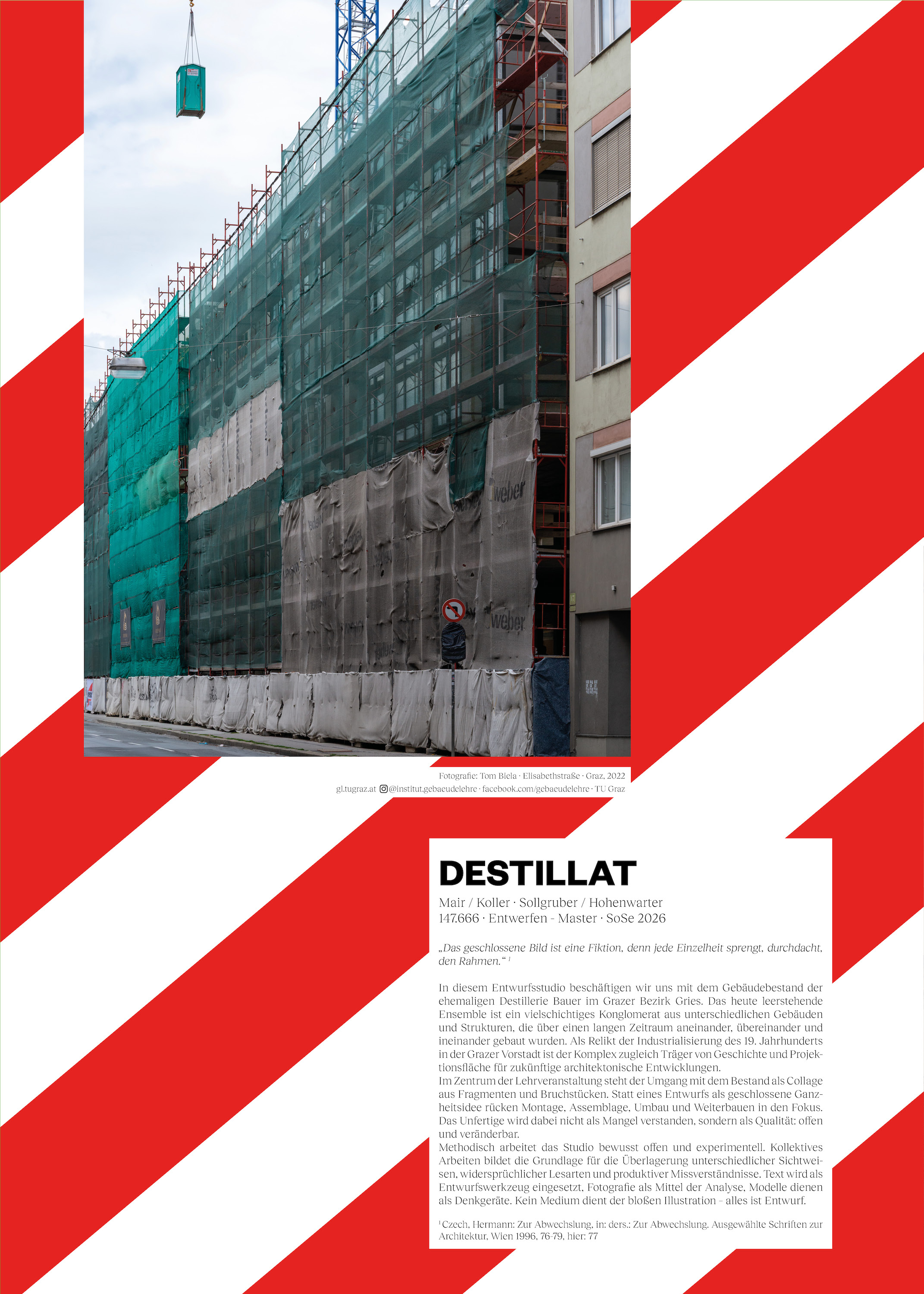
147.666 | Destillat
Concept and Direction
Katharina Hohenwarter, Elisabeth Koller, Eva Mair, Eva Sollgruber
Das geschlossene Bild ist eine Fiktion, denn jede Einzelheit sprengt, durchdacht, den Rahmen.
– Hermann Czech: Zur Abwechslung
In this design studio, we are working on the building stock of the former Bauer distillery in the Gries district of Graz. The complex, which is now empty, is a multi-layered conglomerate of different buildings and structures that were built next to, on top of, and inside each other over a long period of time. As a relic of 19th-century industrialization in the suburbs of Graz, the complex is both a bearer of history and a projection screen for future architectural developments.
This course focuses on treating the existing building as a collage of fragments and pieces. Rather than designing a closed, finished concept, the emphasis is placed on montage, assemblage, conversion and further construction. The unfinished is not viewed as a deficiency, but as a positive quality that allows for openness and adaptability.
Methodologically, the studio deliberately works in an open and experimental manner. Collective work forms the basis for superimposing different perspectives, contradictory interpretations, and productive misunderstandings. Text is used as a design tool, photography as a means of analysis and models as thinking devices. No medium is used merely for illustration – everything is design.

149.666 | Squaring The Roof: Spanning Andreas Hofer Platz
Concept and Direction
Lukas Imhof, Patrick Pazdzior
Andreas Hofer Platz: historically complex and defined by movement and transit. Here, bus lines intersect, people wait, change buses, and disappear again. The assignment is to create a roof for this place—an infrastructure that offers protection and forms a public space. The roof is complemented by small-scale uses. Simple constructions, intelligent structural design, and a high level of detail are central.
We do not design linearly from urban planning to detail. We use images as a recursive design and construction tool, oscillating between scales, different media, and references from architectural history. The design process is accompanied by the ITE's specialization module “Load-bearing structures for building envelopes.” The bus lanes, neighboring building, and the underground garage below set the parameters that call for sophisticated solutions.
With remixes of historical and contemporary architectural images, we seek to capture the atmosphere and translate it into constructible architecture. Renderings, AI-generated and hand-drawn images—large scale and small detail—make construction and expression the central focus. We undertake a school of vision and examine constructive design as a back-and-forth between scales and media.

149.666 | Drin, Dran, Obendruff: Layers of Building upon the Existing
Concept and Direction
Tom Kaden, Hannah Melzer
The industrial housing construction of the GDR is characterised by a variety of types and series, as well as recurring structural rhythms. Order, repetition and durability are evident in Berlin's prefabricated buildings. The early IW types mark a phase of transition amidst the network characterised by the aforementioned aspects. Their design is characterised by a limited, realised, constructively sober and modular arrangement, and by the serial logic of prefabricated building elements.
The IW-57 type represents systemic rationality and marks the beginning of a new stratification. The extension of the IW 57 aims to build on and expand the existing stock. The goal is to create new living spaces that are carefully intertwined with the supporting structure, intended use, and urban context. As part of a detailed system analysis, concepts are developed that consider the supporting structure, building physics and the process requirements of timber construction as integral components. Wood is the primary construction material. From concept to detail, system elements and connections are designed as part of a precise, prefabricated and recyclable construction process balancing efficiency, material awareness and spatial quality.


151.666 | Gebäude haben keine Gefühle
Concept and Direction
Alex Lehnerer, Pia Pollak, Ferdinand Schmölzer
Können Häuser sich hassen? Können sie lieben oder Humor haben? Können sie weinen, wenn sich das Gegenüber von ihnen abwendet?
Wir stellen Gebäude in Beziehung – lassen sie aufeinandertreffen, sich überschatten, annähern, austauschen. Wir suchen Bedeutung und Menschlichkeit in ihrer stillen, kalten Bausubstanz. Mit Phrasen wie „introvertierter Block“ oder „freundlicher Eingangsbereich“ werfen wir Architekt*innen unsere Sachlichkeit über Bord und wiegen uns in der Sicherheit, dass wir – wo andere begründen müssen – einfach „spüren“ können.
Dieses Frühlingssemester werden wir ein Haus für ein Haus entwerfen – und zwar für eines, das wir bereits kennen. Die Beziehung dieser beiden ist weder tektonisch noch strukturell. Sie berühren sich nicht und doch gibt es da etwas zwischen ihnen, das sie zu verbinden scheint – etwas, das wir in ihren emotionalen Zwischenraum hineininterpretieren.
Ausgewählte Ikonen der letzten paar hundert Jahre Architekturgeschichte bekommen von uns ein Gegenüber, ein Dahinter, ein Daneben… Es stellen sich Fragen nach Identität und Differenz: Ich will nicht gleich sein wie mein Bruder, doch ist unsere Ähnlichkeit unleugbar. Eva ist nicht Adams Ebenbild, und doch entstand sie aus seiner Rippe, übernahm seine Struktur.
Über unser Referenzgebäude sind wir gezwungen, uns selbst und unsere Häuser zu positionieren. Städtebau funktioniert auf einmal nicht anders als eine Familienaufstellung; die architektonische Setzung bedeutet nichts anderes als eine gebaute Affektreaktion zweier Charaktere.
Und doch müssen wir uns immer wieder fragen: Haben Häuser wirklich Gefühle?
Ein Gebäude schreit nicht, wenn ich in die Wand bohre, und es erstickt auch nicht, wenn ich es bis ins letzte Eck mit einer Dampfsperre einpacke. Es schimmelt vielleicht hier und dort, doch seine Struktur bleibt bestehen. Ist es nicht einfach Ausdruck unserer menschlichen Egomanie, in allen Dingen immer Abbilder unserer selbst sehen zu wollen?
Ja, jetzt sind wir uns endlich sicher:
Gebäude haben keine Gefühle.
Gebäude haben keine Gefühle.
Gebäude haben keine Gefühle.
… oder?

153.666 | Habitat. A Forest School Made of Living Things in Guinea-Bissau
Concept and Direction
Jennifer Raum, Silvia Claudia Rodrigues Benedito
This Studio examines the act of building through the lens of Habitat, defined by the United Nations as a “place where an organism or population (human, animal, plant, microorganism) lives.” When anchored to the agency of architecture, the notion of Habitat encompasses multiple scales of intervention and temporal frameworks, highlighting the daily interdependencies between humans and non-humans, fostering sovereignty and integrated well-being.
WHERE?
The Studio explores this notion of Habitat within a network of small villages (Tabancas) located adjacent to their Community Forest in the northern Oio Region of Guinea-Bissau, West Africa. It builds upon a desire expressed by these villages and the local NGO (namely, KAFO) to establish a school for children aged 6–12, where they can learn about their environment, culture, and biodiversity through embodied experience aligned with traditional and contemporary knowledge. By using the Community Forest as a grounding site and a living laboratory for learning and interaction, the Studio also highlights its importance as a biodiversity hotspot against the advancement of the Sahel to the North and the place where communities sustain their daily livelihoods—a place of deep symbolic significance and nutrition sovereignty in the context of climatic vulnerability. The Forest-School project is thus intertwined with key objectives including climatic comfort, regard for notions of sacredness, and the optimization of resources. It achieves this by examining local practices of stewardship toward the “living things” and employing traditional construction methods.
HOW?
The Forest-School studio program will delve in the notion of Habitat as a methodology of forming space aligned with climatic adaptation principles, collective action and resource stewardship. Throughout 14 weeks, the Studio will examine the local living-materials and vernacular typologies, tectonics and techniques, as well as the challenges and possibilities arising from human and non-human interactions. The program will also engage with more intangible dimensions, including the rhythms of natural cycles (water, fire, heat, and wind), temporalities of production, cultural expressions, and notions of collective enterprise. While the Forest-School program is informed by the requirements expressed by local communities and NGOs, students are expected to develop a critical position on how the project can be further nurtured and cared for.
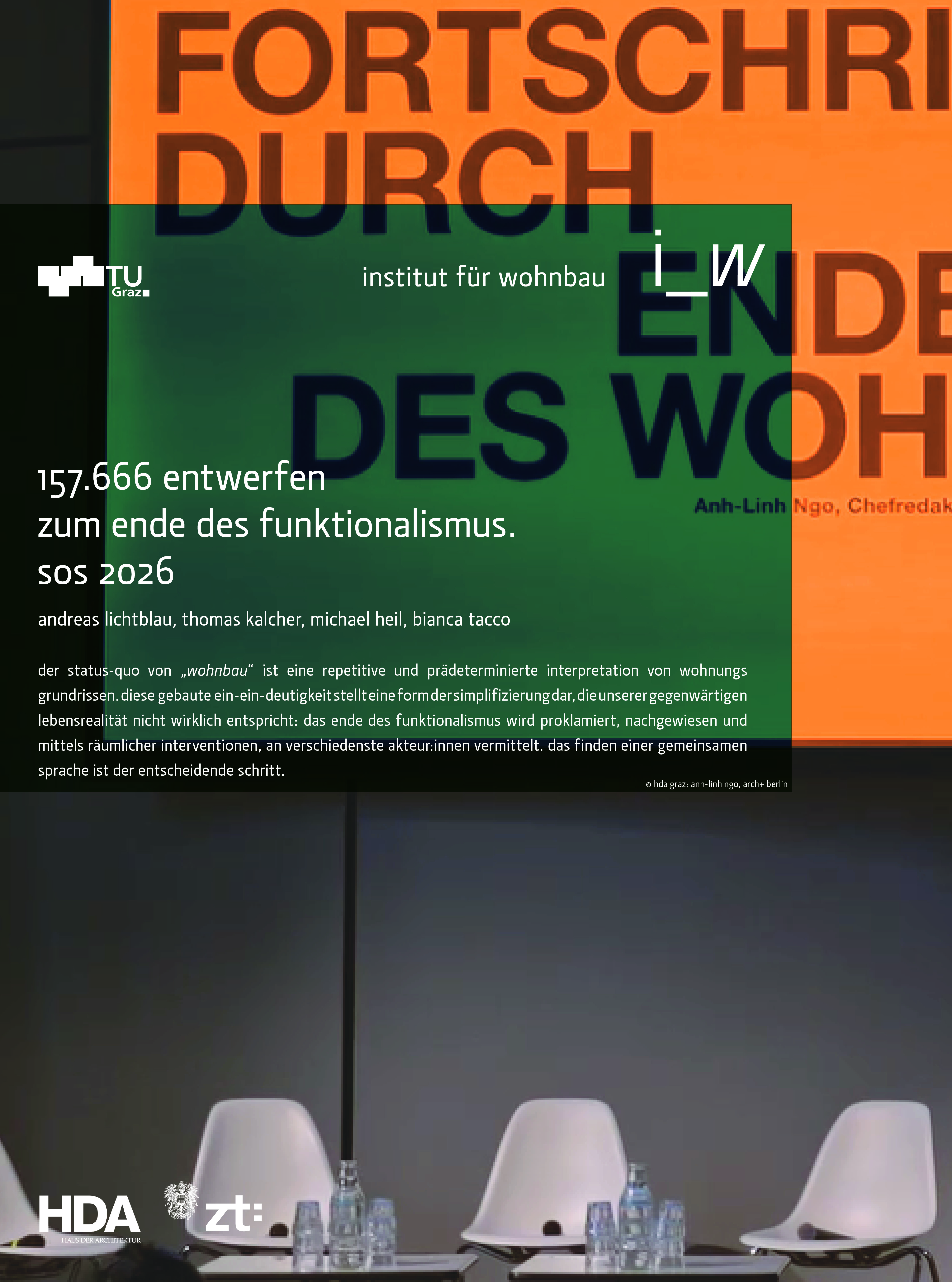
157.666 | Zum Ende des Funktionalismus
Concept and Direction
Michael Heil, Thomas Kalcher, Andreas Lichtblau, Bianca Tacco
Jede Übersetzung ist in erster Linie das Ergebnis eines Gestaltungsprozesses von Sprache als Material, der nicht aus der Beschäftigung mit einem Gegenstand erwächst, sondern aus der Beschäftigung mit der Spannung zwischen zwei Arten der Behandlung eines Gegenstandes.
– Esther Kinsky, Fremdsprechen
Der status-quo von „Wohnbau“ ist eine repetitive und prädeterminierte Interpretation von Wohnungsgrundrissen. Diese gebaute Ein-Ein-Deutigkeit stellt eine Form der Simplifizierung dar, die unserer gegenwärtigen Lebensrealität nicht wirklich entspricht: Gemeinschaftliche Wohnformen, alternative Lebenskonstellationen, Fürsorge und Betreuungspflichten finden keinen Platz, Flexibilität und Variabilität wird im „System Wohnbau“ nicht zugelassen.
Wir plädieren für ein Ende der monofunktionalen Typologie des Wohnens und beschäftigen uns mit dem Entwickeln einer Gegenposition zu aktuellen Entscheidungsmustern. Wir überprüfen die festgefahrenen Maximen des Funktionalismus auf ihre gegenwärtige Gleichgültigkeit. Anhand von literarischen Texten, gebauten Beispielen, kulturanthropologischen und sozialräumlichen Beobachtungen, legistischen Formulierungen und quantifizierbaren Größen werden Spannungsfelder erzeugt und notwendige Handlungsspielräume aufgezeigt, die als Basis für ein Skizzieren einer neuen Programmatik des Wohnbaus notwendig sind. Neben präzisen Beobachtungen und Formulierungen stellt die entsprechende Vermittlung dieser ein wesentliches Merkmal zukünftiger Aufgabenfelder von Architekt*innen dar. Das Ende des Funktionalismus wird proklamiert, nachgewiesen und mittels räumlicher Interventionen an verschiedenste Akteur*innen vermittelt. Das Finden einer gemeinsamen Sprache ist der entscheidende Schritt.
Link to course
Link to institute website

161.666 | Material Tectonics
Concept and Direction
Urs Hirschberg, Milena Stavrić
This semester, the Master Studio at the Institute for Architecture and Media (IAM) is focusing on building with sediments from Lake Neusiedl, which we are processing using 3D printing in the new ShapeLAB. From this sustainable, locally sourced material, we are designing a temporary structure for the natural environment of Lake Neusiedl.

163.666 | Lobbying for what?
Concept and Direction
Ajna Babahmethović, Barbara Gruber, Petra Petersson
Lobby is a transition area, a space where private and public find themselves no longer strictly one or the other. It is a space of encounter, solace and negotiation. The word comes from cloister, covered walks in monasteries, and German Louba (Laubengang), meaning a threshold, a soft transition. These spaces are also waiting rooms where conspiratorial political talks and decisions took place, most famously in the House of Commons, giving rise to the term „lobbying.“ The hotel lobby is the most representative instance of this spatial invention, elevating the lobby to the core—and often spectacle. Its elements—the (revolving) doors, the reception desk, the stairs, the hall, the elevators—define the stage for who one becomes upon entering. The studio, thematically linked to the Austrian Pavilion Koncesija at the 2027 Venice Biennale, asks how can we transport the logics and elements of the hotel lobby, the spectacle or lack of it, to a slightly different form of lobby? How does one steer or create encounters? We want to subvert its seclusive character and invert its bourgeois nature into another utopia of today—a youth centre. We will be searching for current and former grand and inspiring spaces in Austria and Bosnia and work within the existing building fabric by applying different strategies, such as designing new spaces through extraction and transformation. We will create lobbies for youth, around which this old-new typology will emerge. A waiting room for another form of lobbying: a space for transition into adulthood.