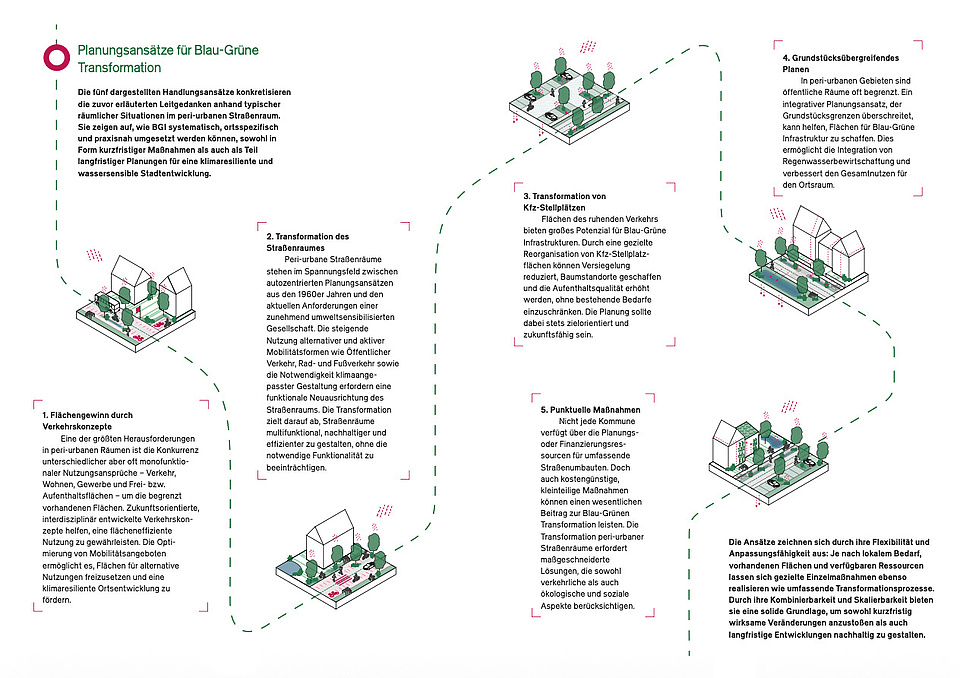
Blue–green infrastructure is essential for creating livable cities: it cools urban environments, retains stormwater, strengthens biodiversity, and generates public spaces with a high quality of stay. Transport infrastructures—such as streets, parking areas, and railway stations—offer significant potential in this regard. While blue–green infrastructure is particularly important in dense urban centers, it can also help make settlement edges and peri‑urban areas within urban–rural transition zones more resilient to climate change. However, the blue–green transformation of peri‑urban mobility spaces has largely been overlooked. This becomes clear when passing through these areas, even without thinking back to extreme rainfall events like those experienced in the summer of 2024.
To explore the potential of peri‑urban mobility spaces for climate‑change adaptation and mitigation, the “PeriSponge” project brought together knowledge from urbanism, urban water management, landscape architecture, transport planning, and participatory processes and applied an integrated, transdisciplinary approach. Working with the cities of Feldbach, Feldkirch, and Wels, the project developed qualitatively sustainable solutions for climate‑resilient water management and improved quality of life along peri‑urban transport corridors, taking climatic, ecological, and social functions into account. In Feldbach, participatory formats played a central role: residents contributed their local knowledge to the redesign of a street segment. The analyses, modeling, and participatory processes across all three cities informed a set of recommendations compiled in the manual for action called “Zukunftsfähige Mobilitätsräume: Blau-grüne Transformation im peri-urbanen Raum” (Future‑Ready Mobility Spaces: Blue–Green Transformation in the Peri‑Urban Context). The manual provides municipalities, planners, and decision-makers with practical support for actively shaping climate-resilient, livable, and sustainable settlement areas.