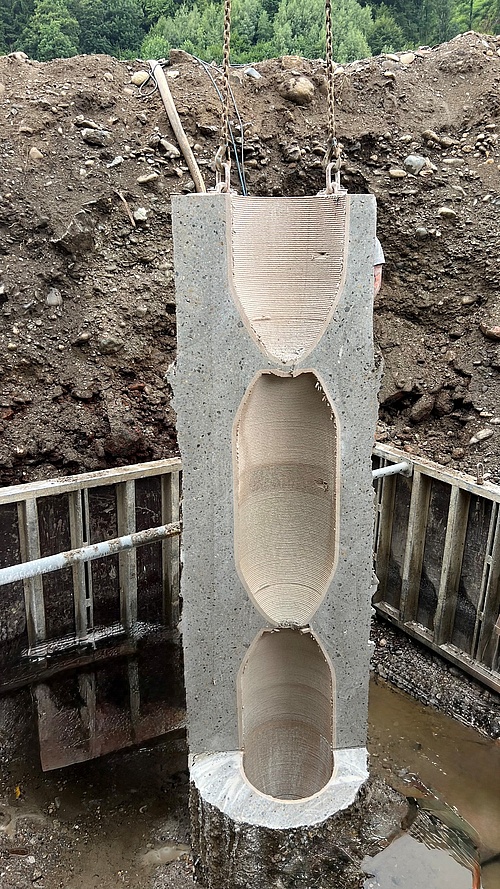
This research project aimed to reduce CO2 emissions in construction by saving material in foundation elements for building construction, with a focus on bored piles. The manufacturing method developed specifically for this purpose enables construction with annular cross-sections instead of solid cross-sections.
Initially, numerical investigations (FEM) were conducted to determine unnecessary cross-sectional areas of conventional bored piles. The reduced components were then recalculated in terms of their load-bearing capacity and interaction with the soil, and verified through component testing—ensuring “consistent load-bearing behavior with reduced material expenditure.” Based on these results, a second phase of the project examined the manufacturing process. A prototype was developed and tested, taking into account borehole creation, reinforcement installation, and the integration of displacement elements, as well as concreting and extraction of the casing. The guidelines and tables developed in the project support structural engineers in the process of designing bored piles by providing a practical and economical approach to dimensioning foundation elements. Depending on the foundation type and soil conditions, material savings of approximately 40 percent in concrete are expected.