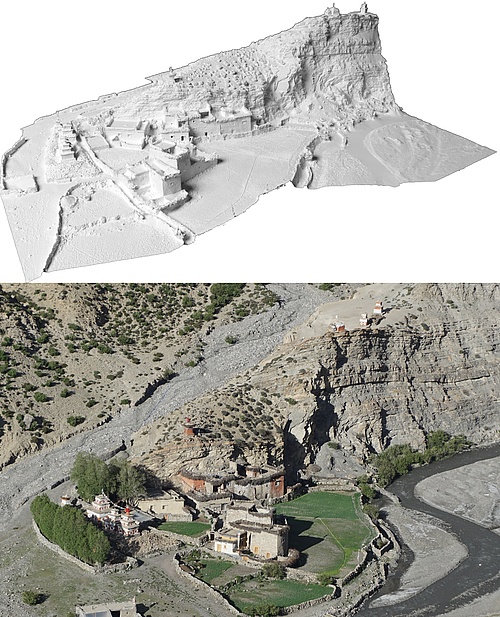
The Buddhist temples and monasteries of the Dolpo region of Nepal are part of a sacred landscape that has developed over the centuries in the cultural area of the Western Himalayas. Since the preserved buildings themselves are the most important and reliable source for architectural research, the project aimed to comprehensively document the inventory in order to obtain material for the analyses of different sacred building types and their development.
In cooperation with the Institute of Engineering Geodesy and Measurement Systems at Graz University of Technology, the building documentation during the fieldwork in 2022 and 2023 was optimized. Compared to previous building surveys, the quality and quantity of data have improved significantly due to the use of digital methods. This collected material comprises twelve ensembles in ten different locations, depicted in 3D point clouds of all visible interior and exterior surfaces, which were overlaid with images from an integrated camera. The representation of these 3D as-is models as OBJ files enabled the creation of a true-to-scale, high-resolution record of all captured objects. Drafting plans of all existing buildings summarizes the field research data, providing the basis for a detailed analysis of the building structures.
None of the buildings have yet been recognized as cultural monuments by the government, and there is currently no list of cultural monuments in Dolpo. The research results thus provide an initial overview of the temples and monasteries in this remote region, which enables the establishment of a comprehensive typology of Buddhist architecture in Dolpo, allowing for comparative analyses with buildings already documented in previous projects. Last but not least, the documentation is essential for facilitating much-needed restoration work.