On Love Afterwards
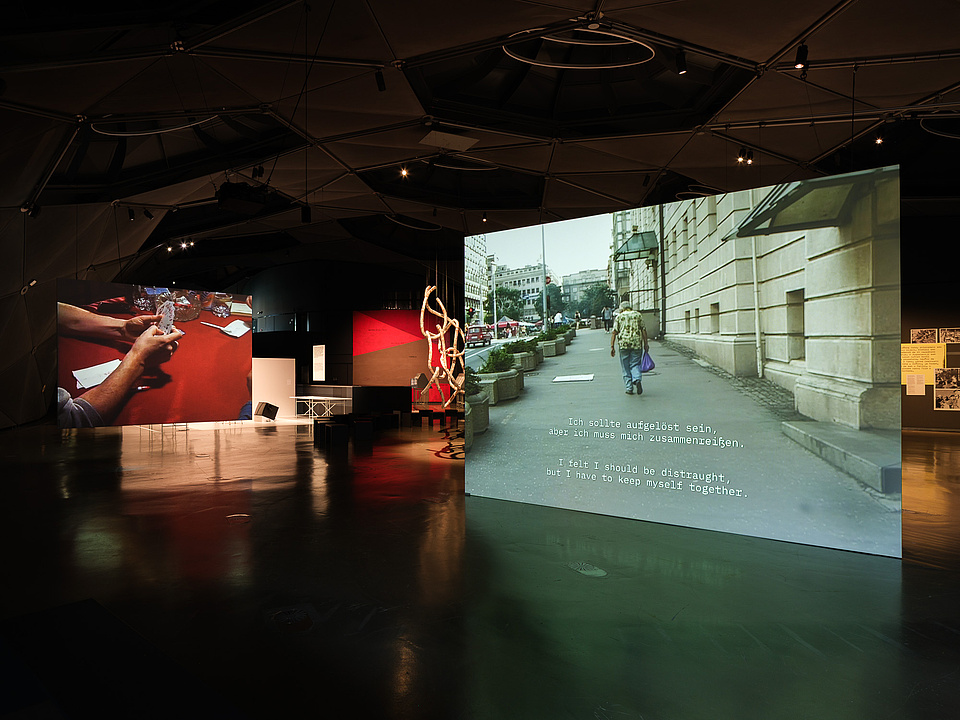
From June 27 to October 12, 2025, Kunsthaus Graz presented the solo exhibition “On Love Afterwards” by Milica Tomić. It sought to explore and address themes such as responsibility, visibility, and injustice through art by understanding ‘exhibiting’ as a verb rather than the exhibition itself as the subject of it. Milica Tomić, head of the Institute of Contemporary Art at Graz University of Technology, revolves her artistic practice around the object. However, the focus is not on the object itself, but rather on the negative space surrounding it—the space that enables the object to exist.
For this reason, Tomić’s work contains complex layers that unfold before the viewer. When she confronts viewers with a portrait of a woman, it is never merely a depiction of female identity; rather, the artist reveals the political and social nuances that construct this very identity. She tackles images of war in a similar manner. Acknowledging that the image extends beyond its depiction, she attempts to fill in the blank space surrounding the missing image, while demanding reflection about the conditions of its production and construction.
Tomić develops a collective artistic practice and experiments with forms of collaboration across various media. She is a founding member of the Yugoslav art and theory group Grupa Spomenik (or Monument Group) and founder of the interdisciplinary project “Four Faces of Omarska.” For the installation Is There Anything in This World You Would Be Ready to Give Your Life For?, presented in Graz and at the 13th Berlin Biennale, she collaborated with the Institute of Architecture and Media at Graz University of Technology to create a suspended knot in the center of the space using ceramic 3D printing and mycelium cultivation.
The Kunsthaus Graz exhibition, curated by Andreja Hribernik and Irena Borić, offered an overview of projects, including XY… Ungelöst – Reconstruction of the Crime (1997), I am Milica Tomić (1998), Portrait of MM (1999), Alone (2001), Reading Capital (2004), One Day, Instead of One Night, a Burst of Machine-Gun Fire Will Flash, If Light Cannot Come Otherwise (2009), The Final Letter “A” (2003/2010), and CONTAINER. Index of War (2004–ongoing). The exhibition design contextualized each work through an intertwined archive, situating it within an investigative process that continues to unfold in the background.
Andreja Hribernik, Irena Borić