
Is There Anything in This World You Would Be Ready to Give Your Life For?
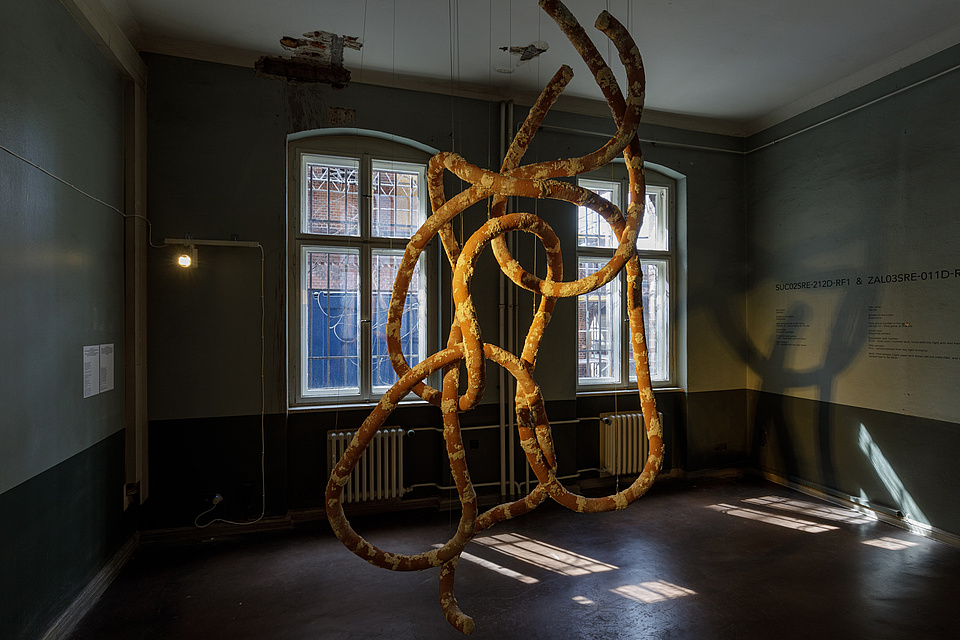
In Theses on the Philosophy of History (1940), Walter Benjamin’s “angel of history” faces toward the ever-accumulating “pile of debris” of the past he feels compelled to mend, yet the “storm of progress” propels him into the future. Milica Tomić’s exhibition “Is There Anything in This World You Would Be Ready to Give Your Life For?”—shown in two different iterations: at the 13th Berlin Biennale for Contemporary Art in 2025 and at Charim Galerie, Vienna, in 2026—echoes this fractured temporality, in which the past’s violent debris remains knotted in the fabric of present and future.
Tomić’s chalk drawing of the Borromean knot—a Lacanian model of the Real, Symbolic, and Imaginary registers—introduces her way of thinking through the structural entanglement of micro- and macrohistories, whilst also recalling her mother Marija Milutinović’s practice of macramé, an ancient Assyrian textile knotting technique.
Portrait of MM (1999), filmed in Belgrade during the NATO bombardment, follows Tomić walking between her and her mother’s apartments, using a first-person camera mirroring the trajectory of a precision-guided “smart bomb.” Their final embrace foregrounds connection amidst everyday life under attack. Nearby, surviving archival slides of Milutinović’s tapestries glow as afterimages of two decades of labor.
Extending the knot motif into large-scale spatial form, the installation Is There Anything in This World You Would Be Ready to Give Your Life For? (2025) combines 3D printed clay with cultivated, ossified mycelium. Framing entanglement as a physical condition, it unsettles the idea of an ontologically fixed, singularly authored object. It is presented alongside a wall vinyl script of forensic case numbers referencing the DNA-based identification and physical anthropology of victims recovered from mass graves after the 1995 Srebrenica genocide.
The exhibition resonates urgently within a current global condition shaped by the normalization of mass death and the resurgence of nationalist state formations, revealing these as enduring structures rather than as historical exceptions.
Sonja Teszler