
Besessene Berge/Possessed Mountains
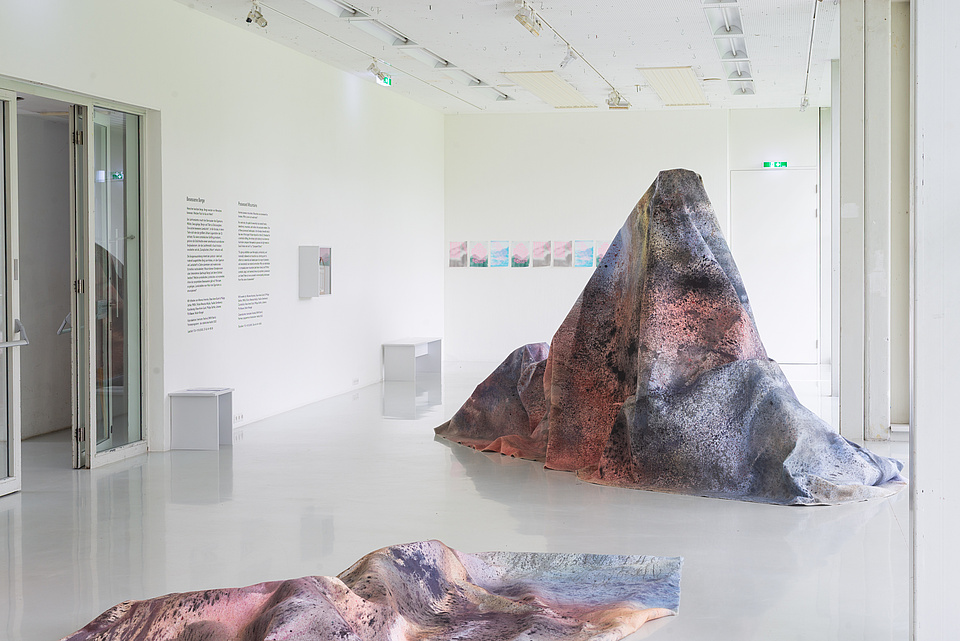
Humans possess mountains. Mountains are possessed by humans. What curse is at work here? Somewhere below the Weinebene, between Styria and Carinthia, one of the largest lithium deposits in the European Union can be found. The deposit was discovered at the height of the nuclear age; in the search for uranium, geologists found lithium instead, worthless at the time. Privatized decades ago for a “symbolic shilling,” the Traudl-Stollen (Traudl Tunnel) and all associated mining rights now belong to the American-Australian mining corporation Critical Metals. They plan to mine the light metal in Carinthia, process it in Saudi Arabia, and sell it to BMW as “European lithium.” A legally, ideally, and materially hollowed-out mountain can be read as a symbol of the relationship between people and landscape in late capitalism.
In the fall of 2025, Rose-Anne Gush and Philipp Sattler from the Institute of Contemporary Art at Graz University of Technology cocurated the exhibition “Besessene Berge / Possessed Mountains.” In Forum Stadtpark, this local example was taken as an opportunity to reflect on the connection between property and mountains in times of planetary and neocolonial extraction regimes: What symbolic, legal, and material means—and historical precedents—do states and corporations draw on to take possession of alpine landscapes? And how can one succeed in emancipating these landscapes from the curse of ownership?
With contributions by: Marwa Arsanios, Rose-Anne Gush, Fiston Mwanza Mujila, PARA, Philipp Sattler, and Paulina Semkowicz, among others.
Rose-Anne Gush, Robin Klengel, Johanna Pichlbauer, Philipp Sattler