Reducing CO2 emissions in the building sector requires a greater reliance on resource‑efficient construction materials. Earthen construction offers significant but still largely underused potential: earth is locally available, fully recyclable, and provides excellent indoor environmental performance with a remarkably low ecological footprint. Yet engineering‑based design standards for load‑bearing earthen structures remain limited. Insufficient knowledge of deformation behavior—particularly creep and shrinkage—further restricts broader applications in architecture and building practice.
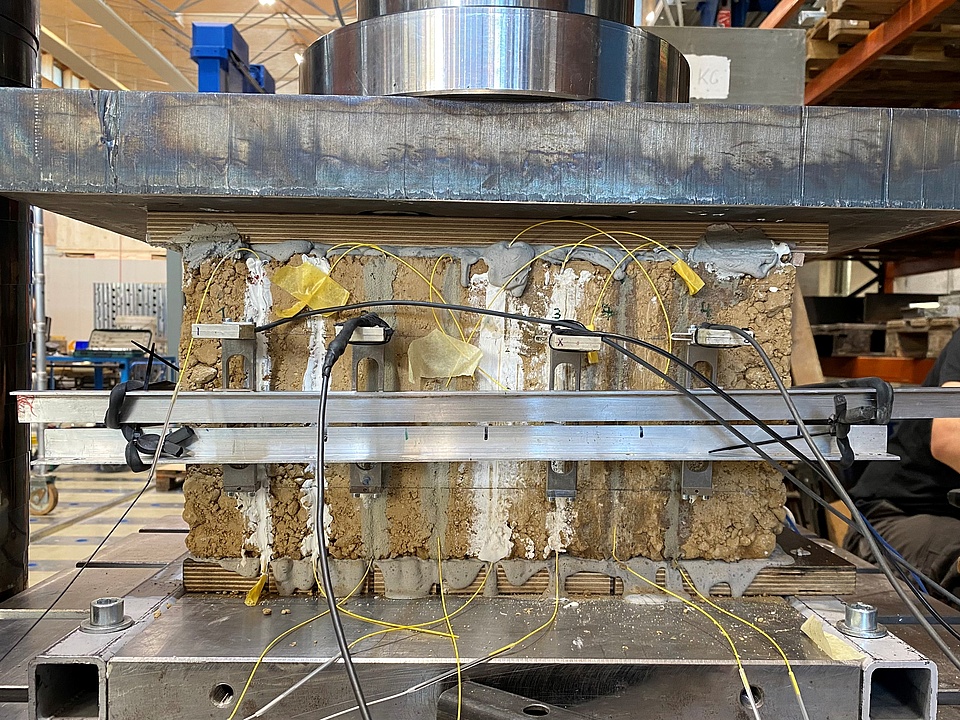
This research project explored whether Distributed Fiber Optic Sensing (DFOS) could serve as a nondestructive, continuous method for measuring the deformation behavior of rammed‑earth elements. DFOS enables high‑resolution, uninterrupted measurement along the full fiber length and can detect even minute local deformations down to the micrometer scale. To assess this potential, systematic laboratory tests were conducted on rammed‑earth specimens of various sizes, ranging from small material samples to large floor‑slab components. Fiber‑optic cables were embedded within the earth and also applied to the surface, with particular attention given to the interaction between fiber, adhesive, and earthen materials. The specimens were then subjected to destructive loading. Their deformation was recorded using fiber optic sensing and compared with conventional measurement methods such as 3D digital image correlation and settlement and strain gauges. Experimentally derived material parameters and deformation data were then incorporated into a numerical model designed to realistically simulate the load‑bearing and deformation behavior of an earthen vault slab under applied loads.
The results demonstrate a strong potential for fiber optic sensing as a nondestructive monitoring technique for earthen buildings. In the future, such sensing technologies could provide valuable insight into internal stress states and crack‑formation processes, and ultimately support the development of technical guidelines that promote the broader adoption of earth as a climate‑relevant construction material.