
Future-Oriented Research: Projects at the Institute of Structural Design—Sustainable Construction
Institute of Structural Design—Sustainable Construction
At the Institute of Structural Design (ITE), Alexander Passer, Professor of Sustainable Construction (NHB), brings together a series of research projects on the pressing challenges in architecture and civil engineering. Since 2023, the project team comprising Carlos Enrique Caballero Güereca and Marcella Ruschi Mendes Saade (ITE), has been working on “IEA EBC Annex 89. Wege zur Umsetzung von Netto-Null-Gebäuden über den gesamten Lebenszyklus” (Ways to Implement Net-Zero Whole Life Carbon Buildings), to address the issue of planning and realizing buildings in accordance with global climate targets. As part of the International Energy Agency’s (IEA) Energy in Buildings and Communities (EBC) program, climate science is being translated into recommendations for building practice. “IEA EBC Annex 89” develops actionable guidelines for CO2 targets and reduction scenarios, providing internationally coordinated methods for full-scope climate accounting, as well as curated best-practice examples. Funded by the Austrian Research Promotion Agency (FFG), the project supports informed design decisions, compliance with future regulations, and coherent action among policymakers, clients, and industry partners.
Also in 2023, the Christian Doppler Laboratory GECCO2 was established as an interdisciplinary research center at the interface of waste management, materials, environmental and geoscience, and civil engineering. Here, inorganic industrial waste flows—consisting of slag, ash, mineral wool, construction and demolition waste, and clay—are recycled in innovative binder systems and building materials, in order to develop waste-based geopolymer building materials for a CO2-neutral circular economy. Complemented with carbon-rich waste compounds such as waste oils, organic fibers, or biomass residues, this integrated approach significantly reduces the ecological footprint of material production and contributes to the systematic optimization of durable, ecologically sustainable, mineral-based building materials. Accelerated, standards-compliant procedures for testing the materials are supported by (micro)biological analyses, field studies, modeling approaches, pilot applications, and life-cycle assessments. Moreover, active participation in standardization committees lays a legal and technical foundation for future use.
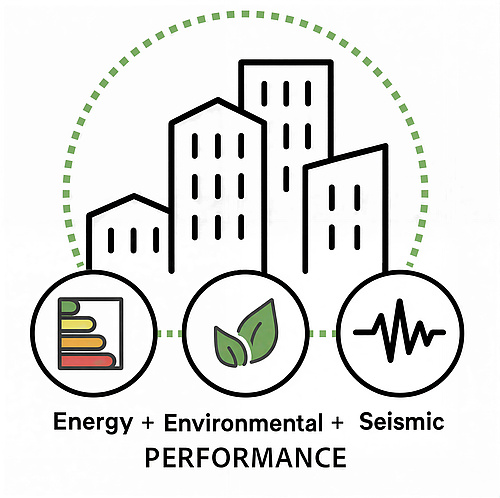
Two projects by the research network Graz Center of Sustainable Construction are likewise focused on how the building industry can help achieve climate neutrality. “GreenRenoV8: Cost-effective Building Stock Decarbonization and Seismic Resilience” is ascertaining the potential of renovating buildings in earthquake-prone regions of Europe. The project is funded by the European Union’s LIFE program and is being carried out in collaboration with partner institutions on a European level. Giovanna Cassavia, Tajda Potrč Obrecht, and Benedict Schwark are studying how earthquake safety and energy efficiency interrelate: strategic seismic retrofitting involves investing in energy sustainability over an entire life cycle. With this goal in mind, “GreenRenoV8” defines national parameters for combating energy poverty that will support the renovation of the worst-performing buildings and facilitate reproducible pathways to zero-emission buildings across Europe. In the project “BIOCHARm. Potenzialanalyse des Einsatzes von Pflanzenkohle im Bauwesen als Beitrag zur Erreichung der Klimaneutralität” (Potential Analysis of the Use of Biochar in the Construction Industry as a Contribution to Achieving Climate Neutrality), carried out in collaboration with the Institute of Applied Geosciences and the Institute of Technology and Testing of Construction Materials, the ITE—NHB is identifying opportunities and regulatory hurdles for the implementation of biogenic raw and residual materials in the Austrian building sector. Biochar, as a porous, solid carbon material, is produced through the thermochemical conversion of biomass in the absence of oxygen and is able to permanently remove carbon from the atmosphere. In this project, material analyses and development, along with life cycle assessments (LCA), will be used to draw up recommendations for action by 2028 in order to arrive at climate-neutral building stock. The project is funded by the Austrian Federal Ministry of Innovation, Mobility and Infrastructure (BMIMI), the Austrian Research Promotion Agency (FFG), and in the scope of the initiative TIKS—Technologies and Innovations for the Climate-Neutral City.
“KRAISBAU. Ein Leitprojekt für die Bauwende” (A Flagship Project for a Building Turnaround) is jointly funded by BMIMI and FFG in the framework of the open4innovation focus area “Circular Economy and Production Technologies.” The project addresses the economic, technical, and legal challenges that hinder a widespread implementation of circular construction. Considering that a significant share of global resource consumption—around 35 percent—stems from the building industry, this aspect is rapidly gaining in importance. With the objective of keeping resource flows in the economic cycle for as long as possible through the recycling, renovation, and reuse of building elements, the project “KRAISBAU” brings together the expertise of 32 research institutions, construction companies, and architectural firms. Methodologically, the consortium consolidates systematic problem analysis and context-related assessment, augmented by the use of artificial intelligence. By combining machine learning and digital planning systems such as building information modeling (BIM), the idea is to make the most environmentally sound, climate-friendly, and resource-efficient options competitive in building practice. Fact sheets, roadmaps, and training concepts offer application strategies for the entire industry—and deliver theoretical and practical solutions for the construction revolution in Austria.
In 2026, the research endeavor “Whole Life Carbon Österreich. Vergleichbare Lebenszyklusbewertungen für Gebäude und Bauweisen in Österreich” (Comparable Life Cycle Assessments for Buildings and Construction Methods in Austria) involving several institutes will be launched. Leo Ettl and Alexander Passer (ITE—NHB, TU Graz) are joined by partners from the University of Innsbruck (Florian Gschösser), TU Wien (Thomas Bednar), the Karlsruhe Institute of Technology (Thomas Lützkendorf), and the team of the Climate Change Centre Austria in coordinating a life cycle assessment method for buildings that is tailored to the Austrian context yet also meets European requirements. In close consultation with all stakeholders, the existing specifications, databases, and methods will be analyzed by 2028 and transferred into a standardized assessment framework for construction-related emissions. The defined system boundaries, validated data sources, and indicators will then be tested in case studies on various construction methods, integrated into future scenarios up to 2050, and compared with national transformation and decarbonization pathways. The project is funded by the Austrian Research Promotion Agency as part of the aforementioned initiative TIKS—Technologies and Innovations for the Climate-Neutral City. It lays out guidelines and recommendations for planning and implementation, while also enabling requirements related to life cycle carbon footprints to be translated into standards, regulations, and certification systems. Political decision-makers and public administrators are thus given decision-making tools to use on the path to climate-neutral cities, and to aid in the implementation of European climate and building policy.