
PHD-Day Summer Semester 2025
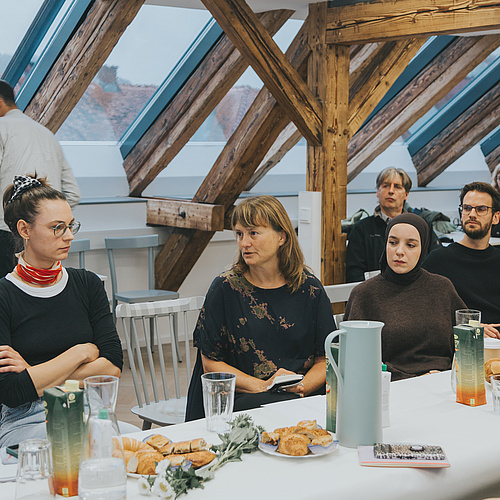
A doctoral dissertation is a deeply personal process—something emergent, unfinished, and raw. When questioning what exactly one is writing about, one inevitably pauses; the spectrum is simply too broad to capture in a few words. At the same time, an external perspective is essential for viewing one’s research through a different lens. Building on these reflections, the Institute of Spatial Design developed the idea of a banquet, an informal gathering without fixed seating, hosted together with the guest Nina Zschocke (Karlsruhe University of Arts and Design), with the aim of foregrounding not the outcome but the dissertation process itself—the thinking, the moments of getting stuck, the hurdles of writing and researching. Central to the format was that the doctoral candidates themselves chose which aspects they wished to bring to the table and which questions they wanted to test in discussion. The presentations reflected a broad thematic range: “Vier Häuser: Fragmentierte Figuren in Nordamerika” (Four Houses: Fragmented Figures in North America; Julian Brües), “Strategies for Anticipating and Transforming Vacancies in (Styrian) Municipalities: Christian Properties as a Potential for Revitalizing the Town Center” (Karina Brünner), “Dreiundvierzig Vier: Zur Theorie und Praxis der Regulierung und Beurteilung von Baugestaltung im Steiermärkischen Baurecht” (Forty‑Three Four: On the Theory and Practice of Regulating and Assessing Architectural Design in Styrian Building Law; David Dokter), “Women Architects and the Design of Sacred Spaces” (Anna Eberle), “Die neue Kleinwohnungsfrage: Typologische Untersuchung auf den Maßstabsebenen Stadt, Gebäude und Wohnung” (The New Small‑Housing Question: A Typological Study Across the Scales of City, Building, and Dwelling; Tobias Gruber), “Gebrauchte Elemente: Eine fotografische Untersuchung der Grazer Wohnarchitektur von 1960 bis 1980” (Used Elements: A Photographic Study of Residential Architecture in Graz from 1960 to 1980; Emilian Hinteregger), “Lost in Translation: Through the Lens of the Magazine Arkitekt in Turkey” (Büşra Köroğlu), “Sufficiency as a Spatial Strategy: Political Dimensions of Transformation in Small Towns and Municipalities” (Alice Steiner), “On Winterness” (Indrė Umbrasaitė), and “Enhancing Building Energy Performance Through AI-Driven Energy Visualization and Human Behavior Influence” (Chengbin Xu).
Büşra Köroğlu

