

Reliable Integrated Circuits in Design and Application
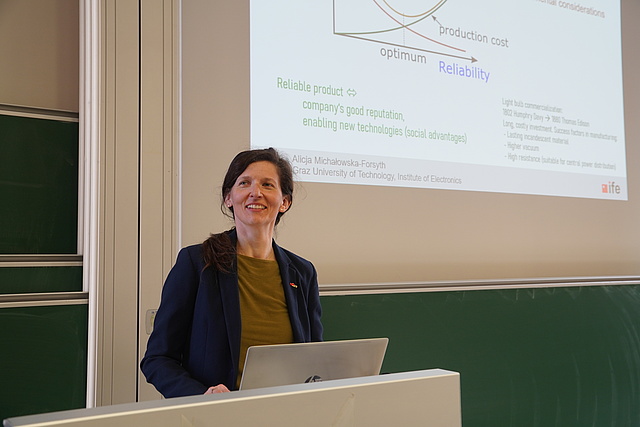
Course developed by: Alicja Michalowska-Forsyth, Institute of Electronics, TU Graz
Contact: alicja.michalowska@tugraz.at
Course Description
This lecture course provides a comprehensive introduction to the principles and practices of microelectronics reliability, addressing the mechanisms that govern the performance, degradation, and lifetime of electronic devices and systems. The course introduces fundamental terminology and concepts of reliability engineering, followed by an overview of the most relevant physical failure mechanisms occurring at the material, device, circuit, and packaging levels, including front-end devices, interconnects, passivation layers, bonding, and encapsulation.
As part of a broader electronic system development perspective, this course is developed within the GreenChips-EDU project, a European Union initiative aimed at promoting sustainable and energy-efficient microelectronics education. In this context, the course incorporates a dedicated module on circular design principles, lifetime-aware engineering, and source management, highlighting the relationship between reliability, extended product lifetime, and environmental impact. This module encourages students to consider sustainability as an integral part of reliability-oriented design, from material selection and technology choice to system-level deployment and end-of-life considerations.
Learning Objectives
After successfully completing the course, students will be able to:
- Explain how environmental and operational stress factors—including temperature, electrical overstress, ionizing radiation, and mechanical stress—affect material properties, device behavior, and circuit functionality.
- Identify and compare the dominant reliability degradation mechanisms induced by different stress conditions at the material, device, and circuit levels.
- Describe and interpret commonly used failure-rate models and statistical reliability frameworks, relating them to underlying physical damage mechanisms.
- Apply reliability modeling concepts to understand the role and limitations of accelerated testing methodologies in lifetime prediction.
- Analyze the impact of process and technology scaling on device sensitivity, variability, and long-term reliability.
- Evaluate representative mitigation and hardening techniques used to improve reliability in modern electronic systems.
- Assess reliability challenges and design constraints for electronic systems operating in harsh and extreme environments.
- Recognize and interpret key international standards and guideline documents relevant to device reliability, qualification, and lifetime assessment.
Course access (via TU Graz)
Course duration: ~ 45 hours
Course type: e-learning (online)
Target audience: Students at Bachelor/Masters level; Professionals
Course language: English
Is this course free? Yes
Open access provided? No, for enrolled TU Graz students only
Self-paced course? Yes
Is the certificate / are the credentials free? No
Assessment type: Self-assessment (for enrolled students at TU Graz only)