
GCCE-Seminar 4

Im Rahmen der GCCE-Seminarreihe hält Prof. Olaf Steinbach vom Institut für Angewandte Mathematik einen Vortrag zum Thema „Finite element error estimates for the approximate computation of normal derivatives“
Wo: Seminarraum Mechanik, Kopernikusgasse 24/IV NT04098
Wann: 17.06.2026 um 17:00
GCCE-Seminar 3
Im Rahmen der GCCE-Seminarreihe hält Eniz Mušeljić vom Institut für Grundlagen und Theorie der Elektrotechnik einen Vortrag zum Thema „Parameter Identification of Magnetic Material Models“
Wo: Seminarraum Mechanik, Kopernikusgasse 24/IV NT04098
Wann: 27.05.2026 um 17:00
GCCE-Seminar 2
Im Rahmen der GCCE-Seminarreihe hält Bernhard Heininger vom Institute für Festigkeitlehre einen Vortrag zum Thema „Non-singular elasticity theory of dislocations on periodic domains“
Wo: Seminarraum Mechanik, Kopernikusgasse 24/IV NT04098
Wann: 13.05.2026 um 17:00
Austrian Numerical Analysis Day

Wann: 07.05 und 08.05.2026
Für Details siehe hier: https://www.applied.math.tugraz.at/tagungen/anaday26/
GCCE-Seminar 1
Die GCCE-Seminarreihe startet wieder!
Beim ersten Termin hält Sanne Kwakman vom Intitute of Biomechanics einen Vortrag zum Thema „3D-Parametermodell zur Simulation der Ballonangioplastie in atherosklerotischen Arterien“
Wo: Seminarraum Mechanik, Kopernikusgasse 24/IV NT04098
Wann: 29.04.2026 um 17:00
GCCE Poster Day
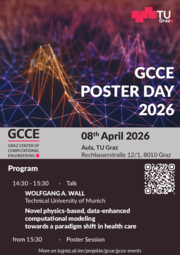
Das GCCE-Konsortium organisiert einen Postertag, um Forschende im Bereich Computational Engineering aus verschiedenen interdisziplinären Bereichen zu vernetzen. Wir laden alle, die sich für computergestützte Methoden interessieren, herzlich ein, daran teilzunehmen.
Die Veranstaltung wird von Prof. Wolfgang A. Wall von der TUM eröffnet, der einen Vortrag zum Thema „Novel physics-based, data-enhanced computational modeling towards a paradigm shift in health care“ halten wird.
Im Anschluss daran finden Posterpräsentationen von Doktoranden und Postdoktoranden des GCCE statt.
Wo: Aula, TU Graz, Rechbauerstraße 12/1, 8010 Graz
Wann: 8. April 2026
- Vortrag von Prof. Wall – 14:30 Uhr
- Poster-Session – 15:30 Uhr
GCCE Networking Meeting
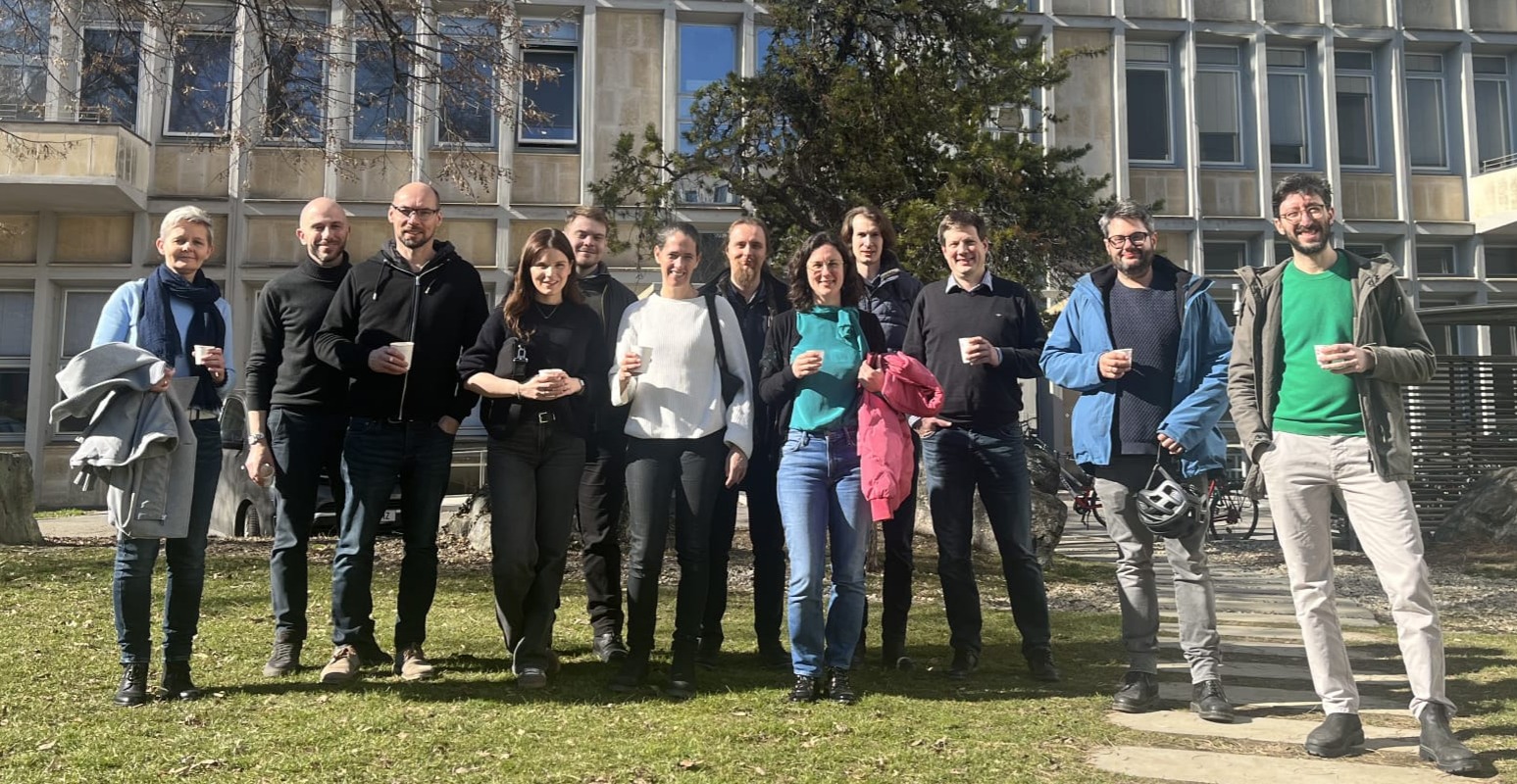
The Graz Center of Computational Engineering (GCCE) hosted a networking meeting on Feb. 27, 2026, bringing together colleagues from the institutes involved in the GCCE. The event provided an opportunity for researchers to exchange ideas in an informal and collaborative atmosphere.
During the meeting, participants discussed current scientific topics, explored possibilities for future interdisciplinary cooperation, and exchanged ideas on upcoming GCCE activities. The gathering highlighted the strong collaborative spirit within the computational engineering community and emphasized the importance of networking across different research areas.
The meeting also served as a platform to strengthen existing connections and initiate new collaborations among researchers working on computational methods and engineering applications.
The next GCCE networking meeting will take place on 7 May 2026 at the Alte Technik campus in Graz.
Vortrag: Data-driven magnetic field simulation

Prof. Dr.-Ing. Herbert De Gersem von der TU Darmstadt wird einen Vortrag zu "Data-driven magnetic field simulation" halten.
- Datum: 31.03.2026
- Uhrzeit: 11:00 bis 12:30
- Ort: Hörsaal i6, Inffeldgasse 25/D, 1. OG, 8010 Graz
Abstract: In standard finite-element methods, the behaviour of magnetic materials is represented by a material model, of which the parameters need to be retrieved from measurements by regression. As an alternative to this procedure, in the talk, I will develop and explain a finite-element method refraining from using a material model but considering the raw measurement data instead. Essentially, the technique amounts to minimising the distance between the material behaviour at the finite-element quadrature points and the measurement points, using a suitable norm in the so-called phase space. Physical constraints are enforced as symmetries in the phase space. The Maxwell equations are added as constraints by the Lagrange multiplier method. The data-driven magnetic field solver will be illustrated for examples from electrical engineering and accelerator technology.
Herbert De Gersem received the M.Sc. and Ph.D. degrees in electrical engineering from KU Leuven, Belgium, in 1994 and 2001. From 2001 to 2006, he was with TU Darmstadt, Germany as a postdoc. Since 2001, he is Associated Professor in Accelerator Physics at KU Leuven. Since 2014, he is Full Professor at the Institute for Accelerator Science and Electromagnetic Field, TU Darmstadt. His research interests include finite-element electromagnetic field simulation for electrotechnical devices and particle accelerators, as well as FDTD and FETD techniques for electromagnetic and ultrasonic wave propagation.
Vortrag "Recent progress in the analysis of the Poisson-Nernst-Planck system"
Assoc. Prof. Rolf Ryham (Fordham University, New York) wird einen Vortrag zum Thema "Recent progress in the analysis of the Poisson-Nernst-Planck system" halten.
- Datum: Mittwoch, 25.3.2026
- Uhrzeit: 17:00-18:00
- Ort: Seminarraum Mechanik, Kopernikusgasse 24 IV NT04098
Abstract: The Poisson-Nernst-Planck system consists of a coupled system of parabolic and elliptic equations describing the diffusion and electromigration of charges and their electrical potential. While well-posedness and long-term behavior for two-dimensional, bounded domains is well understood, the analysis faces significant difficulties in three and higher dimensions where weak solutions are merely found to be locally weakly differentiable. The system, however, enjoys a so-called very weak formulation where, for example, properties like local boundedness can be gained from minimal assumptions.
Vortrag: Streuungs- und Beugungsmodelle für die Schallausbreitung im Freien
Prof. Michael Vorländer von der RWTH Aachen wird einen Vortrag zu Streuungs- und Beugungsmodelle für die Schallausbreitung im Freien halten.
Datum: 18.02.2026
Uhrzeit: 11:00h bis 12:30h
Ort: Hörsaal i6, Inffeldgasse 25d, 8010 Graz
In der Simulation von Außenlärmszenen mit geometrischen Verfahren stellen die Streuungen und Beugungen große Herausforderungen dar. Standardisierte Streugrade sind zu vereinfacht und können spezifische Effekte wie Rückstreuung oder andere Muster der Rückwürfe aus periodischen Oberflächenstrukturen nicht wiedergeben. Beugungen an einzelnen Kanten können mit guten Näherungen angesetzt werden, wobei jedoch die Relevanz der Berücksichtigung von Mehrfachbeugungen über höhere Ordnungen noch unklar ist. Im Vortrag werden sowohl die Streu- und Beugungseffekte diskutiert als auch Implementierungen in Modellen der geometrischen Akustik.
Prof. Dr. rer. nat. Dr.-Ing. habil Michael Vorländer ist seit 1996 Professor an der RWTH Aachen, nun emeritiert seit Februar 2025. Seine Forschungsschwerpunkte sind Auralisation und akustische virtuelle Realität in ihren verschiedenen Anwendungen in den Gebieten Psychoakustik, Bauakustik, Automobiltechnik und Lärmschutz. Michael Vorländer veröffentlichte 3 Bücher und 17 Buchkapitel, 159 Artikel in Fachzeitschriften und hielt 29 Plenarvorträge auf internationalen Konferenzen. Er war Präsident einiger Fachgesellschaften, darunter der International Commission for Acoustics (ICA) in 2011-2013, der Deutschen Gesellschaft für Akustik (DEGA) in 2016-2019 sowie der Acoustical Society of America in 2025-2026.
Festvorträge der Habilitationswerber der GCCE-Fakultäten
Donnerstag, 9. Oktober 2025 ab 14 Uhr
Aula, Rechbauerstraße 12, 1. Stock
Um Anmeldung wird gebeten unter dekanat.bau@tugraz.at
14:00 Uhr Begrüßung durch Prof. Dr.-Ing. Martin Schanz, Dekan der Fakultät für Bauingenieurwissenschaften
Schwingungen – Wie sie entstehen und warum sie meistens unerwünscht sind
Assoc.Prof. Dipl.-Ing. Dr.techn. Michael Klanner, Institut für Mechanik
Wenn Luft Musik macht – Strömungsakustik einfach erklärt
Assoc.Prof. Dipl.-Ing. Dr.techn. Stefan Schoder, Institut für Grundlagen und Theorie der Elektrotechnik
15:30 Uhr bis
16:00 Uhr Pause
Von der Form zur Funktion – Geometrie als Grundlage der Simulation
Assoc.Prof. Dipl.-Ing. Dr.techn. Benjamin Marussig, Institut für Baumechanik
Kernfusion – von der Theorie in die Praxis
Assoc.Prof. Dipl.-Ing. Dr.rer.nat. Christopher Albert, Institut für Theoretische Physik - Computational Physics
Im Anschluss Buffet