
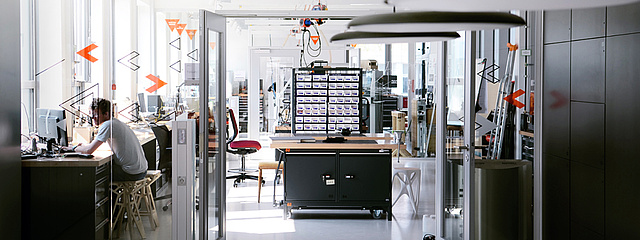
Schumpeter Laboratory
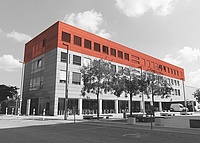
The Schumpeter Lab offers an 800 m² platform for exchange between students, researchers, start-ups and established companies.
Since 2019, the lab has provided access to state-of-the-art infrastructure, digital production machines and extensive multimedia and communication systems with the aim of optimally supporting cooperation between the participants and the resulting product and business model development. Based on the development and implementation of new cooperation models, strategies for targeted collaboration between the relevant players are researched and derived.
Access to the laboratory's facilities and active networking among the participants has led to a significant increase in their engagement in the cooperation formats. Based on learning-by-doing experiences, the practical training and teaching concepts as well as project formats offered provide effective tools for cooperation.
The Schumpeter Laboratory is divided into different areas in terms of space and content:
Design Lab - The multifunctional area
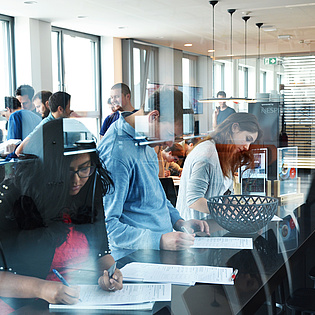
The Design Lab is the multifunctional, multimedia-supported area of the Schumpeter Lab and was designed for flexible use. The room and stage layout can be quickly and easily rearranged for various purposes such as lectures, panel discussions, workshops and the like. The Design Lab is equipped with a high-tech 4K LED video wall and sophisticated sound, lighting and video conferencing equipment, and can accommodate up to 100 people. In addition to regular use by the university, the flexibility of the room allows for a wide variety of non-university events such as board meetings, product presentations and musical events.
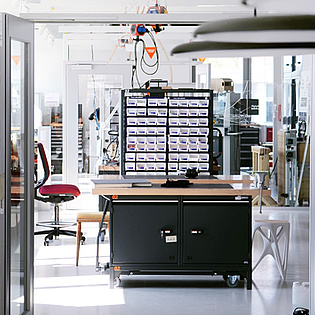
Through the use of mobile workbenches, the DesignLab also offers the possibility of functioning as an extension of the FabLab.
FabLab - Rapid prototyping with digital fabrication machines
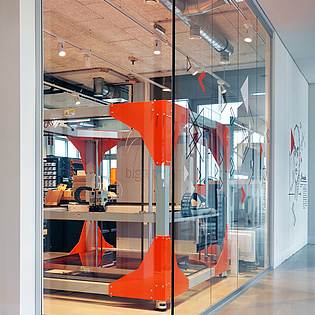
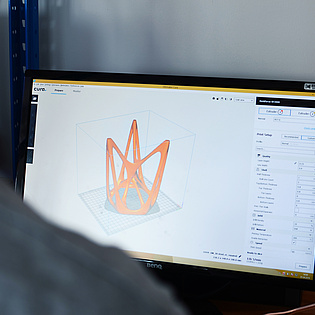
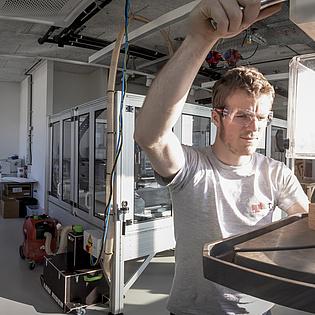
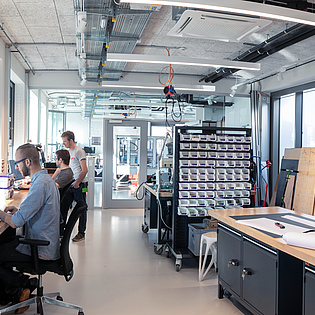
The FabLab premises offer easy-to-use, state-of-the-art digital production machines such as laser cutters, water jet cutters, CNC milling machines, 3D printers using various technologies, 3D scanners and electronic workstations.
Lobby - Space to exchange ideas and experiences
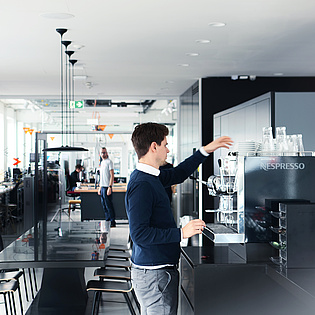
The lobby promotes open communication and is designed to facilitate spontaneous encounters – users of the laboratory are invited to both work and relax there.
Schumpeter & Tesla - State-of-the-art meeting rooms
Two meeting rooms, named after two famous scientists with ties to Graz, are equipped with interactive touchscreen monitors and video conferencing technology to support collaboration through virtual meetings.
Projects at the Schumpeter Laboratory
Various collaborative project formats based on the design thinking approach are regularly implemented at this innovation hotspot:
- MAKERTHON (product development in 48 hours)
- SPINNOVATION (from patent to spin-off in 8 weeks)
- PRODUCT INNOVATION (from industrial challenge to product in 6 months)
Teaching and Executive Education
The Schumpeter Laboratory offers the opportunity to learn and apply practical skills. In a variety of courses and training sessions, participants are guided to be creative and transform ideas into real prototypes.
- DESIGN THINKING AND RAPID PROTYPING
- CREATIVITY TECHNIQUES
- VALUE ENGINEERING
- DESIGN TO VALUE
- INNOVATIONSMANAGEMENT
- ENABLING INNOVATION
Our Partners
ANDRITZ, AVL, ELIN MOTOREN, ENERGIE GRAZ, FRONIUS, GAW GROUP, KNAPP, KNILL GROUP, KTM, KÄSSBOHRER GELÄNDEFAHRZEUGE, LOGICDATA, MAGNA STEYR FAHRZEUGTECHNIK, MIBA, NXP, OMV, ORASIS, PALFINGER, PANKL RACING, PAYER, REMUS SEBRING, TDK , VENTREX, VOESTALPINE, ÖBB TECHNISCHE SERVICES
Our Supporters
ALPEN MAYKESTAG, ATELIER 9, CONRAD ELECTRONIC, HILTI, PICHLER MEDIENTECHNIK, TROTEC

What is the Schumpeter Laboratory?
The lab is a place for exchange and support to promote product innovation involving makers, industry and scientific research.
Who can use the Schumpeter Laboratory?
- Students of our courses
- Members of our industry partners in the course of cooperation formats
- Anyone as a participant in Makerthons, Spinnovation or Product Innovation projects
General requests:
iim@tugraz.at
Head of the Institute:
Univ.-Prof. Dr. Christian Ramsauer
Deputy Head of the Institute:
Dr. Hans Peter Schnöll