
MODUL BUILDING ENERGY PERFORMANCE
LV 159.778 SE Energy and Architecture
LV 159.779 SE Energy Analysis
LV 159.780 UE Energy Modelling
Summersemester 2026
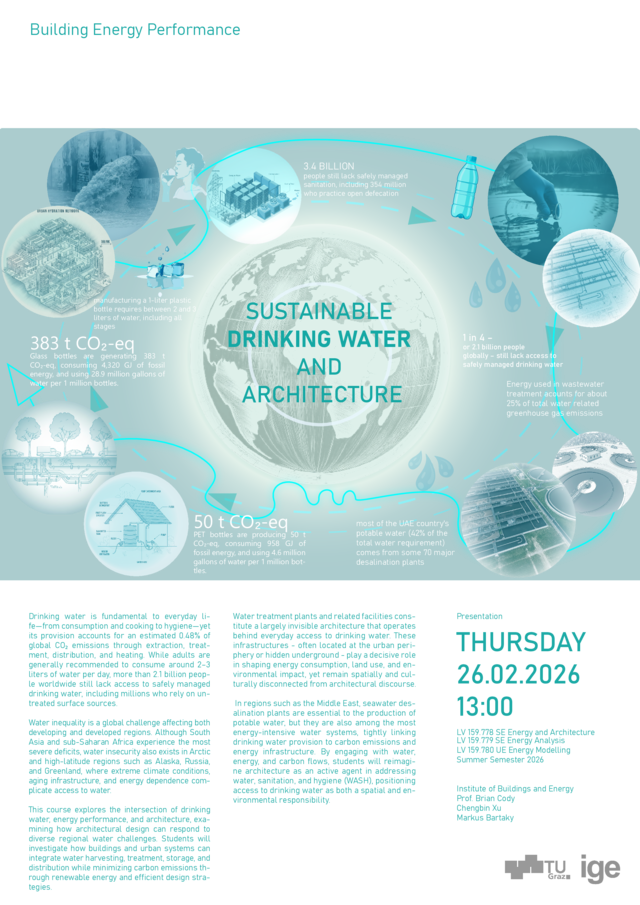
SUSTAINABLE DRINKING WATER AND ARCHITECTURE
Drinking water is fundamental to everyday life—from consumption and cooking to hygiene—yet its provision accounts for an estimated 0.48% of global CO₂. While adults are generally recommended to consume around 2–3 liters of water per day, more than 2.1 billion people worldwide still lack access to safely managed drinking water, including millions who rely on untreated surface sources.
Water inequality is a global challenge affecting both developing and developed regions. Although South Asia and sub-Saharan Africa experience the most severe deficits, water insecurity also exists in Arctic and high-latitude regions such as Alaska, Russia, and Greenland, where extreme climate conditions, aging infrastructure, and energy dependence complicate access to water.
This course explores the intersection of drinking water, energy performance, and architecture, examining how architectural design can respond to diverse regional water challenges. Students will investigate how buildings and urban systems can integrate water harvesting, treatment, storage, and distribution while minimizing carbon emissions through renewable energy and efficient design strategies. By engaging with water, energy, and carbon flows, students will reimagine architecture as an active agent in addressing water, sanitation, and hygiene (WASH), positioning access to drinking water as both a spatial and environmental responsibility.