EELS-imaging of surface plasmons
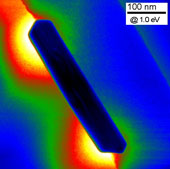
Plasmons are coupled electromagnetic waves that occur inside and on the surface of metals. What makes plasmons of great interest is their ability to confine light to nanoscale regions – much smaller that the wavelength of light.
The S/TEM is also an ideal tool for mapping optical properties of noble metal nanoparticles and nanostructures. In this rapidly developing field we study nanoobjects by means of energy-filtering TEM and STEM with high energy-resolution EELS. Presently, we are using a monochromated FEI Tecnai F20 with a HR energy-filter (MonoTEM) and a monochromated FEI Titan 60-300 with a Quantum energy-filter (Gatan) (ASTEM).
Our experimental efforts are combined with expertise in nano-optics from the Institute of Physics of the University of Graz (Joachim Krenn, Ulrich Hohenester).
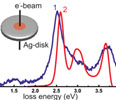
We map the complete plasmonic spectrum of silver nanodisks by EELS and show how the mode which couples strongest to the electron beam has radial symmetry with no net dipole moment. Since this radial breathing mode does not couple to light, it has previously escaped from observation in optical experiments.
“Dark plasmonic breathing modes in silver nanodiscs”, F.-P. Schmidt, H. Ditlbacher, U. Hohenester, A. Hohenau, F. Hofer, J.R. Krenn, Nano Letters 12 (2012) 5780-2905.
The S/TEM is also an ideal tool for mapping optical properties of noble metal nanoparticles and nanostructures. In this rapidly developing field we study nanoobjects by means of energy-filtering TEM and STEM with high energy-resolution EELS. Presently, we are using a monochromated FEI Tecnai F20 with a HR energy-filter (MonoTEM) and a monochromated FEI Titan 60-300 with a Quantum energy-filter (Gatan) (ASTEM).
Our experimental efforts are combined with expertise in nano-optics from the Institute of Physics of the University of Graz (Joachim Krenn, Ulrich Hohenester).
We map the complete plasmonic spectrum of silver nanodisks by EELS and show how the mode which couples strongest to the electron beam has radial symmetry with no net dipole moment. Since this radial breathing mode does not couple to light, it has previously escaped from observation in optical experiments.
“Dark plasmonic breathing modes in silver nanodiscs”, F.-P. Schmidt, H. Ditlbacher, U. Hohenester, A. Hohenau, F. Hofer, J.R. Krenn, Nano Letters 12 (2012) 5780-2905.
Highlights
 ©FELMI-ZFE | We morph a silver nanodisk into a nanotriangle by producing a series of nanoparticles with electron beam lithography. Using electron energy loss spectroscopy (EELS), we map out the plasmonic eigenmodes and trace the evolution of edge and film modes during morphing. We introduce a linear combination of plasmonic eigenmodes to describe plasmon modes in different geometries, hereby extending the successful hybridization model of plasmonics. “Morphing a Plasmonic Nanodisk into a Nanotriangle“, F.-P. Schmidt, H. Ditlbacher, U. Hohenester, F. Hofer, J. R. Krenn, Nano Letters 14 (2014) 4810-4815. |
 ©FELMI-ZFE | Employing electron energy loss spectroscopy, we show that the modes of silver nanodisks can be scaled to the surface and edge modes of extended silver thin films. We thereby introduce a general and intuitive ordering scheme for plasmonic excitations with edge and surface modes as the elementary building blocks. “Universal dispersion of surface plasmons in flat nanostructures“, F.-P. Schmidt, H. Ditlbacher, U. Hohenester, A. Hohenau, F. Hofer, J. R. Krenn, Nature Communications 5 (2014) 3604. |
 ©FELMI-ZFE | We have investigated two different imaging techniques for studying plasmonic excitations in single gold nanoprisms. We demonstrate that the recently developed monochromated energy-filtering (EFTEM) approach can be used alternatively to the well established STEM-EELS imaging method. “Comparison of EFTEM and STEM-EELS plasmon imaging of gold nanoparticles in a monochromated TEM”, B. Schaffer, W. Grogger, G. Kothleitner, F. Hofer, Ultramicroscopy 110 (2010) 1087-1093. |
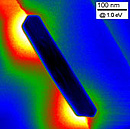 ©FELMI-ZFE | We demonstrate the imaging capabilities of energy-filtering TEM at high energy-resolution, reporting the direct image of a surface plasmon of a gold nanorod at energies around 1 eV. The experimental results have been compared with model calculations performed within the boundary element approach. “High-resolution surface plasmon imaging of gold nanoparticles by energy-filtered transmission electron microscopy”, B. Schaffer, U. Hohenester, A. Trügler, F. Hofer, Phys. Rev. B 79, 041401 (R) (2009) |
 ©FELMI-ZFE | The MonTEM has been used to study the surface plasmons of gold nanoparticles of various shapes. Due the improved energy resolution of about 0.2 eV, surface plasmon excitations at energies well below 1 eV could be accurately measured from raw data. These low energy excitations around 0.8 eV have been observed for the first time. “Monochromated, spatially resolved electron enery-loss spectroscopic measurements of gold nanoparticles in the plasmon range”, B. Schaffer, K. Riegler, G. Kothleitner, W. Grogger, F. Hofer, Micron 40 (2009) 269-273. |
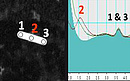 ©FELMI-ZFE | One of the first EELS experiments of surface plasmons on a single nanoparticle has been performed by Gerald Kothleitner and David McComb using the Graz MonoTEM. Based on these early experiments, the group of David McComb (Imperial College in London, now with Ohio State University, Columbus) concentrated on EELS-imaging of dark plasmonic modes also considering the effects of specimen damage during data acquisition. “Electron energy-loss spectroscopy (EELS) of surface plasmons in single silver nanoparticles and dimers: influence of beam damage and mapping of dark modes”, A.L. Koh, K. Bao, I. Khan, W.E. Smith, G. Kothleitner, P. Nordlander, S.A. Maier, D. McComb; ACS Nano 3 (2009) 3015-3022. |
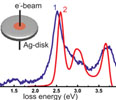 ©FELMI-ZFE | We map the complete plasmonic spectrum of silver nanodisks by EELS and show how the mode which couples strongest to the electron beam has radial symmetry with no net dipole moment. Since this radial breathing mode does not couple to light, it has previously escaped from observation in optical experiments. “Dark plasmonic breathing modes in silver nanodiscs”, F.-P. Schmidt, H. Ditlbacher, U. Hohenester, A. Hohenau, F. Hofer, J.R. Krenn, Nano Letters 12 (2012) 5780-2905. |
Contact
Institute of Electron Microscopy
and Nanoanalysis
Steyrergasse 17/III
8010 Graz
General Information
Verica Bursac
Phone: +43 (0) 316 873 8320
Fax: +43 (0) 316 373 8822
office@felmi-zfe.at
Service Related Inquiries
Hartmuth Schröttner
Phone: +43 (0) 316 873 8349
hartmuth.schroettner@felmi-zfe.at