
Sebastian Rohde, Aidan Cowley, Richard Hasso, Mario Kricher, Mathias Heidinger, Viktor Hacker, Bernhard Gollas
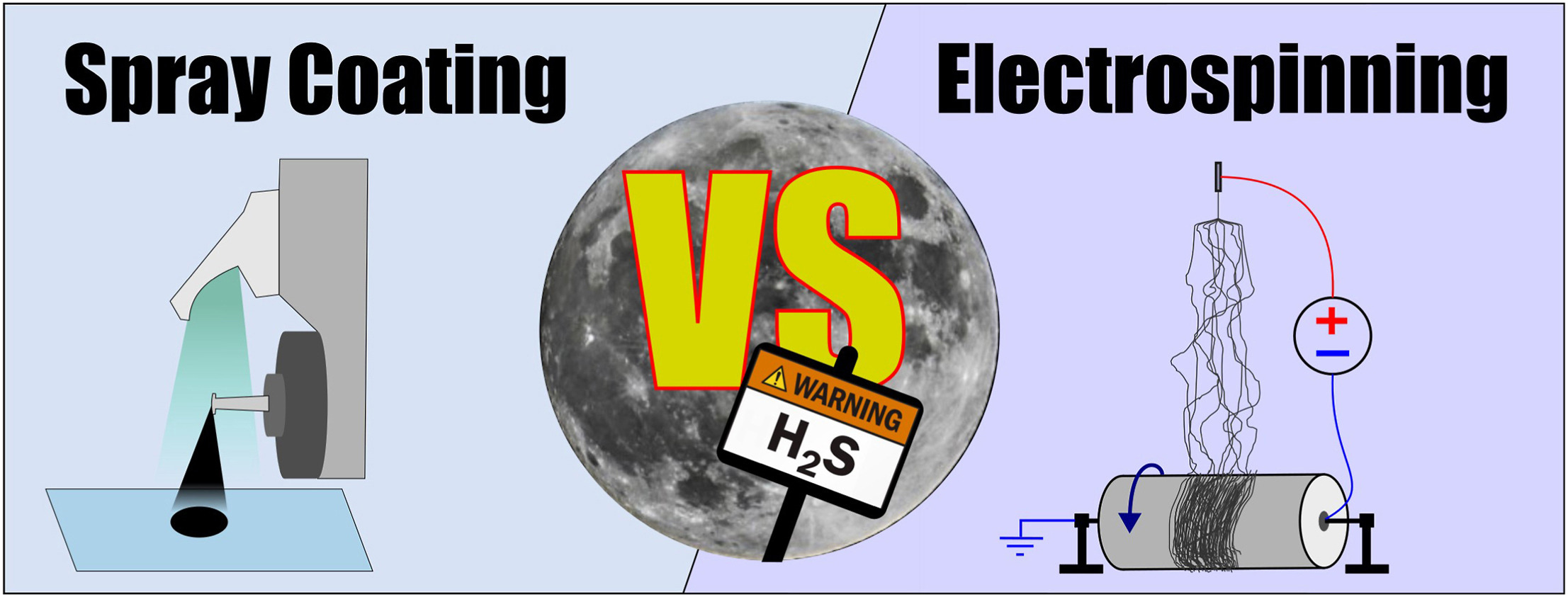
Hydrogen sulphide, found in air, reformed hydrogen, and lunar water, poses a serious threat to platinum electrocatalysts, significantly shortening the lifespan of polymer electrolyte membrane fuel cells. This study examines how electrode fabrication methods influence contamination resistance. Two types of catalyst coated membranes (CCMs)—ultrasonically spray-coated and electrospun nanofibre—were fabricated, each with a platinum loading of 0.3 mg cm−2 on both anode and cathode. Electron microscopy and Hg porosimetry revealed a porous fibre network in nanofibre CCMs, while less porous coated CCMs showed catalyst agglomerates. Both CCMs exhibited similar electrochemical surface areas (∼17 m2·gPt−1), but nanofibre CCMs achieved a peak power density of 437 ± 34 mW cm−2, outperforming coated CCMs (252 ± 13 mW cm−2). Impedance spectroscopy indicated significantly lower time-dependent resistances in nanofibre CCMs (265 ± 10 mΩ cm2) versus coated ones (513 ± 43 mΩ cm2). Under 2 ppm hydrogen sulfide exposure, nanofibre CCMs were more vulnerable to anode contamination due to faster contamination penetration, yet more resilient at the cathode, likely because of enhanced oxygen diffusion and in-operando sulphur oxidation. These results highlight the critical role of electrode structure in contamination behaviour and suggest that hybrid CCMs — combining coated anodes with nanofibre cathodes — may optimize both performance and durability in PEM fuel cells.
Journal of Power Sources
DOI: 10.1016/j.jpowsour.2025.238698
Link to Article