
Florian Tritscher, Merit Bodner, Viktor Hacker, Ricardo Novella, Marcos Lopez-Juarez, Alex Ferri-Sirvent
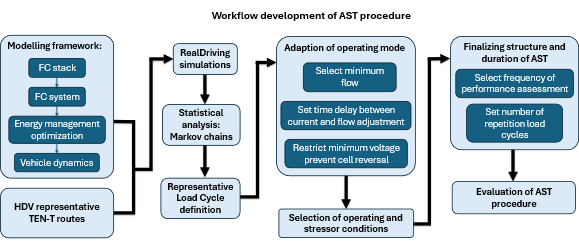
High temperature proton exchange membrane fuel cells (HT-PEMFCs) are a carbon-neutral technology that can help overcome common low-temperature PEMFC issues such as high requirements for purity of the fuel or limited heat rejection at lower temperatures and enable a green transition in powering heavy-duty vehicles (HDVs). However, the higher operating temperature of up to 200 °C poses an additional challenge to the development of suitable and durable materials. The development of accelerated stress tests (ASTs) that can mimic real life applications is crucial to enable a time efficient investigation of new materials and to establish comparable material assessment standards across different laboratories. Here we present an AST that enables the investigation of new HT-PEMFC materials in HDV application related conditions and can be readily adapted to investigate individual cells in a stack. The proposed AST is based on realistic performance of HDFCVs across drive cycle data of the Trans-European Transport Network (TEN-T) and was generated with a real driving simulation-based approach using a multi-layered modeling framework integrating a heavy-duty vehicle with HT-PEMFC technology. In addition, we introduce a highly accelerated stress test (HAST) based on the same simulations with additional stressors to amplify degradation. We provide detailed information regarding the generation of the AST and the HAST as well as experimental data of both protocols being performed for 100 h at 180 °C with state-of-the-art HT-PEMFC materials to validate the testing procedure.
International Journal of Hydrogen Energy
doi.org/10.1016/j.ijhydene.2025.153057
Link to Article