
Lukas Roessler Escudero, Ádám Székeli, Viktor Hacker, Merit Bodner
To achieve the European goals of clean H2 covering 10% of the overall energy demand of the continent by 2050, it will be necessary to exploit all the alternatives that allow for the generation of clean H2, as a continent-wide energy transition cannot rely purely on water electrolysis (WE).
In this vein, sulphur depolarised electrolysis (SDE) presents an alternative where we can take advantage of the worldwide emitted SO2 to change the reactions in the anode of an electrolysis cell, reducing the onset potential from 1.23 V in WE to 0.158 V in SDE and as a consequence, H2SO4 is coproduced alongside the clean H2. Despite its potential, SDE remains at a relatively low technology readiness level, with key knowledge gaps; particularly regarding the reaction mechanisms on the anode side, still to be addressed.
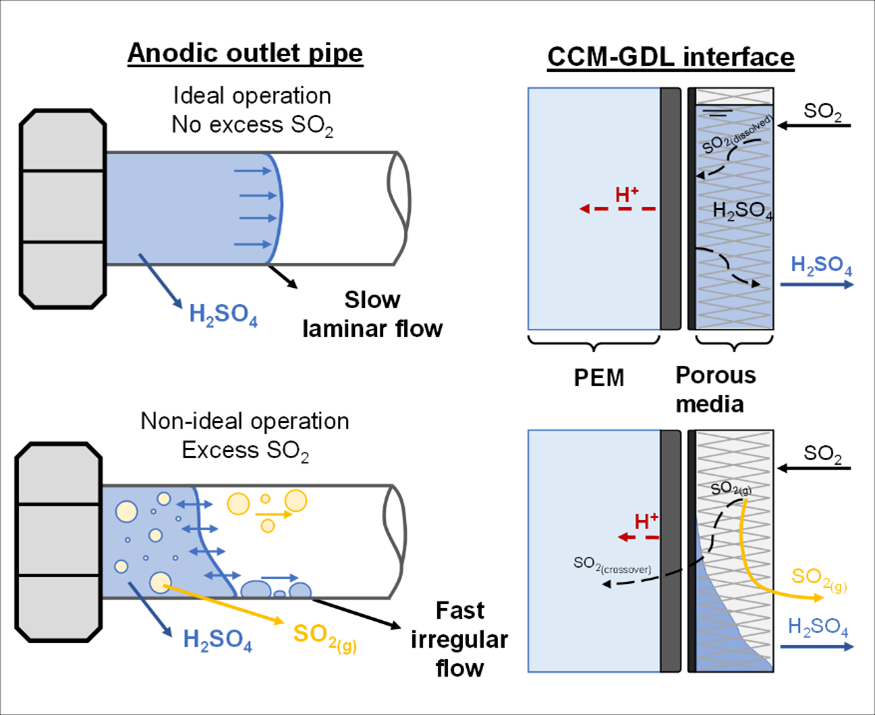
In our latest publication, we present a systematic investigation of the diffusion media within the SDE cell and their effect on overall cell performance. Our findings reveal that the choice of gas diffusion layer has a decisive impact on performance, in some cases determining whether stable operation could be achieved at all. Through optimisation of the diffusion layer, we reached current densities of 1.3 A cm⁻² at 1.2 V, representing ~30% improvement over the current state of the art. Based on observations made throughout the study, we also propose a working hypothesis for the macroscale behaviour of SDE during operation.
These results offer new insights into the anodic processes governing SDE and highlight critical design parameters for building efficient, durable electrochemical systems capable of low-voltage, cost-effective hydrogen production, bringing this technology one step closer to large-scale deployment.
ChemSusChem, Chemistry Europe
doi.org/10.1002/cssc.70660
Link to Article