
BME-Talks #4 | Andrew Webb

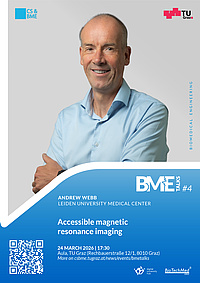
BME-Talks #4
Accessible magnetic resonance imaging
by Andrew Webb (Leiden University Medical Center)
March 24th, 2026 | 5:30 pm
Aula, Alte Technik
Rechbauerstraße 12, 8010 Graz
No registration necessary.
© CSBME - TU Graz
Abstract
MRI is an indispensable part of clinical care in high-income countries (HICs), with more than 100 million scans performed worldwide annually, and around 50,000 machines in hospitals and clinics. As is the case for many high-cost technologies, however, residents in low- and middle-income countries (LMICs) have severely limited access to this technology, despite constituting more than 70% of the world’s population. Most systems are in big cities, distant from rural populations, and are typically bootstrapped together: for example, of the scanners in Africa, ~40% use obsolete hardware and software.
In a 2023 Comment for Nature on the 50th anniversary of the discovery of MRI by Paul Lauterbur, we identified five areas which could help to “democratize” the use of MRI around the world: targeted technology development; clinician confidence; open source documentation; AI in a LMIC settings; and obtaining long-term sustainable funding. Key to each of these areas is the concept of local training, design, development, manufacture and maintenance.
This talk will discuss recent developments in each of these areas, outlining some of the challenges of maintaining an open-source open-science philosophy while recognizing the need for certification of medical devices, as well as open questions on how best to ensure long-term sustainability within very different health care systems.
Bio
Andrew Webb is the Professor of MR Physics in the Department of Radiology at the Leiden University Medical center in the Netherlands. He graduated from the University of Cambridge, and has held positions at the University of Illinois in the USA and Wurzburg University in Germany. His research concentrates on the translation of new engineering concepts into the clinic. His lab now is focused on sustainable open-source low field MRI for low and middle income countries. In 2020 he was the President of the European Society of Magnetic Resonance in Medicine and Biology and co-formed the Committee for Advancement of MRI Education and Research in Africa. In 2023 he was elected to the Royal Dutch National Academy of Sciences. In 2010 he founded the Nadine Barrie Smith trust which has provided financial support for over 150 female undergraduate and graduate students in science and engineering.
Cosar Bianca
CSBME - Marketing, PR, Fakultätskommunikation
Graz University of Technology
Email: marketing.csbme@tugraz.at
Phone: +43 316 873 - 4055
Dear participants!
Photos will be taken in order to promote and document this event!
The photos might be published on brochures or websites of Graz University of Technology as well as on social media.
If you do not wish to be photographed, please tell one of the organizers or photographers!